
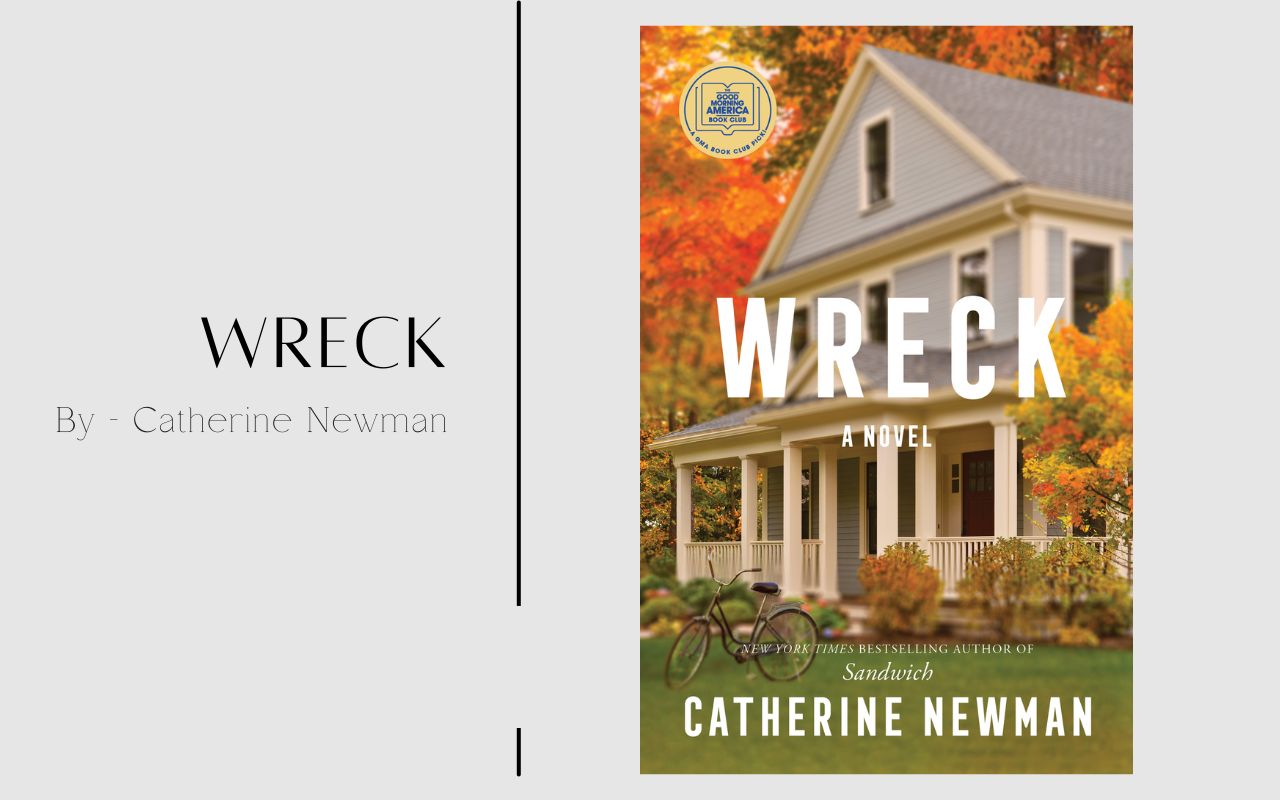
Every now and then, a novel comes along that feels uncomfortably close to real life — not because of a twisty plot or shocking reveal, but because it captures the way fear creeps into the most ordinary days. Catherine Newman’s Wreck does exactly that.
Set in Western Massachusetts and picking up a couple of years after the events of Sandwich, Wreck follows Rocky, a middle-aged wife and mother whose seemingly stable life starts to feel alarmingly fragile. Her mother has died. Her widowed father, Mort, has moved in. Her daughter Willa has returned home after college. Her son Jamie has taken a glossy corporate job in New York. On the surface, everything looks like a fairly typical, loving, slightly chaotic family scene.
But something is wrong. Rocky develops a strange, spreading rash that doctors struggle to pin down. At the same time, she becomes fixated on a local train accident — a young man’s death that haunts her, especially when she realises her son’s company was indirectly connected to the tragedy. Health anxiety, moral guilt and the randomness of disaster collide, and Rocky starts to feel as if the whole scaffolding of her life could collapse at any moment.
Newman turns that anxiety into a story that is raw, funny, sharply observed, and often painfully relatable.
What Wreck Is About: Plot, Family and Fallout
At its core, Wreck traces one intense stretch of Rocky’s life as everything she has always taken for granted begins to wobble.
Rocky is in her mid-50s, going through menopause, still grieving her mother, and trying to keep the household running. Her husband Nick is easygoing and loyal, the sort of man who will quietly do the dishes while everyone else spirals. Their daughter Willa is back home, applying for PhD programs and trying to figure out what adulthood is supposed to look like. Jamie, the golden boy, is in New York, climbing the corporate ladder.
Two things unsettle this domestic picture.
First, Rocky develops a mysterious rash. It’s painful, invasive and, most importantly, undefined. That uncertainty sends her into a tailspin — multiple appointments, worst-case scenarios, endless online searches, and the nagging fear that this might be something catastrophic. Newman doesn’t treat this as a side note; the medical fear becomes a constant undertone, shaping Rocky’s moods and decisions.
Second, there’s the train accident. A young man is killed in what seems like a freak event, but the more Rocky learns, the more she realises her son’s company made a cost-cutting decision that may have contributed to it. The death is not her family’s fault in any straightforward way, yet the connection is close enough to feel unbearable. The story keeps circling this question: what do you do when the people you love are part of a system that harms strangers?
The novel doesn’t lean on big courtroom scenes or thriller-style confrontations. Instead, the “action” lives in the conversations around the dinner table, in late-night worries, in Rocky’s frantic attempts to protect her children, and in the quiet ways guilt seeps into ordinary days. We move between medical appointments, emails, family meals, small joys, and private panics — the places where real life actually happens.
Characters Who Feel Like People You Know
One of the book’s biggest strengths is how fully the characters feel lived-in, especially for readers who already met them in Sandwich. But even if this is your first encounter with Rocky and her crew, they don’t read like strangers.
Rocky herself is the engine of the story. She’s anxious, funny, a little chaotic and endlessly loving. She catastrophizes with almost comic flair, then turns around and makes a joke so sharp you can’t help but laugh. Newman lets her be contradictory: nurturing and self-absorbed, wise and impulsive, terrified and hopeful all at once.
Her father Mort is a standout. He’s grieving his wife, adjusting to living with his grown daughter, and frequently baffled by the modern world. His one-liners and generational misunderstandings give the book some of its most laugh-out-loud moments, but there’s a tenderness underneath. He’s not comic relief; he’s a man trying to stay afloat in a life that’s been rearranged without his consent.
Nick, Willa and Jamie each bring out different parts of Rocky. Nick offers stability and quiet affection. Willa reflects a newer, more politically and socially alert generation, challenging some of her mother’s blind spots while still relying on her. Jamie carries both promise and unease — the child who has “made it,” but whose success is tied to a corporate world with murky ethics.
What makes these characters work is not that they’re perfect or heroic, but that they’re recognisable. This could be your family, your neighbours, your friends. Their arguments, jokes and worries feel like conversations you’ve overheard — or had yourself.
Themes: Illness, Guilt and the Fear of Random Disaster
Wreck wears its themes on the surface but explores them with enough nuance that the novel never feels like an essay dressed up as fiction.
Health anxiety and mortality are everywhere. Rocky’s rash stands in for all the vague, unexplained symptoms that send people down rabbit holes of worry. The novel doesn’t mock that fear; instead, it shows how it hooks into everything else — aging, caretaking, grief, unfinished business with the dead.
Moral responsibility is the second big thread. Jamie didn’t push anyone in front of a train. He didn’t design a machine with the intention to kill. But somewhere, a spreadsheet, a policy or a financial decision in his corporate world is linked to a human being’s death. Newman uses this to probe a very modern question: in a world of huge systems and distant decisions, how do you live with the knowledge that comfort and security often come at someone else’s expense?
Family love and its limits round out the picture. Rocky would do anything to shield her children and her father from harm, but she can’t control illness, accidents or the choices other people make. The book is honest about how infuriating that helplessness feels — and how much courage it takes to keep loving people anyway.
Despite the heavy subject matter, the novel is far from bleak. Newman keeps returning to scenes of food, conversation, shared jokes and small acts of kindness. The message isn’t that disaster is always looming, but that life’s sweetness and terror are permanently entangled.
Style and Structure: Funny, Talky, and Intimate
Newman’s style in Wreck is chatty, warm and highly observational. The narration often feels like sitting at a kitchen table with a friend who tells stories with expressive hands and perfect comic timing, then suddenly says something that makes you swallow hard.
Dialogue is a major driver. The best scenes are often just people talking — Rocky with Mort, Rocky with Nick in bed late at night, the kids sparring across the table. The humour can be sharp, especially when older and younger generations collide over language, identity or politics, but it nearly always lands with affection rather than cruelty.
Structurally, the book isn’t tightly plotted in a traditional sense. You’re not racing toward a single big climax; instead, you move through a series of moments — medical updates, emotional flare-ups, small reconciliations, new details about the accident — that gradually build into a full portrait of a year in this family’s life. Some readers may find the plot a bit loose or the New England setting underused as pure “atmosphere”, especially compared to Sandwich’s vividly drawn Cape Cod backdrop. Others will see that looseness as part of the book’s honesty: real life rarely arranges itself into neat acts.
What’s clear is that Newman knows how to balance humour and heartbreak. Just when a scene threatens to become unbearably tense, she’ll throw in a perfectly timed joke or an image so tender that it resets the emotional temperature without erasing the stakes.
Do You Need to Read Sandwich First?
Short answer: no, but it helps.
Wreck is technically a sequel to Newman’s 2024 novel Sandwich, which introduced Rocky and her family on a Cape Cod vacation. If you’ve read that book, Wreck feels like catching up with old friends a couple of years later. You’ll appreciate the continuity of relationships and get extra satisfaction from seeing how certain dynamics have evolved.
If you’re new to Newman, though, Wreck still stands alone. The key relationships are clear, the backstory is woven in gracefully, and the emotional arc doesn’t rely on knowledge of the previous book. In some ways, starting here might even sharpen your interest in going back to see where these characters began.
Final Thoughts: Who Is Wreck For?
Wreck: By Catherine Newman will resonate most with readers who are drawn to novels about ordinary families facing extraordinary pressure — not through crime plots or high-stakes action, but through illness, grief and the complicated ethics of modern life.
If you enjoy character-driven fiction that mixes humour with genuine emotional punch, you’re exactly the audience this book is courting. It’s especially powerful for readers in midlife or those who’ve navigated the healthcare system as patients or caregivers. The novel speaks directly to anyone who has sat in a waiting room, refreshing their phone, rehearsing catastrophic possibilities in their head while trying to stay cheerful for the people they love.
Is it perfect? Not quite. Some readers may wish for a tighter story or a stronger sense of place. But even with those quibbles, Wreck lands where it matters most: in the messy intersection of fear, love and responsibility. It’s the kind of book that makes you laugh out loud on one page and stare at the wall on the next, thinking about your own family, your own body, your own quiet bargains with fate.
If that’s the kind of reading experience you’re looking for, Wreck is well worth picking up.