

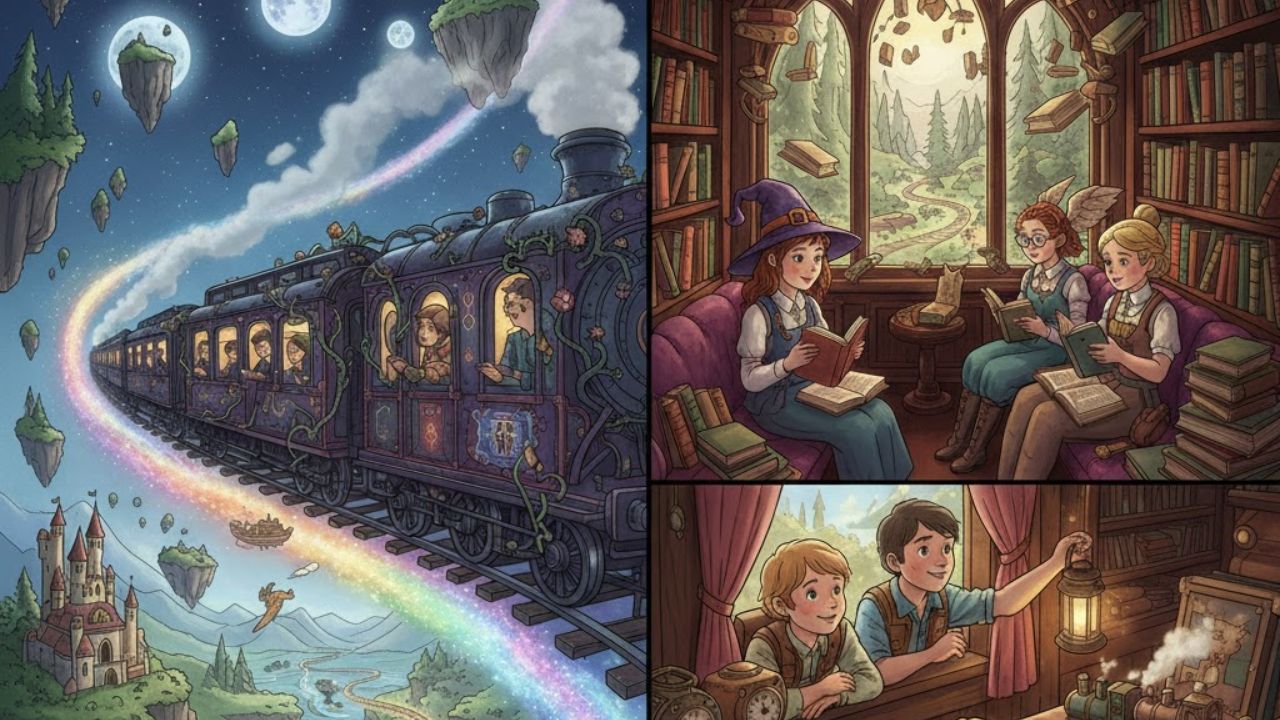
There’s something about a train that short-circuits the imagination. Add a whisper of enchantment — a ticket that materializes at the exact moment it’s needed, a carriage that shifts and reshapes itself, a whistle that signals not a destination but a doorway to another world — and the journey becomes something far greater than simple travel. It becomes transformation. That’s at the heart of Why We Love The Books Set on Magical Trains: they don’t just move characters across landscapes, they move readers into realms where the ordinary brushes against the impossible.
From the charged stillness before the wheels begin to turn to the tender ritual of luggage stacked on a platform, magical-train stories draw power from transition. Stations are thresholds. Compartments are confessional spaces. Windows frame the blur between who a character was and who they are about to become. These narratives feel intimate because trains are familiar — rhythmic, structured, bound to rails — yet magical because they exist in that liminal in-between.
It’s this delicate balance of comfort and wonder that explains our love for books of Magical Trains. They tap into childhood rituals, secret departures, and the quiet thrill of leaving one world behind for another. In the steady clatter of wheels on tracks, readers find both nostalgia and possibility — a promise that somewhere between departure and arrival, something extraordinary might happen.
A mode of travel that equals metaphor
Trains are inherently transitional. Unlike planes, which leap and disappear, or cars, which stay stubbornly domestic, trains move along visible rails; they promise progress while inviting passengers to watch the world slip by. That visible motion makes trains perfect metaphors for change — the slow, inevitable kind that leaves room for thought. When authors make those journeys magical, the train becomes a living threshold: a place where time can bend, where destinations are chosen as much by fate as by timetable, where ordinary rules can be suspended long enough for a character to be remade.
The carriage as micro-society
One reason magical-train books work so well is that a train car is a microcosm. For the length of a journey, strangers are forced into proximity; hierarchies form, alliances are made, secrets are exchanged. Authors exploit this compressed social laboratory. In these stories, a single compartment can reveal a character’s courage, kindness, or small cruelty. That intensity mirrors real emotional development — we become who we are in motion, surrounded by others, tested by delays and diversions. The train forces choices in a way that static settings rarely can.
Ritual, routine, and the power of small details
Good magical-train books lean on ritual. The clack of wheels, the announcement from the conductor, the tearing of a ticket — those small, repeated actions anchor the reader in a world that may otherwise tilt toward the surreal. Rituals promise safety: the formality of a ticket counter, the predictable glow of carriage lights, the communal hush when a train pulls into a station at night. When those rituals bend — when a ticket takes you to the North Pole, or a dining car serves soup that predicts the future — the break between ordinary and extraordinary becomes deliciously visible. Readers enjoy both the comforting repetition and the delicious surprise when rules change.

Nostalgia and the childhood portal
Many beloved magical-train tales are also children’s stories, and that’s not accidental. Childhood itself is a kind of perpetual transit: between dependence and autonomy, between belief and skepticism. Trains in children’s books are literal portals, the hinge on which adventure swings. They promise the extraordinary without needing to erase the familiar: a child tucks a teddy into a seat, still hungry for pancakes, and then — in the next chapter — they find themselves in a world where snowmen sing or wizards supervise sorting hats. That continuity, the mingling of everyday detail and fantastical possibility, explains why adults revisit these books too; they offer a quick, readable passage back to a mind-state where wonder was habitual.
Scenic movement equals storytelling momentum
Movement helps structure a story. A train’s linear route provides built-in pacing: departures, slow stretches of travel where character development happens, sudden emergencies, and the final arrival. Because trains move through distinct stations, authors can structure episodes around stops — each new station a new problem, a new companion, a new lesson. That episodic momentum keeps the reader engaged: the book moves as the train does, and the rhythm of chapters can mimic the clickety-clack of rails.
The romance of mechanics and mystery
Trains are machines that feel a little heroic. There’s steam and brass, whistles and levers — a tactile complexity that invites curiosity. In magical settings, trains often take on personality: a locomotive that remembers its passengers, a dining car that serves memories, a sleeper car that dreams for you. That mechanical romance appeals to readers who love the physicality of storytelling — the idea that magic has gears and buttons, that wonder can be engineered. It’s a neat counterpoint to more amorphous magic systems where spells are purely cerebral.
Communal journeys, private revelations
Aboard a magical train, public space and private revelation coexist. You share benches with strangers, but you might also receive a private prophecy tucked into your pocket, or meet a mentor who vanishes at the next stop. This balance — that we grow in the company of others and in quiet moments alone — resonates with real life. Many of us have experienced the clarity that comes from long transit: a problem looks different when the world moves beneath your feet. Authors translate that clarity into plot device: revelations are believably earned in the slow hours between stations.
Subverting memory and time
Many train narratives toy with time. A carriage might move not just through space but through eras. A jammed timetable becomes a plot engine for time travel, memory retrieval, or second chances. That manipulation of chronology is emotionally satisfying because it addresses a universal wish: to revisit, repair, or better understand a past self. Magical trains allow characters — and readers — to step off the line, examine a version of life that might have been, and then re-board armed with new knowledge.
Design and atmosphere: why illustrations matter
In books for younger readers, illustration often magnifies the magic. The way artists render windows glowing with otherworldly landscapes, the plush textures of seats, or the whimsical uniforms of conductors creates an immersive sense of place. Even in prose-heavy novels, authors will describe the train with sensory precision — the smell of metal and oil, the hum of fluorescent lights, the warmth of a borrowed blanket. Those sensory markers let magic land in the body, not just in the mind.
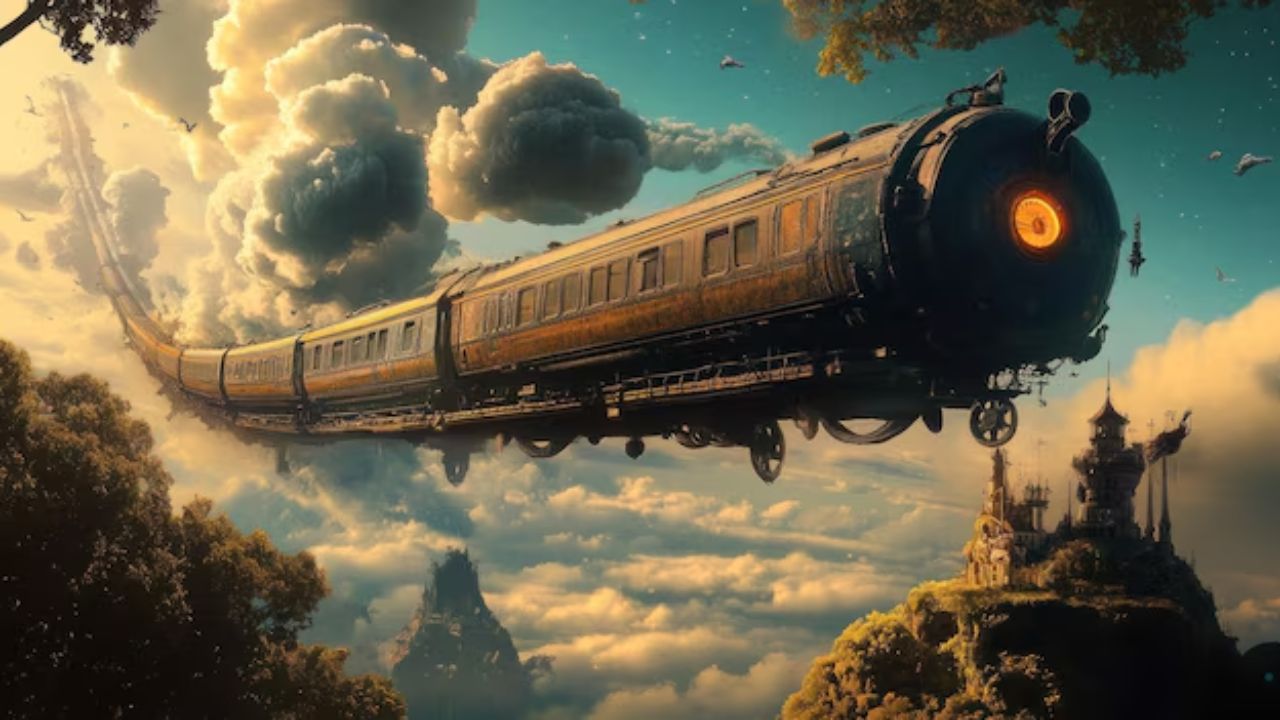
Aesthetic of escape, not evasion
Crucially, magical-train stories rarely advocate for permanent flight from reality. Instead, they stage temporary escapes that change how characters return to the everyday. The protagonist comes back altered, with a piece of the journey tucked into their pocket: courage, perspective, or the memory of a companion who taught them something indispensable. That pragmatic return — the idea that adventure refines rather than dissolves life — is part of the genre’s moral appeal.
Why these books keep finding readers
At the most basic level, magical-train books answer two human hungers at once: the need for movement and the need for wonder. They promise a clear arc — board, travel, arrive — while also offering the unpredictable delights of a world not governed by GPS. They remind us that change can be communal, ceremonial, mechanical, and ineffably lovely. Whether you’re eight and clutching a picture book, or thirty-eight leafing through a novel between emails, a magical train can carry you to a place that feels like both an escape and an education.
So we go back. We buy the ticket, glance at the platform clock, pull our scarves tight, and step into the carriage, ready — as always — to be a little surprised. The train moves on, and with every mile it lays down new rails beneath the heart.