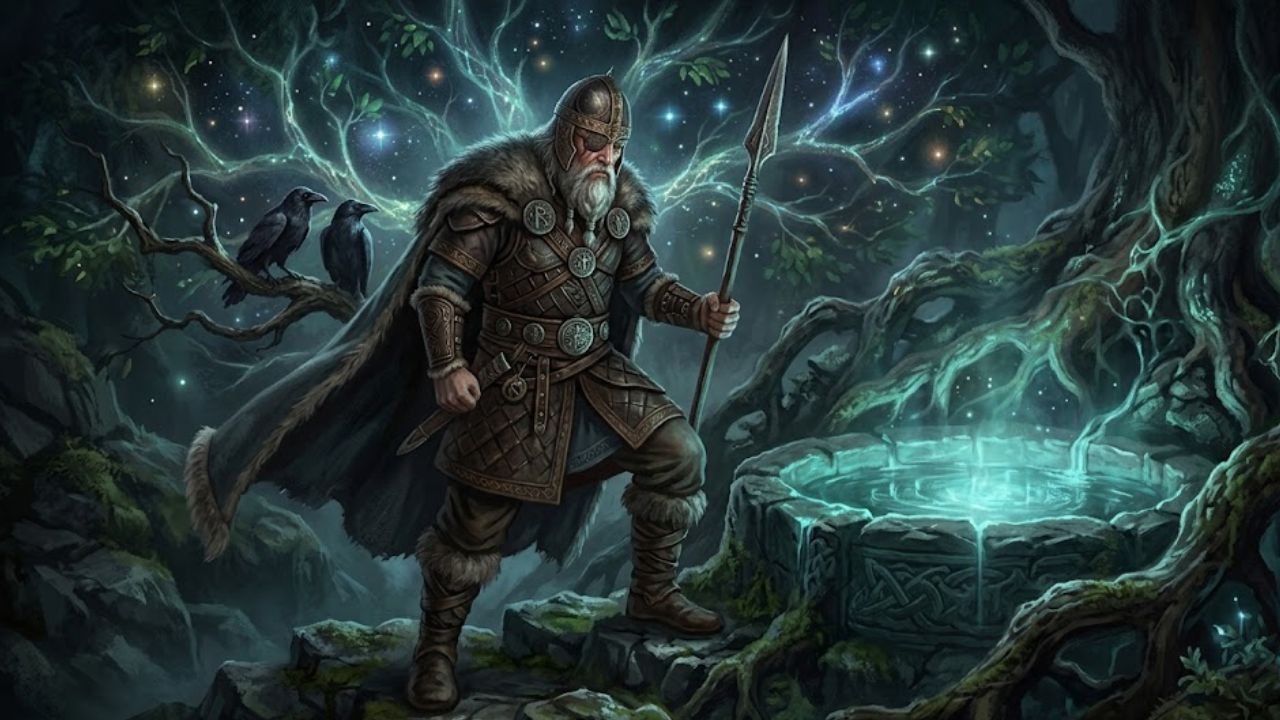
There’s a moment in Norse mythology so brutal, so deliberate, so hauntingly intentional that it stops you cold the first time you really sit with it. A god — the god of gods — walks up to a well, reaches into his own skull, pulls out his eye, and drops it into the water. Not because he was forced to. Not because someone tricked him. Because he asked for it. That moment belongs to Odin. And once you understand why, you start to realize it might be the most human story ever told about the price of knowing things.
Before the Well: Who Was Odin, Really?
To appreciate what Odin gave up, you first have to understand what kind of being he was before he made that choice.
Odin — Allfather, the Grey Wanderer, the One-Eyed God — was never the straightforward warrior-king that casual mythology tends to reduce him to. He was restless. Obsessive. The kind of deity who couldn’t stop asking why. While other gods in the Norse pantheon had cleaner portfolios — Thor had thunder, Freyr had fertility, Tyr had law — Odin’s domain was messier and more dangerous. He was the god of wisdom, war, death, poetry, magic, and prophecy. That combination isn’t accidental. Those things are linked, and Odin knew it better than anyone.
He was also a seeker in the truest sense. Long before the sacrifice at the well, Odin had already traded comfort for knowledge. He wandered Midgard in disguise, cloak pulled low, listening to the stories of men. He hung himself from Yggdrasil — the World Tree — for nine days and nine nights, wounded by his own spear, with no food and no water, in order to receive the knowledge of the runes. He kept two ravens, Huginn and Muninn (Thought and Memory), who flew across the nine worlds each day and returned to whisper everything they saw into his ear.
This was a god who was never satisfied with what he already knew.
So when Odin heard about Mimir’s Well, it wasn’t curiosity that drove him there. It was inevitability.
Mimir’s Well: The Source Beneath the Root
At the base of Yggdrasil — that immense, cosmic ash tree whose roots reached through all the nine realms — there were three wells. Each one fed the tree. Each one held something the tree needed.
The third well, nestled beneath the root that stretched into Jotunheim, the land of the giants, was Mímisbrunnr — Mimir’s Well. And unlike the other two, this one didn’t offer its gifts freely.
Mimir himself was no ordinary guardian. Depending on which source you follow, he was a primordial being of extraordinary wisdom, possibly one of the Aesir sent to the Vanir as a peace hostage, later beheaded in a political dispute. In some accounts, his severed head was preserved by Odin with herbs and magic, and kept as a counselor — the wisest advisor a god could have. But at the well, Mimir was whole, present, and unmoved by rank or reputation.
The water of the well held cosmic knowledge. Not just facts or memories, but deep understanding — the kind that reaches beneath events to the bones of reality. Drinking from it meant seeing the world as it truly was: the patterns beneath chaos, the truths that existence rests on, the fate of everything that ever was or would be.
Of course, Mimir didn’t hand it out freely. The well demanded a price. Always had.

The Bargain: An Eye for the World
When Odin arrived and asked to drink from the well, Mimir’s answer was immediate and non-negotiable.
Your eye.
Not gold. Not years of your life. Not some abstract promise. One of your eyes, given willingly, dropped into the water — and only then would Odin be permitted a single drink.
Let’s pause here for a moment, because this is where a lot of retellings rush past something important. Odin didn’t haggle. He didn’t try to find a loophole or substitute. He didn’t send a lesser god in his place. He stood at the edge of that dark water, reached up, and did it himself.
There’s something almost unbearable about that image — not because of the physical act (though yes, that too), but because of what it tells us about Odin’s relationship with knowledge. He understood, in that moment, that wisdom isn’t given. It’s purchased. And it costs the thing you’re most afraid to lose.
For a warrior god in a culture that prized sight above almost everything — where to lose your eye in battle was to be partially diminished — this was not a small thing. It was, arguably, the most intimate sacrifice possible. He gave up the ability to see half the world in the literal sense, in exchange for the ability to see all of it in a deeper one.
He dropped his eye into the water. It sank.
He drank.
What He Received: The Weight of Knowing
So what did Odin actually get?
The texts are deliberately somewhat vague on this — which is itself interesting. The Norse poets seemed to understand that wisdom isn’t a checklist. You can’t itemize it. But across the Eddic poems and the Prose Edda, we can piece together what the well’s knowledge gave him.
The fate of everything. Odin, after drinking, is the god most associated with the knowledge of Ragnarök — the twilight of the gods, the final battle, the end of the world as the Norse understood it. He doesn’t just know it’s coming. He knows who will kill whom. He knows that Thor will die from the Midgard Serpent’s venom, that Fenrir will swallow him whole, that the world will burn and drown. And he lives with that. Every day. With one eye.
The knowledge of runes and seiðr. While Odin’s mastery of the runes came separately, through his sacrifice on Yggdrasil, the well deepened his understanding of magic in ways that no other being in the Norse cosmos could match. He could practice seiðr — a form of shamanic, fate-altering magic — that was considered so powerful and so transgressive that most male gods wouldn’t touch it. Odin didn’t care about the taboo. He wanted to know.
The ability to counsel. This is subtler, but no less important. The preserved head of Mimir itself whispered counsel to Odin in moments of great crisis — including just before Ragnarök. There’s a reading in which Odin’s sacrifice at the well is partially what earns him Mimir’s trust and ongoing guidance. The well wasn’t just a transaction. It was an initiation.
The burden of foresight. Here’s the part that’s easy to miss: wisdom, in the Norse tradition, was never portrayed as a comfortable thing. Odin knows what’s coming and cannot stop it. He knows Baldur will die. He knows Loki will betray. He knows he himself will be swallowed. The knowledge doesn’t save him from any of it — it just means he sees it coming with terrible clarity. His eye, sitting at the bottom of the well, stares up at the world from below it. It sees everything. And so does he. And neither can look away.
Why the Eye, Specifically?
You might wonder — why the eye? Why not something else? Why not a hand, or a name, or a year of his life?
Because in the symbolic language of Norse myth, the eye is perception. It’s not just sight — it’s the filter through which reality is understood. To give an eye is to surrender one way of seeing the world in order to gain another. Odin doesn’t stop perceiving; he perceives differently. The physical eye he loses is replaced by something that sees beneath surfaces, beneath time, beneath the pretty lies we tell ourselves about how things are.
There’s also something quietly profound about where the eye ends up. It doesn’t disappear. It stays in the well — submerged, preserved, still watching. Some interpretations suggest that Odin’s eye at the bottom of Mimir’s Well is itself now a source of power and vision, an eternal witness to whatever truths drift through those cosmic depths. He didn’t throw his eye away. He planted it.
The Lesson Odin Refused to Ignore
Modern readers sometimes approach this story and see only the extremity of it — a god tearing out his own eye seems like mythology being mythology, dramatic for drama’s sake. But the Norse weren’t melodramatic people. They were, if anything, famously understated. When they put something violent in a story, it was because they couldn’t think of a gentler way to tell the truth.
And the truth here is this: Real wisdom costs something real.
Not effort. Not time. Not study. Something you’re actually attached to. Something you’d grieve.
There’s a version of this we recognize even now — the person who goes through heartbreak and comes out the other side genuinely understanding love better. The person who fails publicly and painfully, and learns something in the wreckage that success never could have taught them. The one who loses someone and, in that grief, begins to understand what matters and what never did.
Odin’s sacrifice doesn’t tell us to be reckless with ourselves. It tells us that understanding has a price, and the question isn’t whether you’re willing to pay something. The question is whether the thing you want to understand is worth what it actually costs.
He decided it was. And then he didn’t spend the rest of eternity congratulating himself for it. He kept moving. He kept asking questions. He kept walking the nine worlds with one eye open.

A God Who Chose Mortality’s Burden
Here’s perhaps the most overlooked dimension of this whole myth: Odin didn’t have to do any of this. He was immortal. Powerful. Allfather. He could have chosen comfort, sovereignty, the pleasures that gods are assumed to want.
Instead he chose suffering in exchange for understanding. He chose to know things that hurt to know. He chose to see his own end and walk toward it anyway, not because he was resigned to it, but because he thought it was better to face fate with open eyes than to close them and pretend it wasn’t coming.
That’s not the behavior of a distant, untouchable deity. That’s the behavior of someone trying, against all odds, to be genuinely awake to the world.
His eye is still down there, they say — in the cold dark water beneath the World Tree, staring upward through millennia, watching everything. Not blinking.
Maybe it’s still watching us.