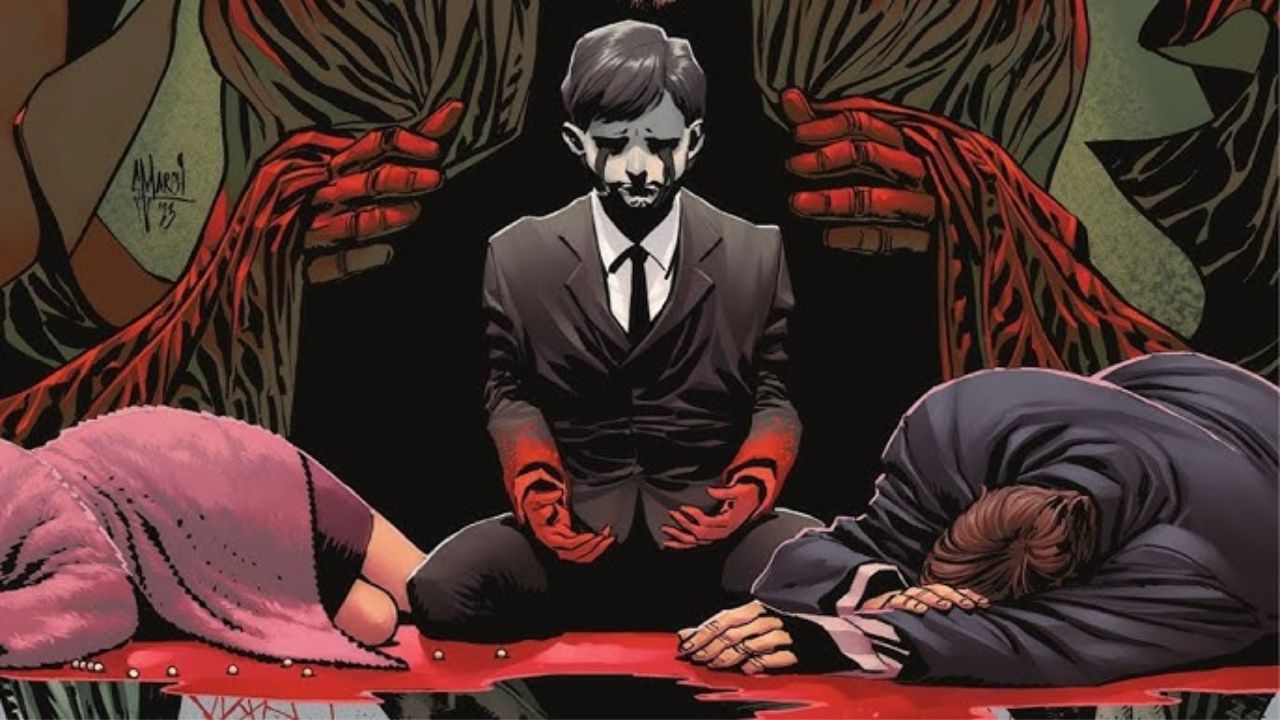
If you’ve watched even a handful of Batman adaptations, you’ve probably noticed something a little absurd: we keep going back to that alley. Thomas and Martha Wayne, dressed for the opera. A mugger named Joe Chill. Two bullets. The pearls scattering across wet cobblestone. Young Bruce left kneeling on the ground. It’s been shown so many times — in comics, on television, in blockbuster films — that it has practically become a cultural reflex, the way we blink when something flies at our face. And yet, each retelling lands with the same weight, the same bruise of sadness. So why does DC keep doing it? Why not trust us to remember? Why keep reopening the wound? The answer, it turns out, is far more interesting than lazy storytelling — and it says something profound about how myths work, how grief works, and what Batman actually is.
The Origin Is the Character
Here’s the thing about Bruce Wayne that separates him from almost every other superhero in the DC stable: he has no powers. No alien physiology, no magic ring, no accidental lab explosion to blame. What he has is a singular, shattering night from childhood. That night is not backstory — it is the character. Strip away the Batsuit and the gadgets and what remains is an eight-year-old boy who watched his parents die and made a vow he has spent his entire adult life keeping.
This is why DC returns to it so compulsively. With Superman, you can skip Krypton and tell a perfectly satisfying story about a man who can fly and punch things really hard. You cannot do the same with Batman. The origin is load-bearing. Everything — the darkness, the obsession, the fear of firearms, the refusal to kill, the sleeplessness, the cave — all of it hangs on those two gunshots. Every time a writer wants to explore a new dimension of who Bruce Wayne is, they tend to find themselves pulling that thread, which leads them back to Park Row on that October night.
“Batman is not a man who became a hero. He is grief that learned to stand upright and wear a mask.”
— A recurring theme across decades of comics criticism
Most superheroes are defined by what they can do. Batman is defined by what he lost. That’s an enormous creative difference, and it explains a lot.
Myth Requires Repetition
There’s a reason every civilization that has ever existed tells its foundational stories over and over again. The Greeks didn’t tell the story of Achilles at Troy once and move on. The Norse didn’t recount Odin’s sacrifice at the World Tree for a single audience and call it done. Myths are retold precisely because they carry meaning that doesn’t exhaust itself — meaning that keeps producing new resonance depending on who’s hearing it, when they’re hearing it, and what they bring to it.
Batman’s origin has become exactly that kind of myth. It operates less like a piece of backstory and more like a sacred text — one that different artists and writers have returned to not to copy the original, but to interpret it. Frank Miller’s version in Batman: Year One is brutal and gritty, drenched in the aesthetics of Reagan-era urban despair. Scott Snyder and Greg Capullo’s retelling in the New 52 era carries a weight of inevitability, a sense that Gotham itself conspired in the Wayne murders. Christopher Nolan’s version in Batman Begins lingers on guilt, on Bruce’s memory, on the way a child’s mind shapes an event into something it can survive.
None of these versions is telling the same story. They’re all in conversation with it.
For the record
The death of Thomas and Martha Wayne was first depicted in Detective Comics #33 (November 1939), just four months after Batman's debut. It was added by writer Gardner Fox to give the character motivation — and has been considered canonical ever since. The murderer was not named "Joe Chill" until 1948.

Each Retelling Is Actually About Something Different
Here’s where it gets genuinely interesting: if you line up the major retellings of the Wayne murder across the decades, you’ll notice that the scene itself barely changes — but what it’s about changes constantly.
In the Golden Age comics, the death of Thomas and Martha Wayne was essentially functional. It answered the question, “Why does this man dress up as a bat and fight criminals?” The scene had no particular emotional sophistication; it was just a plot mechanism to justify the premise.
By the time the Bronze Age rolled around, writers started using the origin to explore the nature of trauma and the question of justice versus vengeance. The murder started appearing in Bruce’s dreams and flashbacks, usually at moments of crisis — as if DC was discovering that grief doesn’t heal, it just becomes part of the architecture of a person.
In the 1980s and 1990s, particularly in the wake of Frank Miller’s seismic work, the origin became a meditation on cycles of violence. Gotham as a city was sick. The Waynes’ deaths weren’t an aberration — they were a symptom. Bruce’s response wasn’t heroism so much as a deeply personal, arguably pathological attempt to fix something that might be unfixable.
In more recent decades, writers like Tom King have used the origin to interrogate happiness itself — to ask whether Bruce Wayne could ever allow himself to be at peace, whether the man who was built from grief could exist without it.
Each of these is a different story. The alley is just the door they all walk through to get there.
New Audiences, New Introductions
There’s also a practical reality here that’s easy to overlook when you’ve been reading comics for years: new people encounter Batman all the time. Children watch Batman: The Animated Series and fall in love with the character. Teenagers discover the Nolan trilogy. Adults pick up a graphic novel on a whim. Not everyone carries eighty-five years of canon in their heads. For each of these audiences, the origin is not redundant — it’s essential context, told fresh.
This is, in a sense, how serialized mythology has always worked. The story of any enduring character gets retold for each new generation not because the storytellers are lazy, but because the story belongs to everyone, and everyone deserves to encounter it for the first time.
“The Wayne murders do not belong to 1939. They belong to every year anyone has ever felt the specific helplessness of losing someone they couldn’t protect.”
It Keeps Bruce Human
There’s another reason — perhaps the most emotionally honest one — that DC keeps returning to this scene: it’s the only thing that keeps Bruce Wayne from becoming a god.
Think about it. Over the decades, Batman has been depicted as so brilliant, so capable, so relentlessly prepared that writers started calling him “the world’s greatest detective” and then quietly made him capable of defeating Superman in a fistfight, building contingency plans to take down every hero in the Justice League, and essentially knowing everything and anticipating everything. On paper, this version of Batman has no vulnerabilities.
And then you show him at eight years old, kneeling in the rain, and suddenly he is just a small boy again. Suddenly the man behind the mask is not a god or a myth or a strategic genius — he’s someone who lost his parents before he understood what losing something really meant. He’s someone most of us, in our most honest moments, can recognize.
The repeated returns to the Wayne murders are DC’s way of saying: don’t forget this. don’t let the cape and the car fool you. this is where he comes from, and this is what it costs him, every single day.
The Story DC Is Actually Scared to Tell
Here’s the provocative angle that nobody usually says out loud: part of the reason the Wayne murders keep getting revisited is because the story that logically follows them — Bruce Wayne healing, moving on, finding peace — would effectively end Batman as a concept.
Think about what a psychologically resolved Bruce Wayne would look like. He would hang up the suit. He would let go of the vow. He would acknowledge, as Alfred has told him approximately eight thousand times, that his parents would not have wanted this for him. In other words, he would become human in the fullest sense — someone who processed his grief rather than weaponizing it.
DC can’t let that happen, because Batman without the wound is not Batman. So instead, the origin gets revisited perpetually, keeping the wound fresh, keeping the motivation intact, keeping the character from outgrowing the event that created him. It’s a little uncomfortable when you look at it squarely — the commercial logic of superhero publishing essentially requires that Bruce Wayne never truly heal.
Some writers have pushed back against this beautifully. Tom King’s Batman run (2016–2019) spent 85 issues wrestling with exactly this question, building toward a version of Bruce who might finally be capable of joy — and then watching DC intervene in the narrative to prevent it. It’s almost literary in its irony: the character is not allowed to move past his trauma because his trauma is his brand.
Notable retellings
Detective Comics #33 (1939) — The original, two-page origin. Batman #47 (1948) — First appearance of Joe Chill by name. Batman: Year One (1987) — Frank Miller's landmark recontextualization. Batman Begins (2005) — Christopher Nolan's intimate, guilt-laden film version. Batman: Earth One (2012) — An entirely reimagined take on the night. Batman: Three Jokers (2020) — Uses the origin to explore inherited trauma.

What It Says About All of Us
There’s a reason the Wayne murders resonate so deeply across so many cultures and so many decades that aren’t really about Batman at all. Loss — especially the sudden, violent, senseless kind — is one of the most universally human experiences there is. The image of a child watching their parents die and being unable to do anything about it taps into one of our oldest, most primal fears.
We keep watching it happen because we recognize something in it. Not necessarily the specific circumstances, but the emotional logic: the way one night can become the axis around which an entire life rotates. The way grief can become identity. The way some wounds don’t close — they just become load-bearing walls in the structure of who you are.
Batman, in this light, is not really a superhero story at all. It’s a story about what happens to a person when loss becomes their whole foundation — and whether that foundation can hold anything other than darkness. We keep returning to the pearls and the alley and the rain because we haven’t answered that question yet. Maybe we can’t. Maybe that’s exactly why he’s still here, cape billowing over eighty-five years of Gotham nights, still keeping a vow that nobody asked him to keep.
The parents die over and over again because Batman never stops watching it happen. Neither do we. And the strangest, saddest, most human thing about that is: we wouldn’t have it any other way.