

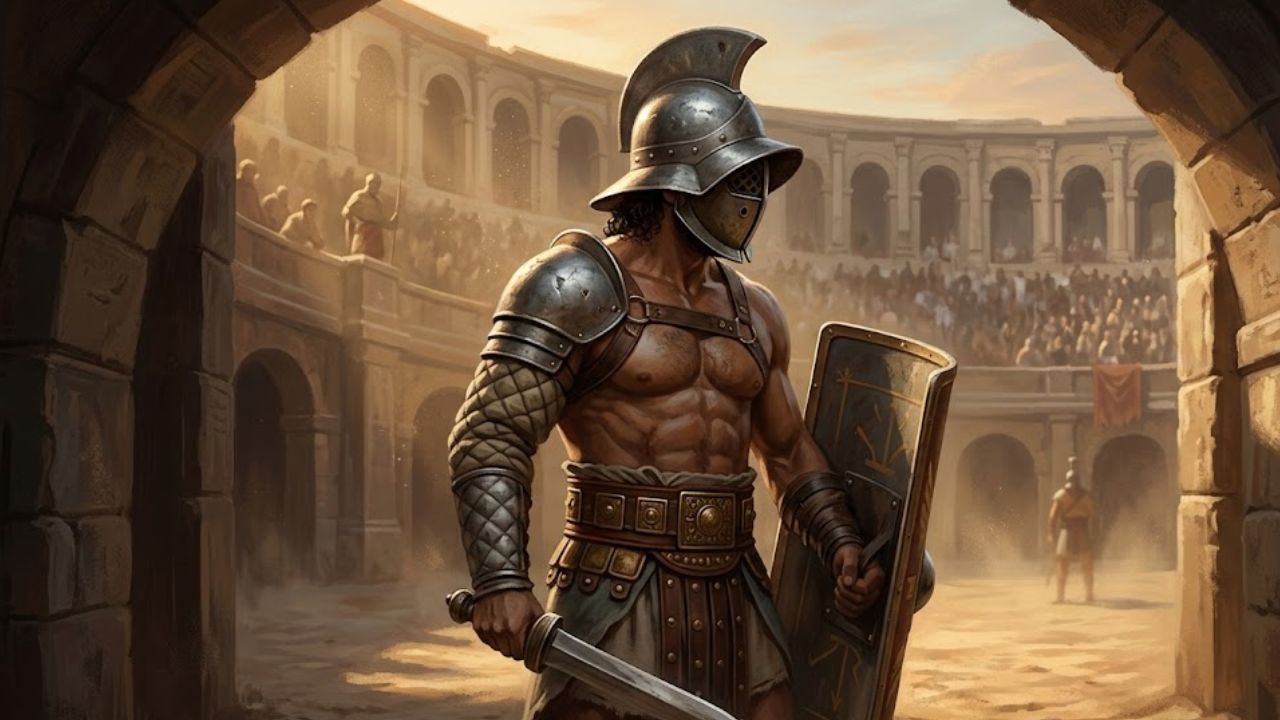
In the blood-streaked sands of the Roman arena, where life and death clashed under the roar of crowds, few names echo through history with as much quiet mystery and lasting fascination as Flamma — literally “The Flame.” Unlike many gladiators whose identities were lost to time, Flamma’s story survives through an epitaph carved in stone, fragments of inscriptions, and the collective imagination of scholars trying to piece together a life lived on Rome’s most brutal stage.
He was Syrian by birth, a man whose prowess with sword and shield transformed him from a cog in Rome’s machinery of spectacle into a figure worthy of legend. But his uniqueness wasn’t just in skill; it was his curious rejection of something almost sacred in the gladiatorial world — freedom itself.
The Enigma Begins: Roots Lost in History
The simple truth is we don’t know exactly where Flamma came from, how he grew up, or what first brought him into Rome’s sphere. The ancient record — sparse and fragmentary — offers no childhood narrative, no hometown gossip, no familial origins. What we do know, based on inscriptions and the consensus of historians, is that he was a native of Syria, then one of the far-flung provinces under Roman dominion.
Syria in Flamma’s era was a crossroads of cultures and a theater of empire — a place where local warriors might come into direct contact with Roman legions. It’s plausible that Flamma began life as a soldier or at least a man familiar with combat, but that part of his biography is lost to time. What most historians agree on is this: Flamma likely became a slave, either through capture in war or through another form of forced servitude. From there, he was trained and sold to a gladiator school — ludus — where fighters were molded into entertainers and combatants whose survival depended on grit, skill, and sheer force of will.
This was not a romantic path. It was grueling, humiliating, and often short. Gladiators were property. Their bodies belonged to their owners, and their survival depended on satisfying crowds hungry for violence.
Into the Arena: Becoming a Secutor
In Rome, gladiators were far more than fighters — they were icons, entertainers, and living symbols of Rome’s martial ethos. Their matches were not just physical battles, but performances deeply entwined with political power, social spectacle, and cultural ritual.
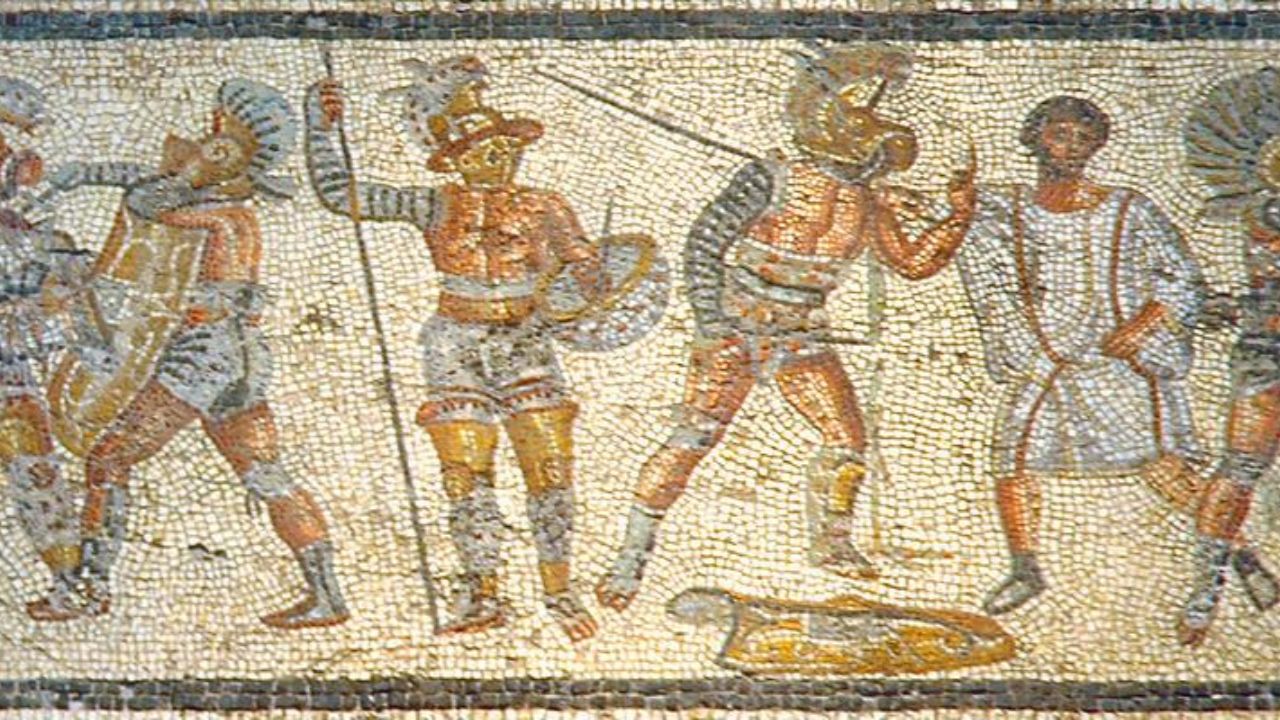
Within this brutal hierarchy of combatants, Flamma specialized as a secutor — one of the gladiatorial classes trained specifically to counter the quick, net-wielding retiarius. A secutor was heavily armored, equipped with a large shield (scutum) and a short sword (gladius), and wore a distinctive helmet with narrow eye slits designed to protect against the retiarius’s trident. This gear made him a relentless figure in close combat, a silent force advancing through mesh and spear.
Being a secutor was grueling work. These gladiators moved with the weight of their armor pressing down upon them, trained to push forward against an opponent’s agility and cunning. The matchup itself was theatrical — speed versus strength, distance versus proximity, entanglement versus blunt force.
Yet, within this world of punishment and performance, Flamma thrived.
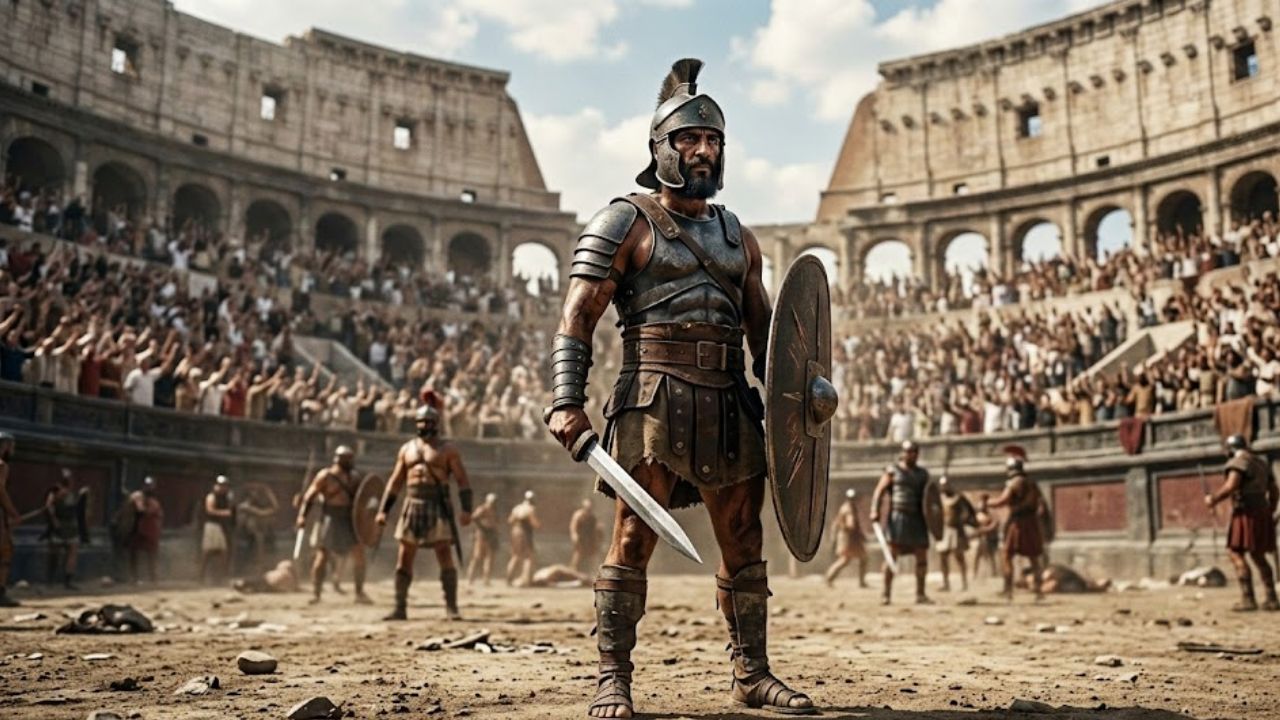
34 Battles, 21 Wins — A Record Written in Stone
The most vivid evidence of Flamma’s life comes not from chroniclers or poems, but from his gravestone, discovered in a Roman province on the island of Sicily. That stone — a testament etched in Latin — records the stark numbers of his life:
“Flamma, secutor, lived 30 years, fought 34 times, won 21 times, fought to a draw 9 times, won reprieve 4 times, a Syrian by nationality. Delicatus made this for his deserving comrade-in-arms.”
Those figures are striking. Gladiators rarely amassed such a lengthy career — most succumbed to serious injury or death in far fewer battles. Flamma’s 34 bouts, with 21 victories and nine draws, marked him among the most seasoned and successful fighters of his time.
Even more remarkable is the balance in that record. Nine draws suggest not mere survival, but endurance — contests so evenly matched that neither combatant could decisively finish the other. Four reprieves indicate that even in moments of defeat, the crowd or officials deemed him worthy of mercy.
In an arena culture obsessed with dominance, Flamma carved out something more nuanced: consistency, resilience, and spectacle.
The Rudis: Freedom Offered and Refused
One detail stands out more than the victories: he was offered the prize of freedom — the rudis — four different times, and rejected it every time.
In the grim economy of the gladiatorial world, the rudis held immense significance. A wooden sword, it was more than a token — it was a ritualized release, a signal that a gladiator had earned his liberty through courage, endurance, and skill. For most, the rudis was the ultimate goal, the leap from life-risking entertainer to a free person capable of forging a new life beyond the arena.
So why refuse it? Why turn down the very prize others risked everything to obtain?
Historians have debated this question for decades, and no definitive answer survives. But several possibilities emerge.
1. The Arena Was His Identity
For many gladiators, the arena was not merely a workplace — it was an identity. Outside the amphitheater, Flamma would have returned to anonymity. Inside it, he was The Flame, a name shouted by thousands. The roar of spectators in places like the Colosseum — though we cannot confirm he fought there — symbolized a level of recognition rare in the ancient world.
Freedom might have meant obscurity. Staying meant immortality.
2. Fame and Wealth Over Uncertainty
Successful gladiators were celebrities. They received gifts, sponsorships, and attention that free laborers could scarcely imagine. Women reportedly adored them. Graffiti in Roman cities reveals names scratched into walls like modern sports heroes.
A freed gladiator, by contrast, often became a trainer or retired quietly. The pay diminished. The fame faded. For a man who had spent years refining his skill and reputation, the choice may not have been as irrational as it first appears.
3. Brotherhood and Loyalty
Flamma’s epitaph was commissioned by Delicatus, described as his comrade-in-arms. This detail suggests camaraderie forged through shared danger. Gladiator schools were brutal environments, but they were also tightly bonded communities.
Leaving might have meant abandoning brothers who bled beside him. For some, that loyalty outweighed personal liberation.
4. Psychological Transformation
There is also the harder truth: prolonged exposure to violence reshapes a person. The arena demanded constant readiness, focus, and emotional control. The structure of that life — training, combat, rest, repeat — created rhythm and purpose.
Freedom, in contrast, could have felt destabilizing. A man conditioned for combat might struggle in civilian life. Choosing the arena may have been less about rejecting liberty and more about embracing familiarity.
Life and Death in the Arena
Despite his skill and acclaim, Flamma was, like all gladiators, mortal. He died at around 30 years of age, a mature but not old age by Roman standards — especially for someone who had repeatedly faced lethal combat.
We do not know the cause of his death. It may have been a final wound sustained in battle. It may have been illness. What matters is that he did not die forgotten. His record was preserved. His nationality noted. His achievements carved permanently into stone.
In death, as in life, he stood apart from the nameless many who perished anonymously in sand soaked dark with blood.
What Flamma Reveals About Rome
Flamma’s story is not merely about one man. It is about the machinery of Roman entertainment and the society that demanded it.
Gladiatorial combat was statecraft disguised as sport. Emperors used games to solidify popularity. Crowds projected ideals of courage, masculinity, and endurance onto the fighters below. Victory symbolized Roman dominance; defeat mirrored the empire’s unforgiving ethos.
In that world, a foreign-born slave from Syria could become a celebrated warrior. Rome was brutal, but it was also paradoxically meritocratic within the arena. Skill could elevate even the most marginalized individual to prominence — if he survived long enough.
Unlike Spartacus, who sought escape and rebellion, Flamma did not fight against the system. He excelled within it. And unlike Commodus, the emperor who famously staged himself as a gladiator for spectacle, Flamma’s battles were not theatrical vanity — they were survival.
This contrast sharpens his legacy. He was neither rebel nor ruler. He was something more grounded and, in many ways, more human: a professional who mastered his craft in the harshest conditions imaginable.
The Meaning of His Choice
Modern audiences often struggle to understand Flamma’s refusals. Freedom is assumed to be universally desirable. Yet history repeatedly reminds us that human motivation is complex.
For Flamma, the arena may have represented purpose, validation, and mastery. He was undefeated in the sense that he maintained his reputation and longevity. Even when he did not win outright, he endured.
There is something profoundly compelling about a man who repeatedly stood at the threshold of liberation and consciously stepped back into danger. It suggests conviction — or perhaps addiction — to the life he knew.
His choice forces us to confront uncomfortable questions:
- Is freedom always the ultimate good?
- Or can identity and recognition outweigh autonomy?
- What does it mean to choose the very system that once enslaved you?
Flamma does not answer these questions directly. He leaves them etched between the lines of his epitaph.
The Flame That Endured
Centuries have passed since his final fight. The arenas have crumbled. The empire that once roared approval has long since fallen. Yet Flamma’s name survives.
He is remembered not because he conquered nations or rewrote laws, but because he embodied something elemental: endurance under pressure, skill honed through hardship, and a will that defied easy categorization.
His life burned brightly and briefly — like a flame in the wind.
And perhaps that is the most fitting metaphor of all.
In the end, Flamma’s story is not simply about a Syrian gladiator who fought 34 times. It is about the paradox of human ambition. It is about how a man can be both enslaved and empowered, constrained and celebrated.
History rarely preserves the voices of those forced into the arena. Yet through one stone inscription on a quiet Sicilian landscape, Flamma still speaks.
Not in grand speeches.
Not in imperial decrees.
But in numbers.
In scars.
In choice.
And in that choice, he became legend.