There is a peculiar kind of courage required to strip a legend down to its bones. To take a figure who has, over decades, accumulated the armour of myth — the cave, the cowl, the villains, the city — and ask: what was he before all of that? What did he look like in the dark, uncertain, bleeding and afraid? That is exactly what writer Frank Miller and artist David Mazzucchelli dared to do in 1987, across four issues of Batman (issues #404–407), and what they produced remains, nearly four decades later, the most honest, most human, and most artistically complete origin story DC Comics has ever published.
Batman: Year One is not a story about a superhero learning to use his powers. It has no supernatural events, no alien invaders, no multiverse-threatening catastrophe. It is, at its heart, two stories running on parallel tracks: a young Bruce Wayne returning to Gotham City after years abroad, determined to wage a one-man war on crime, and a morally compromised police lieutenant named James Gordon arriving in that same city, determined to do his job honestly in a place that punishes honesty. Both men are outsiders. Both men are learning. And through their intertwined struggles, Miller and Mazzucchelli gave us something rarer than spectacle — they gave us truth.
The Anatomy of a Masterpiece: What Year One Actually Is
Published during a period of extraordinary creative ferment in comics — sandwiched between Alan Moore’s Watchmen and the broader post-Dark Knight Returns revisionism — Batman: Year One arrived with a deceptive quietness. It did not announce itself as a revolution. It simply was one.
The story spans roughly twelve months, the first year in which Bruce Wayne operates as Batman in Gotham City. He is twenty-five years old. He is not yet the consummate tactician, the World’s Greatest Detective, the figure who has a contingency plan for every catastrophe. He is a man with a mission, a skillset, and an enormous capacity for punishment — but no real idea of how to begin. His early attempts at vigilantism are fumbling and bloody. He is beaten, shot, nearly killed. He makes mistakes that real criminals would exploit. And watching him learn — watching him discover, through failure, what Batman needs to be — is one of the most compelling character arcs in all of comics literature.
Year One doesn’t ask us to worship Batman. It asks us to believe in him — and that is a far harder, far more rewarding thing to achieve.
Running alongside Bruce’s story is Jim Gordon’s — and this parallel structure is one of the book’s most elegant innovations. Gordon arrives in Gotham as a transfer from Chicago, a good cop in a corrupt city, carrying the weight of a past affair and a pregnant wife and the daily erosion of working within a police department that operates more like organised crime than law enforcement. His chapters — narrated in his own clipped, weary internal monologue — ground the story in a moral realism that superhero narratives rarely attempt. Gordon is not extraordinary. He is relentlessly, painfully ordinary, and his decency shines all the brighter for it.
Bruce Wayne’s Arc
From wounded idealist to living symbol — a man learning that justice requires both strategy and restraint, not just will and rage.
Jim Gordon’s Arc
From isolated honest cop to reluctant ally — a man discovering that the pursuit of integrity in a corrupt system demands its own form of heroism.
The Craft of Darkness: Miller’s Script, Mazzucchelli’s Vision
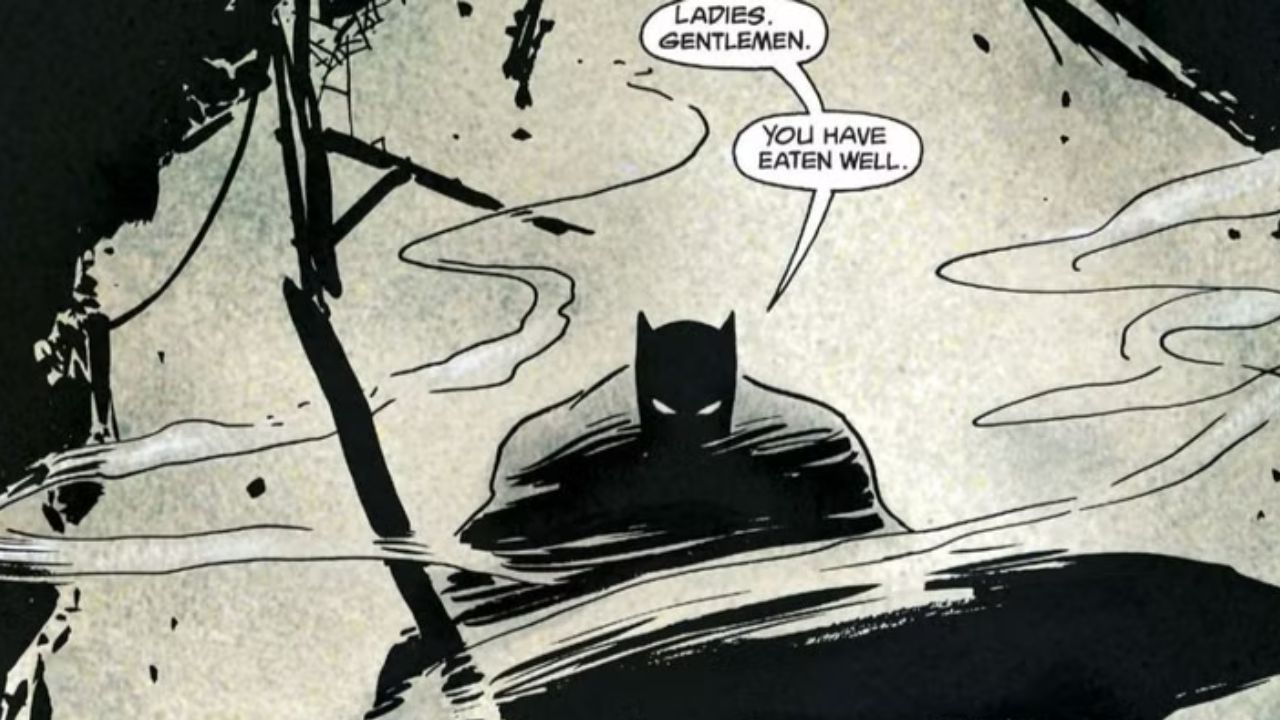
To fully understand why Year One works as well as it does, you must understand the collaboration at its heart. Frank Miller, fresh from the success of The Dark Knight Returns, brought to the script a screenwriter’s economy and a crime novelist’s instincts. His panels direct like a Scorsese film — tight close-ups, hard cuts, overlapping internal monologue from two different minds on the same night in the same city. The dialogue is sparse and precise. The internal narration has the rhythm of hard-boiled detective fiction, its sentences short as punches.
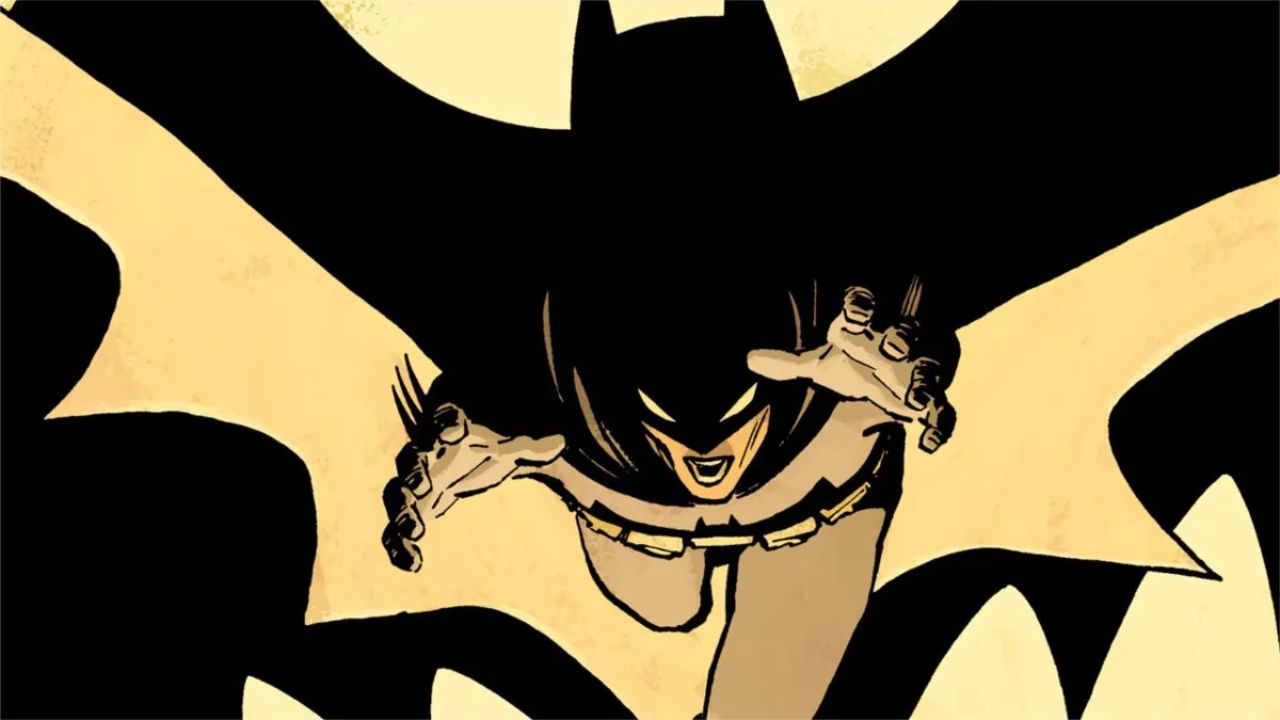
But it is David Mazzucchelli who transforms the script into something visually sublime. Where The Dark Knight Returns had been kinetic and expressionistic, Mazzucchelli’s work on Year One is controlled, almost filmic in its restraint. His Gotham is not the grotesque architectural nightmare of later interpretations — it is a recognisable American city, rain-slicked and corrupt, with a weight of ordinary life in every background. His characters have real bodies that bleed and tire. His Batman, in those early pages, is not imposing — he is someone trying to be imposing, and the difference matters enormously.
The palette. Colourist Richmond Lewis deserves as much credit as anyone for the book’s atmosphere. Her restrained, warm-cool palette — all amber streetlight, blue shadow, and sudden bursts of red — gives Gotham a texture that feels lived-in and dangerous simultaneously.
The page design. Mazzucchelli’s panels are almost always rectangular, his compositions classical. Yet within that discipline, he finds moments of extraordinary visual invention — the famous sequence of Bruce Wayne’s first night out, badly beaten, crawling back to the manor, blood on the carpet, a bat crashing through the window. It is comics storytelling at its highest pitch.
The dual-narration boxes. Miller’s decision to have both Bruce and Gordon narrate alternating sequences, sometimes within the same page, creates a fugue-like structure that no other Batman story has replicated with such success.
The Gotham That Year One Built
One of Year One‘s most lasting contributions to DC’s mythology is the version of Gotham City it established. Miller’s Gotham is not the Art Deco fantasy of the Tim Burton films, nor the steel-and-glass dystopia of later comics iterations. It is a city recognisably modelled on late-1970s, early-1980s New York — Times Square grind-houses, corrupt precincts, tenement fires, prostitution as a street-level fact of life. The city is sick, and it is sick in ways that have specific, systemic causes: police corruption, political graft, organised crime operating in plain sight.
This grounding matters because it gives Batman’s mission moral weight. He is not fighting supervillains here — The Joker doesn’t appear; the Rogues Gallery is absent. He is fighting the specific, correctable failures of a human institution. And that makes his efforts, and his costs, feel real in a way that universe-saving adventures rarely achieve. When Bruce Wayne crawls home through the manor grounds after a disastrous first attempt at vigilantism, near death from wounds and cold, and whispers — to a memory, to his dead father — “I’m afraid I may have to die tonight,” the drama is purely human. No cape can save him here. Only stubbornness and a bat.
Selina Kyle, re-imagined here as a streetwalker in East End, is given more dignity and complexity in four issues than most characters receive in four decades. She is nobody’s footnote.
The book also introduces, almost incidentally, a young district attorney named Harvey Dent — uncorrupted, idealistic, an ally. It gives us Gordon’s relationship with his family, the ethical cost of the compromises he makes and refuses to make. It suggests, without spelling out, the ecosystem of civil society that Batman will spend his career attempting to protect and strengthen. Every character who appears, even briefly, feels like a person with a life outside the panel.
Why Every Other DC Origin Story Falls Short
DC Comics has produced many origin stories across its history, some of them genuinely great. John Byrne’s Man of Steel, which rebooted Superman in the same period, is admirably constructed. Geoff Johns’ various retellings of Green Lantern mythology are ambitious in scope. But none of them achieve what Year One achieves, and the reason comes down to a single word: necessity.
The best origin stories do not merely explain how a hero came to be — they explain why that hero must exist. They show us a world in which the hero’s specific qualities are the precise solution to a specific problem. Year One does this with devastating clarity. Gotham is corrupt in a way that formal institutions cannot fix — the police are the crime, the courts are compromised, the political class is bought. Into this environment comes a man with no affiliation with any institution, with resources that make him unbribable, and with a trauma that has converted itself into pure mission. The logic is airtight. Batman is not a fantasy in Year One — he is an inevitability.
The Competition – and why they don’t match up
Man of Steel (1986). Competent and compassionate, but Superman’s power differential makes genuine jeopardy nearly impossible to sustain. The emotional core is softer, the craft admirable but less singular.
Secret Origin (Green Lantern, 2008). Epic in ambition, but its pleasures are those of mythology, not character. The human scale is sacrificed for cosmic grandeur.
Superman: Birthright (2003). Beautifully illustrated and emotionally sincere, but it borrows its best ideas and never finds a voice as distinctive as Miller’s.
Geoff Johns’ New 52 origins. Competent executions of existing concepts, but they carry the smell of corporate mandate — stories told because schedules demanded them, not because their creators had something to say.
The Shadow It Has Cast: A Legacy in Four Colours
It is impossible to overstate the extent to which Batman: Year One has shaped every Batman story told after it. Christopher Nolan’s Batman Begins is, in many respects, a faithful adaptation of its structure and tone — the corrupt city, the fumbling first attempts, the relationship with Gordon as an equal rather than a subordinate, the insistence on street-level crime as the primary antagonist. The film even lifts specific shots from Mazzucchelli’s pages.
The 2022 film The Batman, directed by Matt Reeves, owes an equally conspicuous debt — the rain-soaked cinematography, the Gordon partnership, the focus on institutional corruption rather than superpowered villainy, the detective work at the story’s centre. When Robert Pattinson’s Batman narrates his actions in a clipped journal entry, he is speaking in a voice first given to the character by Frank Miller’s script.
1987
Batman: Year One published
Four issues in Batman #404–407 permanently alter how the character’s origin is conceived, told, and visualised.
1992
Batman: The Animated Series
Bruce Timm’s landmark television series draws heavily from Year One’s character designs and moral gravity, introducing the aesthetic to a generation of children.
2005
Batman Begins
Nolan’s film transplants Year One’s structure, tone, and several specific scenes to the screen. It becomes one of the defining superhero films of its era.
2011
DC New 52 reboot
Even in a line-wide continuity overhaul, Year One’s core beats are preserved — the new origin stories orbit its gravity without displacing it.
2022
The Batman (film)
Matt Reeves delivers perhaps the most immersive Year One adaptation yet made, its rain-soaked Gotham practically illustrated by Mazzucchelli’s ghost.
The Ending That Earns Everything
Great origin stories end with a beginning — with the sense that, at last, the world as we know it has come into being. Year One achieves this with a final sequence of such perfect economy that it has haunted the character ever since. Gordon, now a lieutenant, stands on a rooftop. Batman appears. Gordon turns away — does not look. They exchange words about a district attorney named Harvey Dent, about escalation, about what is coming. And then, because Gordon has turned his back, Batman is gone.
It is a scene about trust. About two good men, working toward the same thing from different sides of the law, finding a way to coexist in the same dark city. It is also, quietly, devastating — because we know, as comics readers, what is coming. We know what Harvey Dent becomes. We know what the escalation Gordon mentions will eventually produce. Year One ends at the precise moment before the mythology swallows the man, and it is the last time, in the main continuity, that Batman will seem truly, vulnerably mortal.
That is the secret of its greatness. Year One gives us the man before the legend, and it does so with such skill and sincerity that the legend, when we think of it afterward, carries his humanity inside it. Every subsequent Batman story — every grim line, every calculated risk, every moment of unexpected compassion — points back to these four issues, to this year, to the night a bat came through a window and a young man decided what it meant.
A Story That Earns Its Myth
Four issues. Twelve months. Two men learning what it costs to be good in a city that punishes goodness. That is Batman: Year One — and it is enough. It has always been enough.