
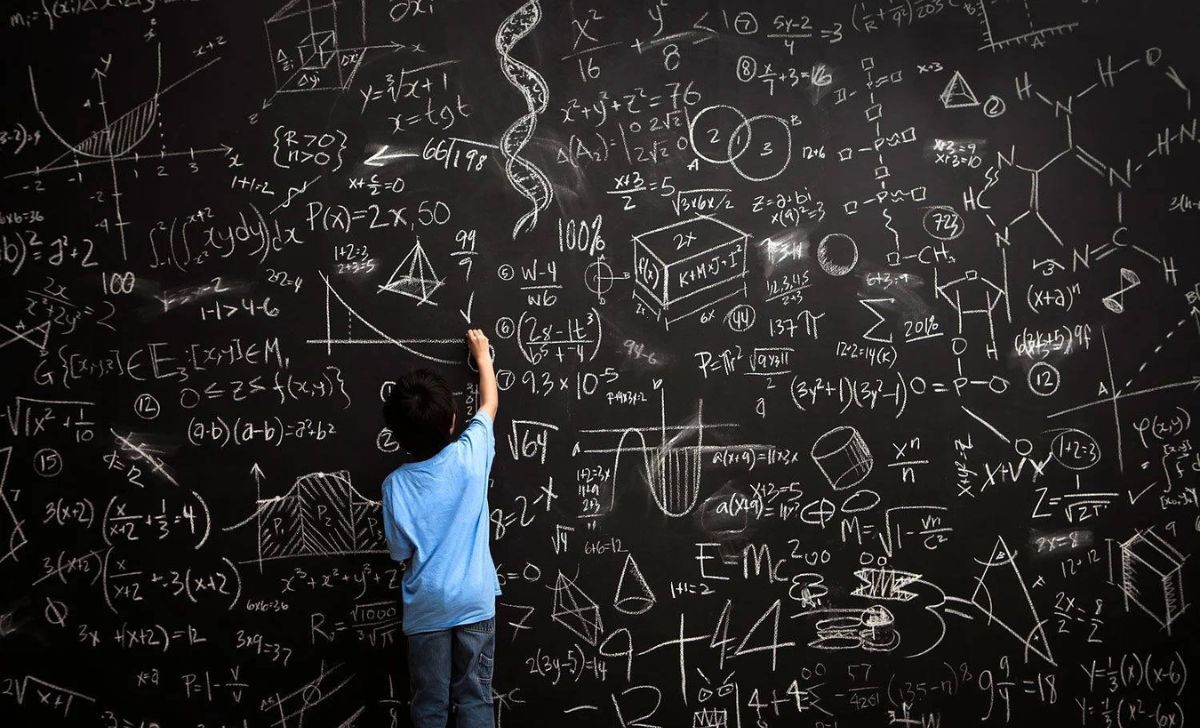
Mathematics. It’s in everything—from the delicate spiral of a sunflower to the architecture of galaxies. But one of the most profound questions ever asked is this: Would math still exist if humans didn’t? Is mathematics something we discovered like explorers unearthing hidden continents, or is it something we invented to make sense of the world? This age-old debate stretches across centuries of thought—from the mystical beliefs of ancient Greece to the hard logic of modern science. Let’s walk through the powerful ideas and historical milestones that define this fascinating conversation.
The Ancient Origins: Numbers as Living Forces
Long before modern math textbooks and calculators, ancient thinkers viewed numbers as more than just symbols.
In 5th-century BCE Greece, the Pythagoreans believed that numbers were not only real—they were alive. To them, the number one was called the “monad,” the sacred source from which all other numbers (and therefore all things) were born. In their eyes, numbers were active agents that shaped the universe itself.
Plato, another giant of Greek philosophy, took this belief even further. He argued that mathematical ideas were not inventions of the mind but unchanging, eternal truths—just as real as the mountains or stars, whether or not we ever became aware of them.
Then came Euclid, the “Father of Geometry,” who saw the natural world as a physical expression of mathematical law. To him, the geometry of nature wasn’t just a coincidence—it was proof that math was written into the fabric of reality.
The Skeptics: Is Math Just a Man-Made Tool?
While ancient Greeks saw math as a divine truth, others have challenged this view. Critics argue that even if numbers seem universal, math itself is a human invention—a clever language our brains created to make sense of the chaos around us.
In the 19th century, German mathematician Leopold Kronecker famously said,
“God created the natural numbers, all else is the work of man.”
To Kronecker, only the basic idea of counting—natural numbers—could be considered “real.” Everything else? Just a sophisticated mental game built by people.
This view shaped an entire wave of mathematical thinking. One of its champions, David Hilbert, tried to systematize all of mathematics through a set of logical, human-made rules—an effort known as axiomatization. Like Euclid had done with geometry, Hilbert wanted to do with all of math: define it as a consistent, rule-based structure, not something discovered in nature, but something we built like a board game.
And then there was Henri Poincaré, who helped develop non-Euclidean geometry—the mathematics of curved spaces. He pointed out that the very existence of different geometrical systems (flat vs. curved) proved there was no single mathematical “truth.” Instead, different rules produced different outcomes, showing math could be more like a game of logic than a window into nature’s laws.
The Turning Point: Math That Predicts Reality
Just as many were beginning to see math as nothing more than a set of invented symbols and logic, something strange happened—pure math started explaining the real world.
In 1960, physicist Eugene Wigner coined the phrase,
“The unreasonable effectiveness of mathematics.”
Wigner was puzzled. How could theories developed purely for fun or intellectual curiosity suddenly turn out to describe nature so precisely?
Take the British mathematician G.H. Hardy, for example. He proudly claimed that his number theory had no practical use at all. Yet his work laid the foundation for modern cryptography—essential to digital security. Some of his abstract ideas also became part of the Hardy-Weinberg principle in genetics, which later won a Nobel Prize.
Or consider the Fibonacci sequence, a series of numbers first described by Fibonacci while studying the growth pattern of rabbits. Surprisingly, the sequence turned up everywhere in nature—spiraling through pine cones, flower petals, sunflower seeds, even inside human lungs.
Then there’s Bernhard Riemann, a 19th-century mathematician who studied strange, curved spaces. At the time, his work seemed purely theoretical. But decades later, Einstein used Riemann’s geometry to formulate the theory of general relativity, transforming our understanding of gravity and spacetime.
And what about knot theory? First explored in the 18th century just to describe how loops and twists work in space, it later helped scientists explain how DNA untangles itself during cell replication. Today, it’s even being applied to string theory, a leading theory in physics about the universe’s smallest building blocks.
The Heart of the Debate: Creation or Discovery?
With both sides making compelling arguments, we’re left with questions that challenge the boundaries of philosophy, science, and even spirituality:
- Is math a toolkit we invented to understand nature, or a truth embedded in the cosmos?
- Can something be real if it only exists in the mind?
- If no one is around to count the trees in a forest, does the number of trees still exist?
Some argue it depends on the concept. Maybe counting and basic arithmetic are more “real” or discovered, while complex algebra or calculus are human-made structures we use to solve problems.
But others believe the answer is deeper than any one theory. Maybe the truth of math lies somewhere between invention and discovery—a strange middle ground where human minds recognize something that’s always been there, even if we give it new form.

Final Thoughts: The Eternal Puzzle of Math
Whether we discovered math like archaeologists unearthing ancient fossils, or invented it like artists painting meaning onto a blank canvas, one thing is clear: mathematics works.
It predicts the motion of planets, decodes the secrets of DNA, secures your online bank account, and helps us explore distant galaxies. Whether it was always there or we made it up, math has proven itself time and again to be one of our most powerful tools—and perhaps one of the most mysterious gifts of the universe.
So next time you see a spiral in a flower or watch a rocket launch into space, remember: you’re witnessing something that may just be the native language of reality itself.