
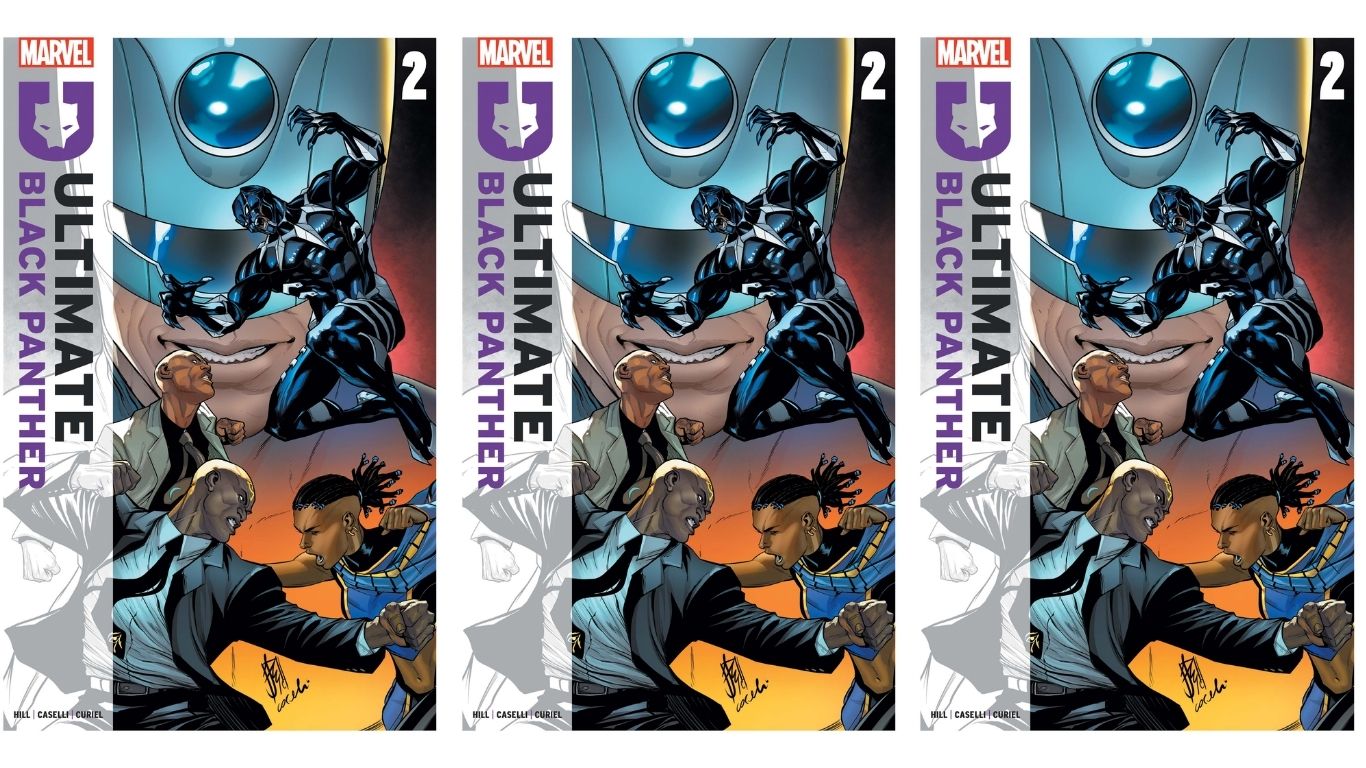
If the first issue declared war, Ultimate Black Panther #2 explains what kind of war Wakanda is truly fighting. This is not a simple invasion. It is psychological, spiritual, and political—engineered by gods who do not march with banners, but with influence. From the opening page to its explosive final panel, this issue shows T’Challa learning that the most dangerous enemy is not the one at the border—but the one already inside the story Wakanda tells itself.
A World Shaped by Tyrants
The issue opens with a stark reminder of the Ultimate Universe’s grim foundation. The Maker reshaped Earth by erasing heroes before they could rise, replacing them with a ruling council of villains. Though The Maker himself is imprisoned, his legacy endures.
Among the most powerful remnants of that council are Ra and Khonshu, operating together under the identity of Moon Knight. They dominate Africa not merely through force, but through faith, fear, and myth. Wakanda stands as the last unconquered territory—not because it is unseen, but because it has refused to kneel.
This framing immediately clarifies the stakes: Wakanda is not fighting an army. It is resisting a theocracy with superhuman enforcement.
A King and His Queen
We shift inward, to Wakanda’s royal quarters, where T’Challa and Okoye share a moment of intimacy heavy with unspoken dread.
T’Challa is preparing himself—physically and mentally—for what comes next. Okoye challenges him directly, accusing him of carrying the weight alone. She tells him the truth soldiers rarely admit: Wakanda’s enemies do not fear secrecy anymore. They fear him.
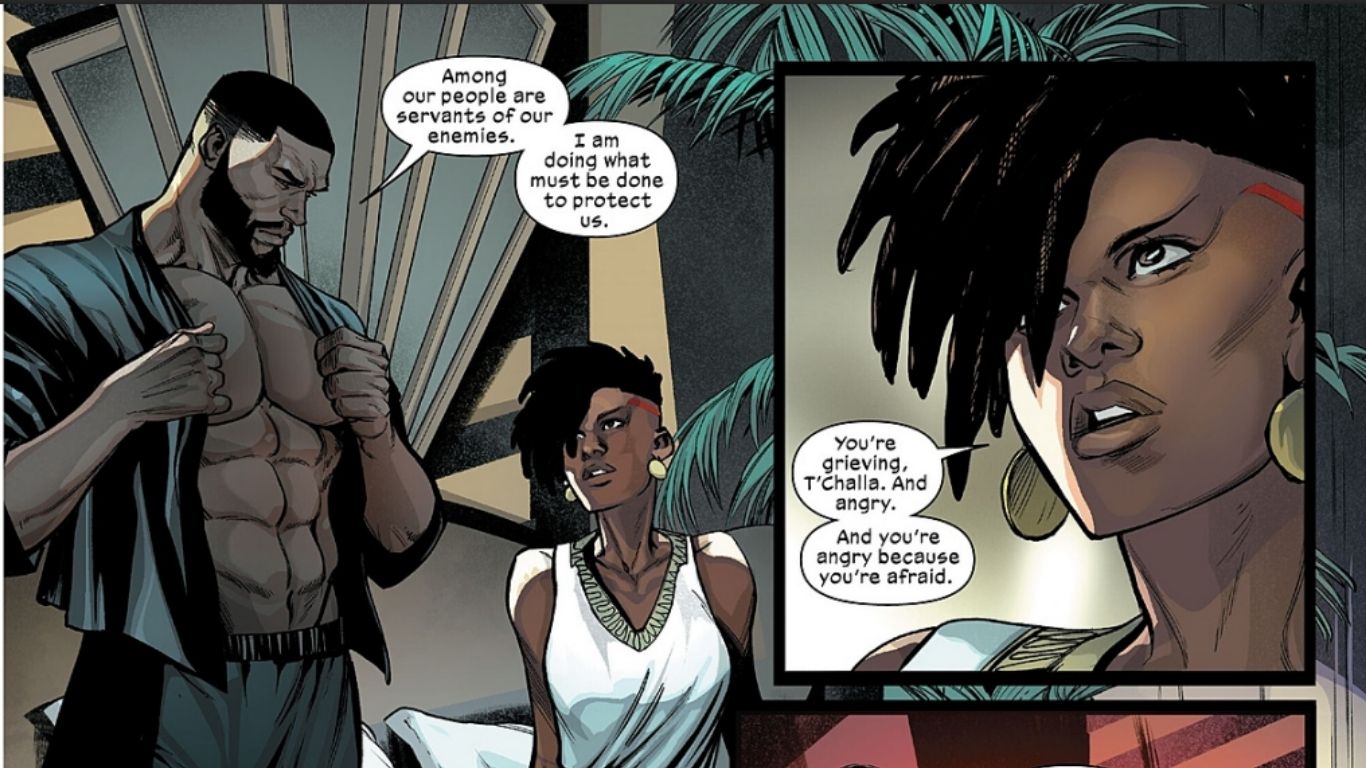
Yet T’Challa’s doubt is not about strength. It is about consequence. He knows that once Wakanda strikes openly, there will be no return to isolation. Peace, once broken, cannot be carefully reassembled.
This exchange reinforces one of the series’ strongest themes:
T’Challa is not afraid to fight. He is afraid of what fighting will turn Wakanda into.
The Vodu-Khan and the Language of Gods
T’Challa returns to the Temple of the Vodu-Khan, where Matron Imala offers neither comfort nor reassurance—only truth.
She speaks of visions: gods walking openly, destiny demanding blood, and Wakanda standing at the crossroads of belief and annihilation. The gods, she says, are not distant. They are active.
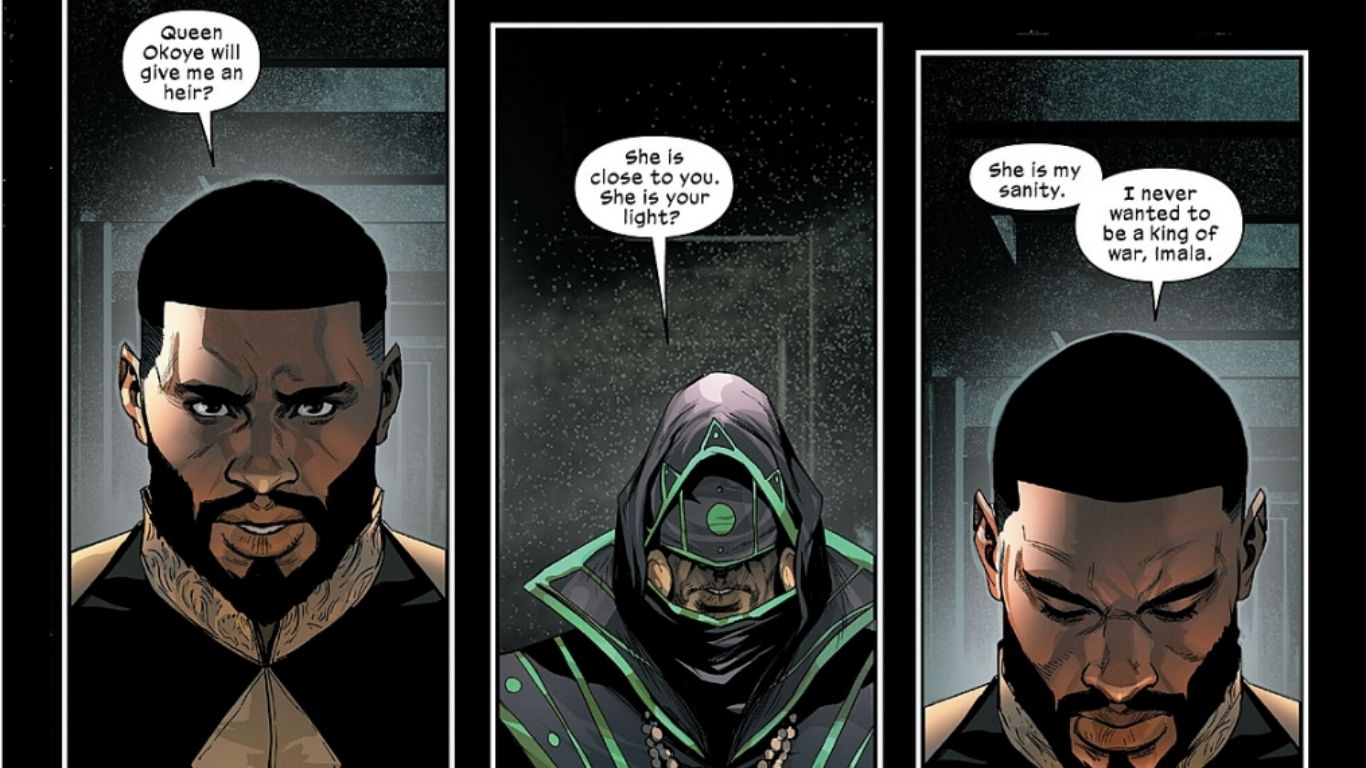
Most disturbing is her reminder that Wakanda itself was shaped by divine interference long ago. The question is not whether gods should be trusted—but whether they can be ignored.
T’Challa remains skeptical, yet the cracks in his certainty are visible. His refusal to submit to prophecy may be noble—but prophecy, in this world, has teeth.
Blood at the Border
The war becomes physical.
At Wakanda’s outer perimeter, Dora Milaje clash with armored forces bearing the marks of Moon Knight’s dominion. The battle is brutal, fast, and merciless. Wakandan technology holds the line—but not without cost.
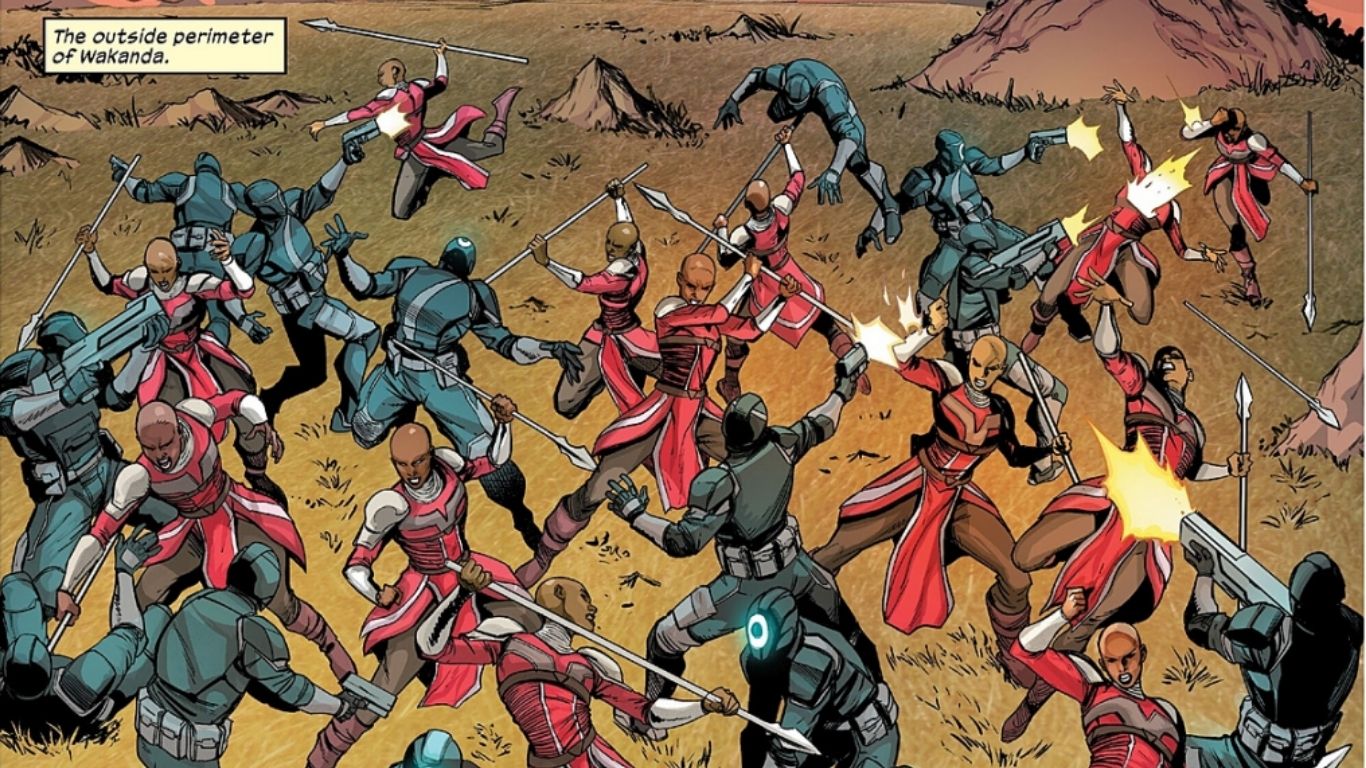
A Wakandan aircraft is brought down. Soldiers fall. For the first time, Wakanda bleeds on its own soil.
As the Dora rally with cries of “For Wakanda!”, the message is clear: secrecy no longer guarantees safety. The war has found them.
The Gods Speak Plainly
Behind the scenes, the architects of the chaos reveal themselves.
Ra and Khonshu appear together—cold, radiant, and utterly convinced of their righteousness. Wakanda, they argue, is an aberration. A kingdom hoarding power instead of submitting to divine order.
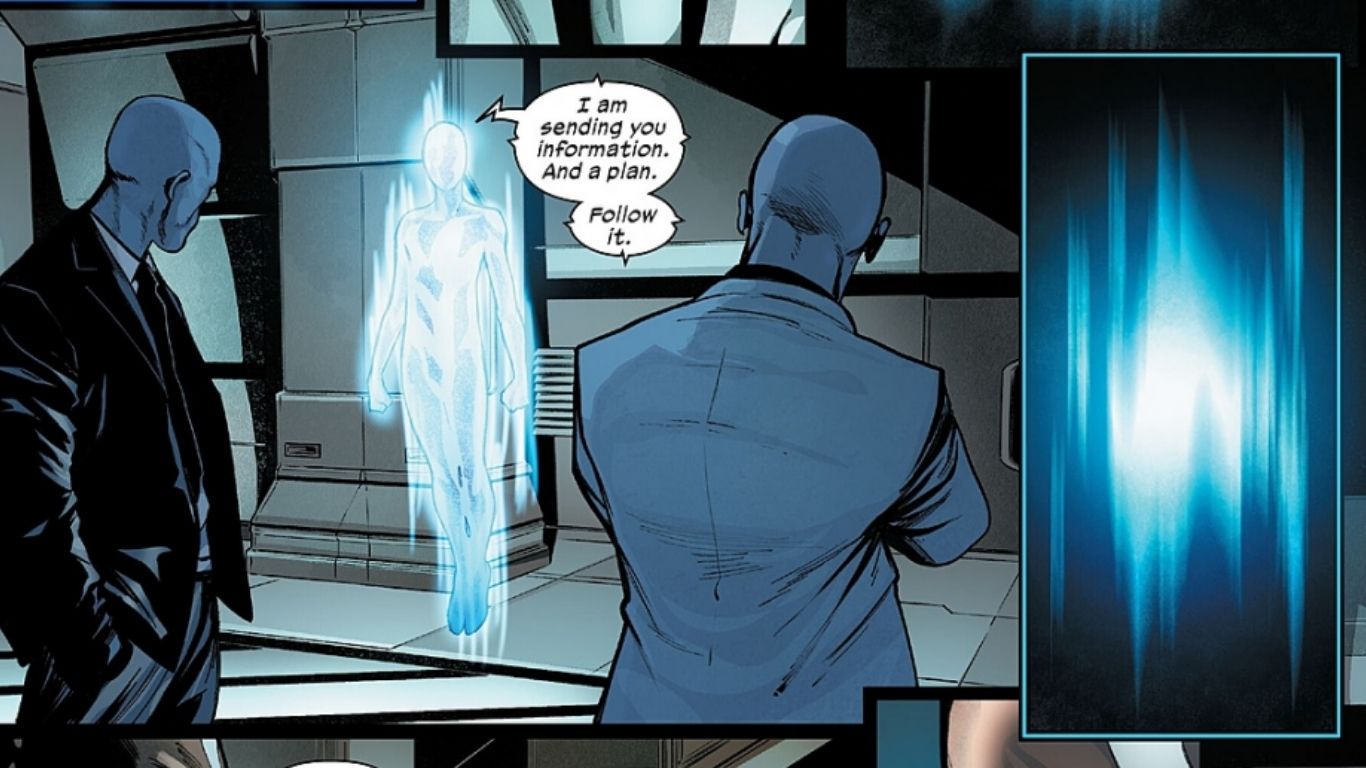
Their plan is not invasion—it is conversion through destabilization. They intend to fracture Wakanda from within, to turn its strength against itself, and to force T’Challa into a position where he must either kneel or watch his people suffer.
Most chilling of all: they do not see themselves as villains. They see themselves as necessary gods.
The War Room: Truths Spoken Aloud
Back in Wakanda, T’Challa convenes his council.
Here, the war becomes political. Evidence suggests collaboration—someone feeding information to the enemy. Shuri’s anger erupts. Okoye demands justice. The Dora Milaje stand ready.
T’Challa, however, does something unexpected.
He slows everything down.
He reminds them that traitors rarely act alone—and that panic is exactly what Moon Knight wants. If Wakanda turns inward too quickly, it will destroy itself faster than any god could.
Still, the conclusion is unavoidable:
There is a traitor. And they are close.
The King Moves First
The final pages bring the issue to its breath-stealing climax.
T’Challa takes to the field as the Black Panther, coordinating defenses while tracking suspicious movements beyond Wakanda’s borders. Communications falter. Signals drop.
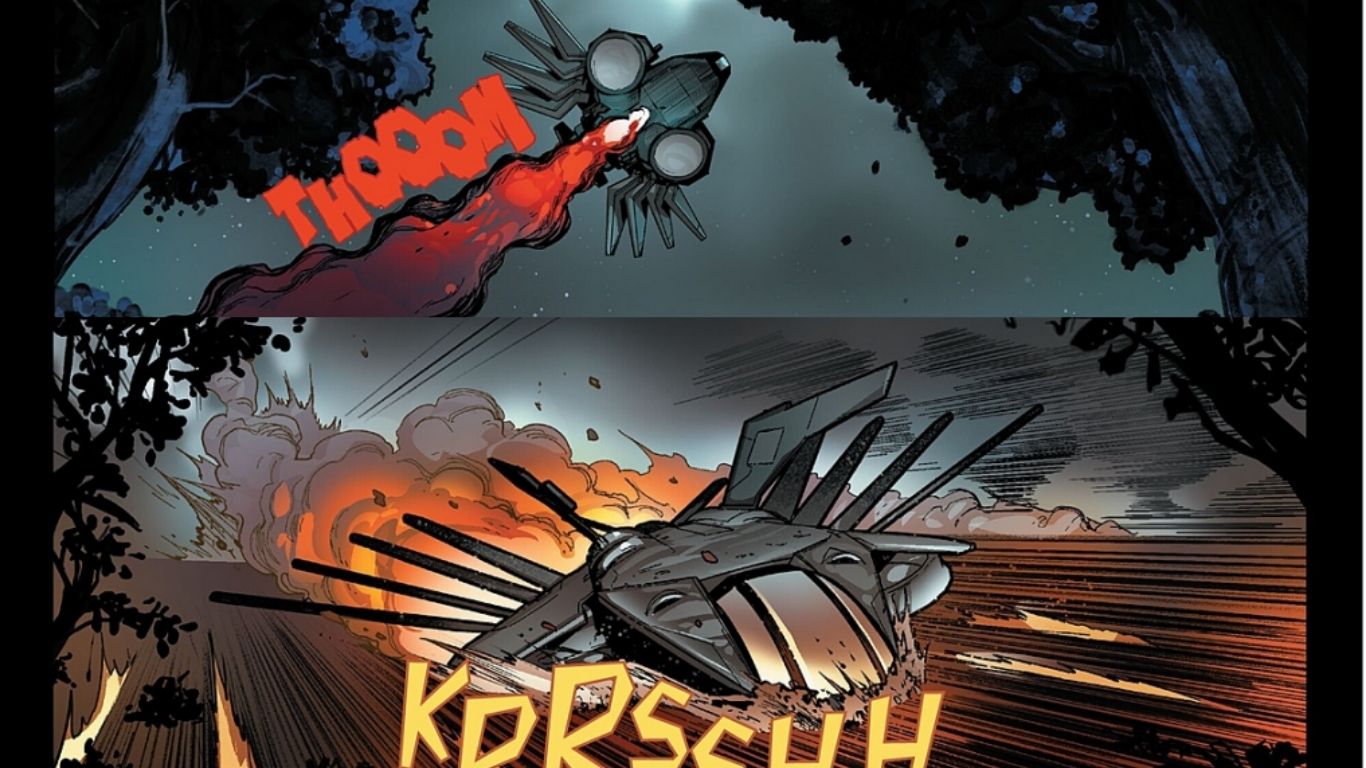
Then disaster strikes.
A Wakandan craft is ambushed and crashes violently into the jungle. From the wreckage emerges T’Challa—alive, furious, and utterly alone.
The last image is pure intent: the Black Panther crouched in the darkness, eyes burning, ready to hunt.
The war is no longer theoretical.
It has found him personally.
As the firefight reaches its peak, T’Challa—operating alone as the Black Panther—faces overwhelming odds. Moon Knight–aligned soldiers surround him in the wilderness. Their weapons are advanced, their coordination precise, and their confidence unsettling. They believe the Panther has finally been cornered.
They are wrong.
The Sky Answers (Lightning Without Warning)
Thunder rolls across the page.
Dark clouds gather unnaturally fast, swallowing the moonlight. Blue-white lightning forks through the sky—not random, not natural. The sound effect stretches across the panel: KRRRR.
This is not weather.
This is arrival.
The battlefield falls silent as electricity crashes into the ground like a divine summons. The soldiers are gone. The gunfire stops. T’Challa drops to one knee, bracing himself as the earth trembles beneath him.
For the first time in the issue, the Black Panther looks small.
“Woman… Made of Light.”
From the heart of the storm, a figure descends.
She floats effortlessly, wrapped in lightning, her body framed by raw energy rather than armor. Every bolt bends toward her as if recognizing its master. Her presence is overwhelming—beautiful and terrifying in equal measure.
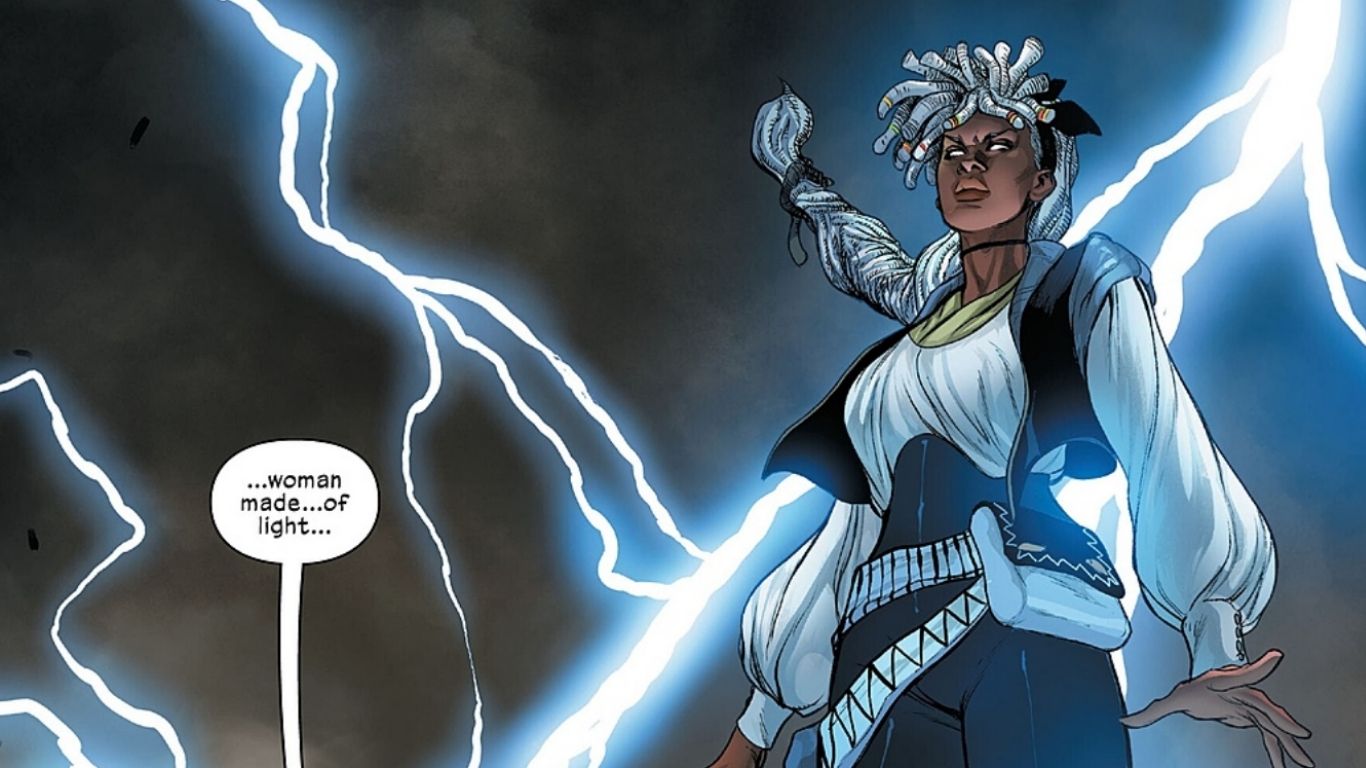
T’Challa looks up and speaks the words aloud, not as a question, but as recognition:
“Woman… made of light.”
This is Wind-Rider.
In traditional Marvel mythos, that name echoes Storm—but here, in the Ultimate Universe, she is something far more dangerous: a living weapon of the Ra–Khonshu faction, empowered not just by weather, but by divine authority.
She does not attack.
She does not speak.
She simply hovers, lightning dancing around her like a crown.