

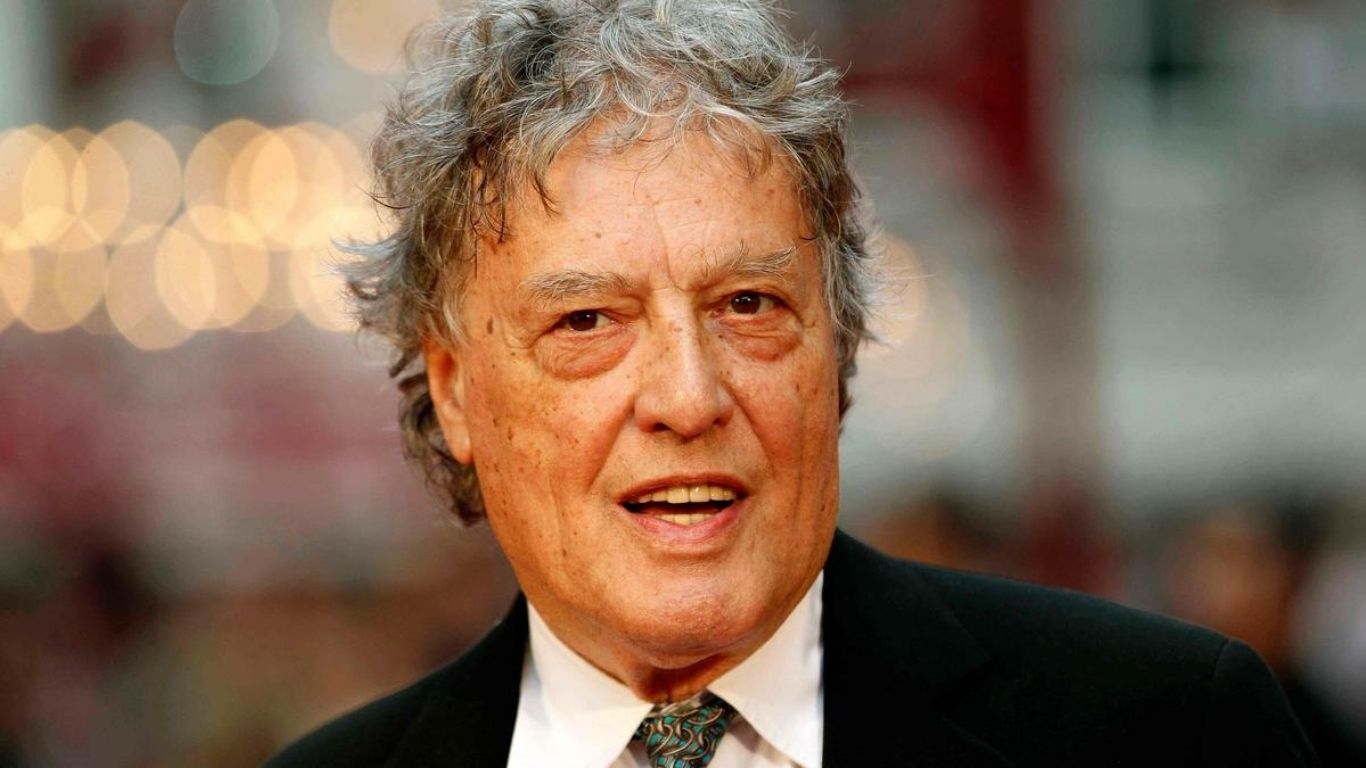
Tom Stoppard, the Czech-born British playwright whose dazzling intellect and linguistic exhilaration reshaped modern theatre, has died at the age of 88. Widely admired as one of the greatest dramatists of his generation, Stoppard’s career spanned more than six decades, marked by award-winning plays, acclaimed screenplays, and a body of work defined by philosophical depth, humor, and theatrical daring.
A Playwright Who Created His Own Adjective
Stoppard was one of the few writers to inspire his own dictionary entry: Stoppardian. The term captured his signature blend of philosophical concepts, playful irony, and complex, often time-bending narrative structures. Critics described him as “intellectually dazzling,” while audiences loved the acrobatic humor and emotional resonance beneath his clever dialogue.
His rise began with Rosencrantz and Guildenstern Are Dead—first spotted at the 1966 Edinburgh Fringe—an audacious take on Hamlet told through the bewildered eyes of two minor characters. It became an international phenomenon and earned Stoppard his first Tony Award, making him the youngest playwright to receive a staging at the Royal National Theatre.
A Life Shaped by War and Reinvention
Born Tomáš Straussler in 1937 in Zlín, Czechoslovakia, Stoppard’s early years were marked by upheaval. His Jewish family fled the Nazi invasion in 1939, first to Singapore, then to India after the Japanese assault. His father, an army medical officer, stayed behind and was killed during the Japanese occupation.
After the war, his mother married British Army major Kenneth Stoppard. The family relocated to England in 1946, and Tomáš Straussler became Tom Stoppard, a transformation that would define the beginning of his British identity.
From Journalist to Literary Luminary
Stoppard left school at 17, eager to avoid university and dive into journalism. He worked for the Western Daily Press and the Bristol Evening World, where he served as reporter, humor columnist, and drama critic. He also freelanced for Scene magazine under the pen name “William Boot,” a humorous nod to Evelyn Waugh’s fictional journalist.
His first play, A Walk on the Water, appeared on television in 1963. By 1966, he had written his first and only novel, Lord Malquist and Mr. Moon, showcasing his quirky, surreal imagination.
An Extraordinary Theatrical Career
Across the 1970s and 1980s, Stoppard cemented his reputation with works that blended intellectual rigor and theatrical spectacle. These included:
- Jumpers – philosophy meets gymnastics
- Travesties – a satirical twist on Oscar Wilde
- Every Good Boy Deserves Favour – a collaboration with André Previn featuring a full onstage orchestra
- The Real Thing – a deeply emotional exploration of love, fidelity, and artistic truth, considered one of his finest works
He later produced masterpieces such as Arcadia (which he regarded as his best) and The Invention of Love, a poetic reflection on A.E. Housman.
His final triumph, Leopoldstadt, explored the fate of a Viennese Jewish family devastated by antisemitism—drawing from truths he only learned about his own Jewish heritage in his 50s.
By the end of his career, Stoppard had won a record five Tony Awards for Best Play, more than any playwright in history.
A Screenwriter Behind Blockbusters
Beyond the stage, Stoppard was a sought-after screenwriter and script doctor. His works included:
- Brazil (1985), co-written with Terry Gilliam
- The Russia House (1990), adapted from John le Carré
- Empire of the Sun, Billy Bathgate, Enigma, Anna Karenina, and Tulip Fever
- Shakespeare in Love (1998), which won an Academy Award for Best Original Screenplay
Directors frequently turned to him to refine scripts. Steven Spielberg even joked that Stoppard was responsible “for every line of dialogue” in Indiana Jones and the Last Crusade, though uncredited.
He also contributed to Star Wars: Revenge of the Sith and was once pulled out of the shower by Spielberg to address a script issue with Schindler’s List.
His only directorial effort came in 1990 with the film adaptation of Rosencrantz & Guildenstern Are Dead, starring Gary Oldman and Tim Roth, which won the Golden Lion at Venice.
Independent Mind, Humanitarian Heart
Stoppard described himself as a “timid libertarian” and admired Margaret Thatcher, distinguishing himself from the largely left-leaning theatre community. He publicly supported the U.S. invasion of Grenada in 1984 and was known for his steadfast beliefs.
At the same time, he maintained a deep commitment to civil rights, especially regarding Eastern Europe. He befriended dissident writer Václav Havel and worked to promote his writings during Soviet repression. Later, he wrote The Coast of Utopia, a sweeping trilogy about 19th-century Russian political radicalism.
He received major honors including a CBE in 1978, a knighthood in 1997, and the PEN Pinter Prize in 2013.
A Personal Life Full of Warmth and Wit
Despite his immense success, Stoppard was described as sociable, charming, and effortlessly enviable. Playwright Simon Gray once joked that Stoppard was enviable “in every way—yet somehow not envied.”
He married three times, and his final marriage in 2014 was to Sabrina Guinness. He had four children, including actor Ed Stoppard.
Stoppard wrote with a Swiss-made Caran d’Ache fountain pen, eschewing typewriters and computers. He often dismissed the idea of grand creative philosophies, saying that the play itself created the idea—not the other way around.
When asked where his ideas came from, he famously quipped: “Harrods.”
His Final Days and Lasting Legacy
Tom Stoppard died peacefully at his home in Dorset, England, surrounded by his family. Those close to him remembered not only his extraordinary works but also his generosity, humor, and love for the English language.
He leaves behind a body of plays and screenplays that changed modern theatre, expanded the possibilities of storytelling, and demonstrated that wit and intellect could also carry great heart.
His legacy endures in the plays that bear his name—and in the adjective Stoppardian, a tribute to a mind unlike any other.