
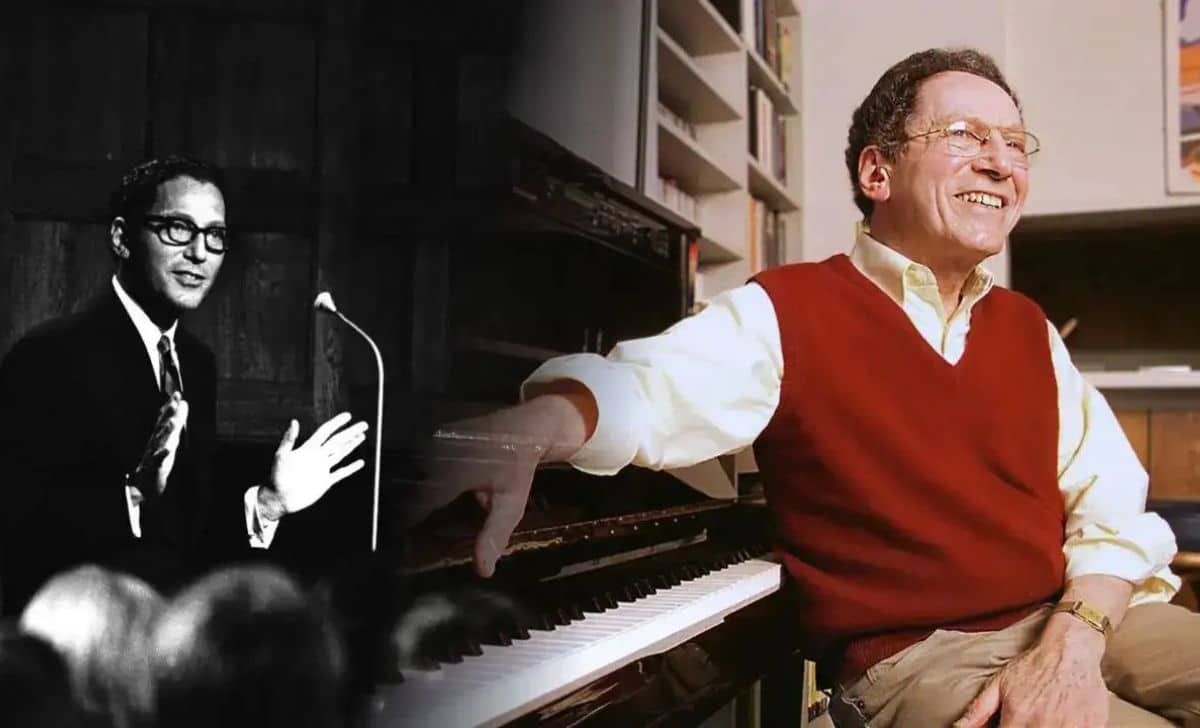
Tom Lehrer, the legendary musical satirist who turned wit into an art form and walked away from fame to pursue a quiet life teaching mathematics, passed away at the age of 97 on Saturday in Cambridge, Massachusetts. His longtime friend David Herder confirmed his death, although no cause was given.
With a career that combined intellectual humor, biting social commentary, and musical brilliance, Lehrer’s legacy remains etched in the hearts of fans and performers alike. From Cold War paranoia to religious rituals, nothing was off-limits — and everything was delivered with a catchy tune and a straight face.
A Math Prodigy Turned Musical Maverick
Born in New York City in 1928 to a Jewish family, Lehrer was a child prodigy. He entered Harvard at the age of 15 and earned his mathematics degree by 18. Though he pursued graduate studies and a teaching career, Lehrer’s creativity soon found an outlet in satire.
He began writing songs in the early 1950s to entertain his friends, using a piano and his razor-sharp sense of irony. His first album, Songs by Tom Lehrer (1953), was self-released and included tracks like “I Wanna Go Back to Dixie” and “Fight Fiercely, Harvard.” Lehrer’s satirical commentary on topics like racism, militarism, and the American South caught attention quickly.
In Lehrer’s own words: “When I got a funny idea for a song, I wrote it. And if I didn’t, I didn’t.”
Satire with a Smile: Songs That Shocked and Delighted
Lehrer’s work stood out for its brilliant juxtaposition of cheery melodies with dark, biting lyrics. “Poisoning Pigeons in the Park,” for example, mocked springtime songs with gleeful references to animal cruelty. “The Old Dope Peddler” turned drug dealing into a cheery jingle. And “The Vatican Rag” poked fun at Catholic rituals with lines like:
“Get down on your knees, fiddle with your rosaries. Bow your head with great respect, and genuflect, genuflect, genuflect.”
Though his topics were often provocative — from nuclear war to racism and smut — Lehrer’s academic tone and gentlemanly delivery disarmed criticism. Even when mocking folk songs or criticizing segregation, he rarely drew public outrage.
Musicologist Barry Hansen once said, “Tom Lehrer is the most brilliant song satirist ever recorded.” Randy Newman and “Weird Al” Yankovic also named him as a major influence.

Reluctant Fame and a Swift Exit from the Spotlight
Despite his success, Lehrer never sought celebrity status. In fact, he was famously uncomfortable with performing in public. “It was like a novelist going out and reading his novel every night,” he once told the Associated Press.
Still, he released a handful of classic albums. His 1959 LP More of Tom Lehrer and the live recording An Evening Wasted with Tom Lehrer were widely acclaimed, with the latter earning a Grammy nomination. He briefly returned to the spotlight for the satirical 1964 television show That Was the Week That Was, penning weekly political songs. Those were later released in the 1965 album That Was the Year That Was, which included standout tracks like “Pollution” and “Who’s Next?”
Lehrer also wrote songs for the children’s educational TV series The Electric Company, finding fulfillment in helping kids learn through music. “Hearing from people who benefited from those gave me far more satisfaction than praise for my satirical work,” he admitted.
A Teacher at Heart
While the world applauded his musical genius, Lehrer always saw himself as a math teacher first. He taught at institutions like Harvard, MIT, and the University of California at Santa Cruz, where he remained on faculty into his late 70s. He moved to California partly to escape New England’s winters, quipping, “You didn’t even have to see snow, and that was a great revelation to me.”
He never mixed his two worlds. When students signed up for his classes expecting comedy, they were met with rigorous mathematics. “It’s a real math class. I don’t do any funny theorems,” he once said. “So those people go away pretty quickly.”
A Legacy That Lives On
Though his catalog includes only about three dozen songs, Lehrer’s impact on satire and comedy music is immense. His songs were revived in the 1980 musical revue Tomfoolery and continue to circulate in comedy and musical circles. In 1998, he made a rare public appearance in London for an event honoring producer Cameron Mackintosh.
In a final act of generosity and anti-commercialism, Lehrer placed all of his lyrics and music into the public domain in 2020, giving fans and performers the freedom to use his work without restriction.
The news of his death prompted an outpouring of tributes. “My last living musical hero is still my hero but unfortunately no longer living,” wrote “Weird Al” Yankovic on Instagram. One fan echoed Lehrer’s irreverent tone, commenting, “The pigeons are safe, BUT AT WHAT COST.”

A Life Beyond Satire
Lehrer’s life was marked by brilliance, integrity, and a refusal to be boxed in by fame. He was a man who could have dominated the entertainment world but chose the quiet path of academia instead.
He once said, “I just wanted to be a grad student… That’s what I wanted to be.” While he never finished his Ph.D., his legacy — one of laughter, intellect, and daring — remains unforgettable.
In a world increasingly divided, Lehrer’s songs continue to offer a mirror — one that reflects both absurdity and truth, always with a smile.
Rest in peace, Tom Lehrer. You taught the world to laugh — and think — at the same time.