

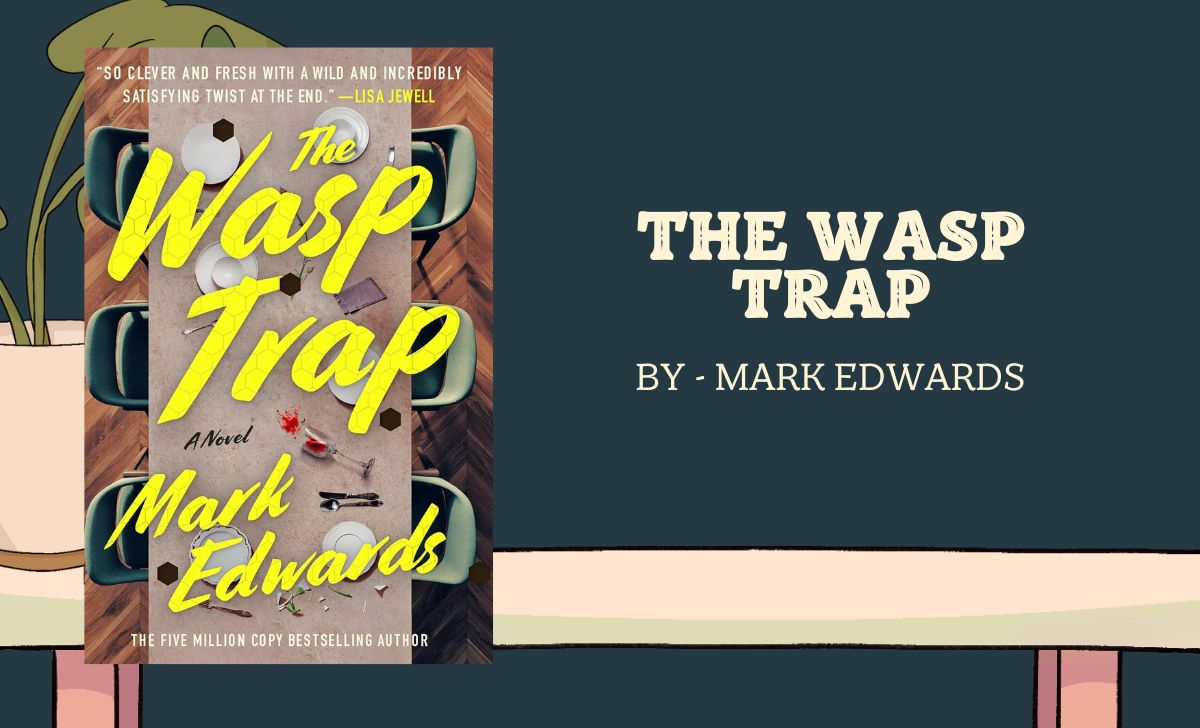
Mark Edwards’s The Wasp Trap opens like a gilded invitation: a stylish Notting Hill townhouse, an elegant dinner party, and six former colleagues reunited under the guise of mourning their late mentor. What begins as nostalgia and polite conversation rapidly curdles into a claustrophobic contest of truth and survival. Edwards — known for his knack for plotting and mounting tension — hands readers a locked-house thriller where the rules are psychological as much as physical. The result is a propulsive page-turner that balances character reckonings with twisty puzzle-work.
Plot overview: the set-up and the snare
The story follows six people who once worked together building a dating site under the direction of an eccentric psychology professor. Years later, they gather to commemorate that professor’s death, only to find themselves forced into a cruel game: reveal your darkest secret or face escalating consequences. The novel alternates between the present-night tension of the dinner party and flashbacks to the summer they all spent under the professor’s influence. As the evening progresses the characters’ carefully curated lives begin to crack, and the group must confront both the sins of a shared past and an immediate threat that won’t let anyone leave unchanged.
Characters and dynamics: believable people, uncomfortable truths
What makes the situation feel urgent is Edwards’s attention to social texture: these are not archetypes but people whose smaller compromises and private vanities make them plausibly vulnerable to blackmail and violence. Will — the protagonist readers are encouraged to root for — is sketched with enough compassion that his panic and resourcefulness land emotionally. The other characters each carry a chip of moral grey, which means alliances shift naturally instead of at the author’s whim. That fluidity of trust fuels both the suspense and the book’s quieter, creepier moments. Reviewers and early readers have repeatedly praised Edwards’s cast construction and his ability to keep sympathy uneven and interesting rather than flat.
Pacing and structure: a real-time crescendo
Edwards runs the evening almost in real time, which ratchets tension effectively. The chapters are concise, and he alternates scenes so that the reader always knows a fresh piece of the backstory is coming, just when the pressure in the room is highest. That structure keeps momentum high and provides a satisfying architecture for reveals: every flashback reframes present actions, and the interplay of timelines grows more than decorative — it becomes integral to the puzzle. Some readers might find the steady supply of twists exhausting; others will appreciate that the book rarely pauses longer than it needs to. Publishers Weekly and Library Journal both flagged the novel’s deft pacing as a principal strength.
Themes: manipulation, memory and what we owe one another
Beneath the mechanics of the plot there’s a current about influence and accountability. The group’s shared history with an influential psychology professor who taught them to analyze — and occasionally manipulate — emotions gives the novel a darker philosophical edge: how responsible are people for the consequences of training someone else to read and exploit human behavior? Edwards uses the dating-site origin to ask whether scientific curiosity, when mixed with ambition and charisma, can become dangerous. Thematically, the book explores how memory is contested, how truth is performative in social settings, and how past injustices reverberate into present danger. Several reviewers picked up on that ethical undercurrent as what elevates the book above pure puzzle-thriller fare.
The twist factor: clever, sometimes audacious
Edwards is a writer who has made a career out of cleverly deployed surprises, and The Wasp Trap delivers. The climactic reversals are often audacious — occasionally to the point that very careful readers might spot the scaffolding — but the emotional payoff is usually genuine. When the final layer peels away, it reframes not only events but also the moral weight of earlier choices. Fans of twist-centric thrillers will likely be satisfied; those who prefer low-key realism may find some maneuvers theatrical. Either way, the novel commits to its conceits with confidence. Shelf Awareness and a number of book bloggers singled out the finale as especially memorable.
Strengths: atmosphere, dialogue, and a locked-room feel
A principal strength is the atmosphere — the elegant house, the simmering awkwardness of old friendships, the claustrophobia of a group under pressure — all of which Edwards renders with economy. Dialogue is functional and often sharp, revealing character through posture, evasion and tiny social gambits rather than long expository monologues. The “locked-room” aspect (a mansion that becomes a trap) is used smartly: it’s not just a gimmick, but a way to force moral choices into the open. Many early reviews noted how effectively the setting becomes another player in the story.
Minor drawbacks: ambition sometimes strains credibility
If the novel has a weakness, it’s that at times plot complexity threatens plausibility. To deliver a satisfying twist-heavy thriller you need a certain willingness to accept contrivances; Edwards asks that of his readers. A few subplots feel slightly rushed or instrumentalized, especially in the final third, where the engine of revelation speeds up and some emotional beats get compressed. That said, for many readers the excitement and the moral complexity will outweigh these minor structural creaks. Damppebbles and other reviewers mentioned similar quibbles while still recommending the read.
Who should read it?
If you enjoy tightly wound psychological thrillers, locked-room mysteries updated for the social-media age, or novels where people’s worst histories come back to haunt them, The Wasp Trap is likely to satisfy. It’s an especially good pick for readers who like their suspense served with ethical ambiguity and for book groups that enjoy arguing about characters’ culpability. If you prefer subtle realism or novels that avoid dramatic reversals, this may not be your ideal match.
Final verdict
The Wasp Trap is a propulsive, morally uneasy thriller that combines a claustrophobic setting, credible character friction, and an appetite for surprising turns. Mark Edwards builds tension economically and keeps readers guessing until the very end — and when the last reveal arrives, it reframes the whole story in a way that feels earned even if it occasionally leans on theatrical choices. For fans of twist-driven psychological suspense, it’s an effective and entertaining entry in Edwards’s catalog.