

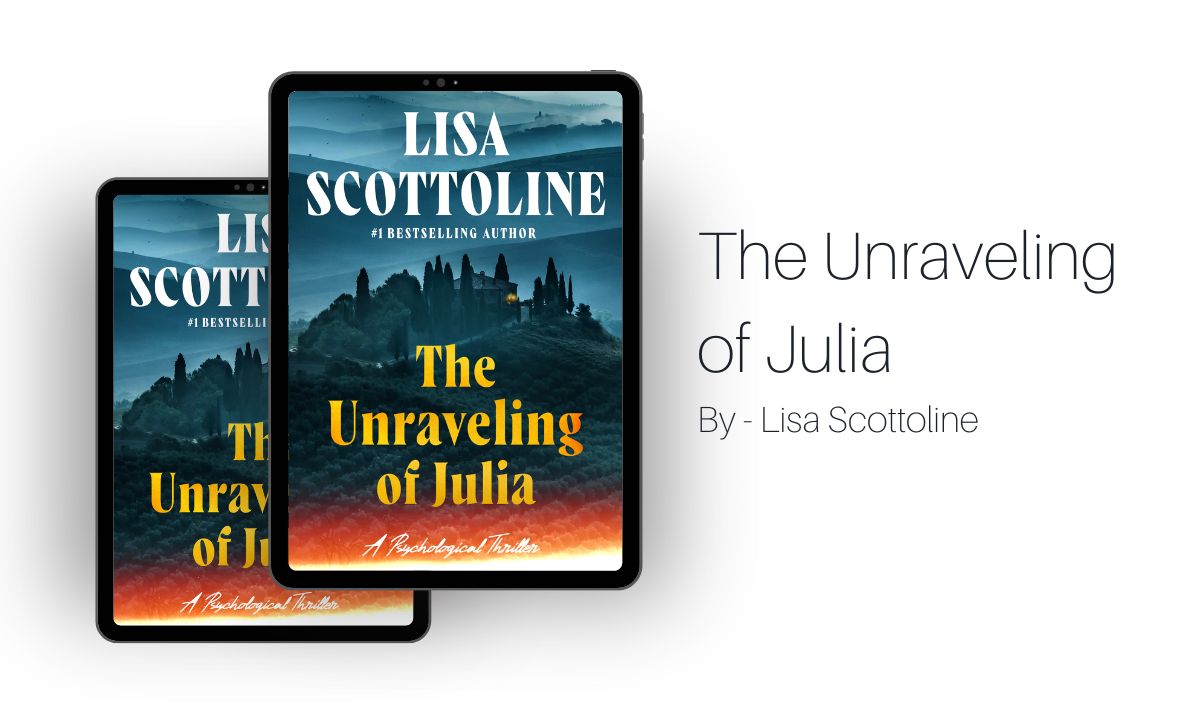
In The Unraveling of Julia, bestselling author Lisa Scottoline delivers a gripping gothic mystery set against the haunting beauty of the Tuscan countryside. When Julia Pritzker inherits a crumbling villa from a stranger after her husband’s tragic murder, she’s thrust into a world of ancestral secrets, eerie visions, and chilling conspiracies. What begins as a search for closure becomes a tense psychological journey filled with supernatural ambiguity, historical echoes, and dangerous revelations. With themes of grief, identity, and self-discovery, this novel offers an emotionally rich and suspenseful escape for readers who love their mysteries laced with atmosphere and intrigue.
Plot
Julia Pritzker’s life is shattered when her husband, Mike, is murdered during a mugging gone wrong in Philadelphia. Deep in grief and mothballed in her home, she spirals into agoraphobia. Then, a letter arrives: she’s inherited a grand villa and vineyard in Tuscany from Emilia Rossi—a complete stranger. Curious and desperate for answers about her biological family, Julia travels to Italy, hoping to find closure and identity.
In Tuscany, the villa is a decaying labyrinth, and the locals are enigmatic. Julia uncovers that Emilia believed herself descended from the Renaissance noblewoman Caterina Sforza, and that Julia herself bears an uncanny resemblance. Unexplained visions, haunting dreams, menacing followers, and ominous coincidences propel Julia into a swirl of suspicion—Is she losing her mind, or is someone orchestrating events? She must untangle the villa’s past, her own lineage, and the reason behind her inheritance, all while confronting murder, conspiracy, and astrological portents.
Atmospheric Italian Gothic
Lisa Scottoline’s descriptions of the Tuscan villa and countryside are immersive—crumbling frescoed walls, overgrown vineyards, winding stone lanes under golden sun—striking the perfect balance between romantic beauty and something unsettling lurking beneath. The villa isn’t merely a setting; it feels alive, a silent witness steeped in conspiracy and history.
These sensory details aren’t superficial; they mirror Julia’s mental state. When she hallucinate—drugged by caretakers in one twist—Scottoline compresses grief, paranoia, and gothic suspense into vivid prose. The way the setting both soothes and haunts Julia enriches the narrative beyond a simple thriller.
Julia’s Emotional Journey
Julia’s journey from a grief-stricken recluse to a woman reclaiming agency is the emotional core of the novel. Her initial breakdown and retreat into isolation are written with raw authenticity. The shock of her husband’s violent death, compounded by her belief that an ominous horoscope foretold it, drives her to desperation. Traveling to Italy becomes both an escape and a battlefield for her fractured identity.
Gradually, Julia regains strength. Her growing relationship with Gianluca, an Italian librarian and art historian, feels like a lifeline—grounded not in instant romance but shared curiosity about history. Her self-discovery crescendos as she confronts her inheritance, heritage, and sanity. Critics note that while Julia is compelling and relatable, some supporting characters—like caretakers Anna and Piero—remain underdeveloped, sometimes feeling like plot tools rather than fully realized people.
A Twist-Laden Mystery
Beneath the gothic ambiance is a tightly wound mystery: Who killed Mike—and was it related to Julia’s inheritance? Is someone shadowing her? Is the astrology real or manufactured to manipulate her?
Scottoline threads an international conspiracy involving child trafficking, property deals, and murder that spans continents. The discovery of an underground cell beneath the villa is both horrific and pivotal, shifting the story from atmospheric mystery to hard-hitting suspense.
The danger escalates logically but tension occasionally stumbles under the weight of too many conspirators. Still, the central conspiracy—which ties Emilia’s paranoia and Julia’s tragedy—remains coherent and compelling as the novel reaches its climax.
Supernatural vs. Psychological
One of the novel’s most compelling dynamics is its ambiguity. Ghostly visions of Caterina Sforza appear at critical moments; astrology seems to guide Julia’s fate. But Scottoline keeps it ambiguous—are these supernatural events or orchestrated hallucinations? Was Julia drugged by caretakers or haunted by bloodline echoes?.
This blurred line elevates the suspense. Readers are left unsure whether to believe in curses and spirits—or the cruelty of human hands. It keeps every scene oscillating between eerie wonder and real-world dread.
Pacing & Structural Balance
The novel unfolds in classic gothic rhythm: slow-building atmosphere, escalating eeriness, and a final, explosive reckoning. While some reviewers feel the middle drowns under conspiracy complexity and astrological asides, the payoff satisfies. The villa’s hidden dungeon, the trial in Philadelphia, and Julia’s psychological rebirth tie together in a fitting conclusion.
Still, pacing dips in the middle—some readers felt certain astrology threads went on too long or romance subplot too quick. Yet others appreciated the genre-mixed tension and emotional beats as part of the journey.
Strengths & Spots of Friction
Strengths
- Italian setting & atmosphere: Tuscan landscapes and a decaying villa make the ideal gothic backdrop.
- Julia’s character arc: From grief and anxiety to self-possession—a psychologically believable and affecting transformation.
- Mystery structure: From a local murder to conspiracy and secret cellars, the stakes steadily increase and intrigue holds.
- Genre-blending: Gothic suspense, literary mystery, romance, paranormal/light supernatural—mixed in a way that many find refreshing.
Points of friction
- Too many threads?: Some readers felt that with astrology, conspiracy, romance, paranormal, and historical echoes, the story risked imbalance.
- Supporting cast: Characters like Anna, Piero, and law enforcement are sometimes considered undercooked compared to Julia’s richly drawn arc.
- Romantic underdevelopment: The sudden Florentine romance felt underbuilt for a widow still processing trauma, though others found it charming.
Final Verdict
The Unraveling of Julia is a beautifully atmospheric gothic thriller—a suspenseful journey through grief, inheritance, and identity set amid sunlit Italian decay. Its strengths lie in Julia’s believable emotional growth, the thickening mystery, and a villa so vividly described it takes on a character of its own. The secret dungeon and hallucinatory edge up the stakes nicely.
Readers who savor atmospheric settings, ambiguous supernatural cues, and layered mysteries will find it richly rewarding. Though the sprawling conspiracy, extended astrology plotlines, and romance may feel uneven to some, the payoff is generally satisfying.
For those seeking a darkly romantic, globe-spanning suspense, Lisa Scottoline takes you there—with whispers of astrology, the echo of lineage, and a thrilling unraveling that keeps you guessing until the last page.
If you enjoy gothic mysteries infused with real emotion and a dose of paranormal, The Unraveling of Julia is a haunting escape.