
- Oedipus’ story begins with a dire warning.
- Arriving at Thebes, Oedipus found the city in terror.
- Determined to save his city, Oedipus launched an investigation.
- Oedipus rejected the claim, angry and defensive.
- Oedipus, relieved that the prophecy might not come true, feared he might still marry Merope.
- Blinded and broken, Oedipus begged to be exiled.
In the world of Greek mythology, few stories strike as deeply as that of Oedipus—king, hero, and tragic figure doomed by prophecy. His life was shaped not by free will but by divine foretelling, and despite his best efforts, he fulfilled the very fate he tried to avoid. This is the tragic tale of Oedipus, told through the legendary works of Sophocles.
A Doomed Prophecy at Birth
Oedipus’ story begins with a dire warning. King Laius and Queen Jocasta of Thebes received a chilling prophecy from Apollo’s oracle: their newborn son would grow up to kill his father and marry his mother.
Desperate to change their destiny, they acted swiftly. Laius pierced the infant’s ankles and ordered him left to die on Mount Cithaeron. However, fate had other plans. The shepherd entrusted with this grim task couldn’t go through with it. Instead, he passed the baby to a fellow shepherd from Corinth, who brought the child to the childless King Polybus and Queen Merope.
They named him Oedipus, meaning “swollen-foot,” and raised him as their own son. The boy grew up unaware of his true lineage.
The First Clues of Identity
Years later, at a banquet, a drunken guest hurled a painful truth at Oedipus: he wasn’t the biological son of Polybus and Merope. Though his adoptive parents denied it, the seed of doubt had taken root.
Troubled and searching for answers, Oedipus visited the oracle at Delphi. But instead of clarity, he received a horrifying prophecy: he would kill his father and marry his mother.
In a panic, Oedipus fled Corinth—believing Polybus and Merope to be his real parents. Determined to outpace fate, he unknowingly ran straight toward it.
The Fatal Encounter at the Crossroads
While journeying toward Thebes, Oedipus encountered a royal carriage at a crossroads. When its driver tried to push him aside, a violent confrontation followed. Oedipus killed the travelers in self-defense—unaware that one of them was King Laius, his biological father.
In that moment, the first part of Apollo’s prophecy came true.
Riddle of the Sphinx
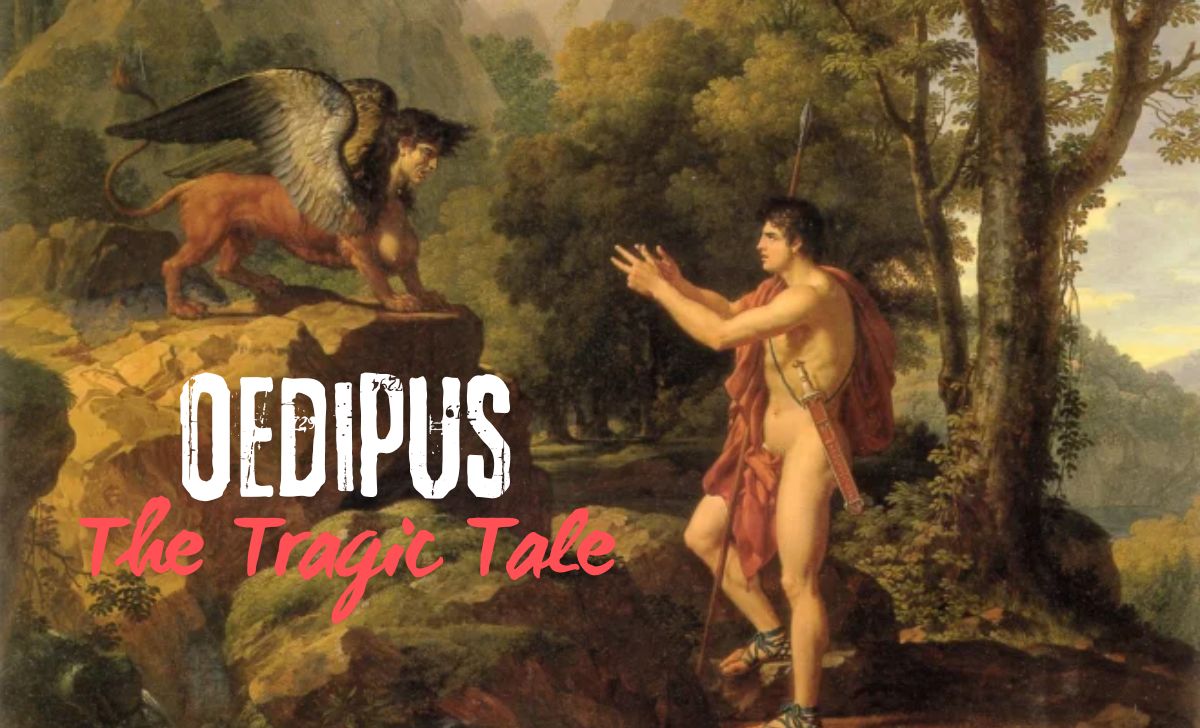
Arriving at Thebes, Oedipus found the city in terror. The Sphinx had laid siege, killing all who couldn’t answer her riddle. But Oedipus did. With his wit, he solved her puzzle, ending her reign of terror.
The grateful people of Thebes crowned him king. He married the widowed queen, Jocasta—his biological mother. Neither of them knew the truth. Together, they had four children, unknowingly completing the second part of Apollo’s terrible prophecy.
The Plague and the Search for Truth
Years passed peacefully until a plague struck Thebes. Desperate for relief, Oedipus sent Jocasta’s brother, Creon, to the oracle. The message was clear: Thebes would only heal when the murderer of King Laius was found and punished.
Determined to save his city, Oedipus launched an investigation. He consulted Tiresias, the blind prophet, who at first refused to speak. But eventually, Tiresias accused Oedipus himself.
Oedipus rejected the claim, angry and defensive. Jocasta also dismissed it, saying that Laius had died at a crossroads, allegedly at the hands of bandits. This detail haunted Oedipus.

The Horrible Revelation
A messenger soon arrived from Corinth with news: King Polybus had died. Oedipus, relieved that the prophecy might not come true, feared he might still marry Merope. But the messenger revealed a deeper truth—Polybus and Merope weren’t his real parents.
This opened the floodgates. Oedipus summoned the Theban shepherd—the very man who had spared his life. Piece by piece, the truth fell into place. He had killed his father at the crossroads. He had married his own mother. The prophecy had been fulfilled, entirely.
Horror, Shame, and Blinding Grief
When Jocasta realized the truth, horror overtook her. She took her own life.
Moments later, Oedipus, full of rage and grief, stormed into her chamber. Discovering her lifeless body, he seized the brooches from her dress and plunged them into his own eyes, blinding himself in a fit of agony and guilt.
He had been blind to the truth his whole life—now he would never see again.
Exile and the Final Chapter
Blinded and broken, Oedipus begged to be exiled. But he was taken back into the palace to await Apollo’s final word.
Years later, Sophocles wrote a sequel to this tragedy: Oedipus at Colonus. In this play, an aged and exiled Oedipus arrives in Colonus, the birthplace of Sophocles himself.
Here, Oedipus faces new accusations—of incest and patricide. But he no longer protests. Instead, he declares his innocence of intent. He had committed these acts unknowingly. The guilt no longer binds him as it once did.
He bids farewell to his daughters, Antigone and Ismene. Then, as if guided by a divine hand, Oedipus peacefully transcends into death. His long journey, filled with suffering and revelation, comes to a quiet and mystical end.
Also Read: How Loki’s Mischief Gave Thor His Legendary Hammer, Mjolnir