The Tragic Tale of Mestra and the Hunger of King Erysichthon begins in Thessaly, where Mestra, a princess born into privilege, carried the weight of a fateful legacy. Her father, King Erysichthon, was consumed by vanity and greed, a ruler who defied the gods and desecrated the sacred in his relentless pursuit of glory. His arrogance would not only bring divine wrath upon himself but also entangle Mestra in a curse where hunger, punishment, and a strange form of freedom became inseparably bound.
The King Who Defied the Gods
Erysichthon’s downfall began when he decided to build a magnificent new hall—a shrine not to the gods, but to his own ego. Demanding only the best materials, he led his men into the sacred grove of Demeter, goddess of agriculture and nourishment. Ignoring the warning signs and offerings that adorned the trees, Erysichthon struck his axe into the largest oak.
The ancient tree bled. A haunting cry echoed through the grove—the dying voice of a wood nymph who lived within the oak. Her final breath carried a plea for vengeance, one that reached the ears of Demeter herself. Outraged at this violation, Demeter vowed to teach Erysichthon a lesson that no mortal arrogance could withstand.
The Birth of a Curse
Demeter summoned a mountain nymph and sent her to the remotest corners of existence, where Hunger—the goddess of famine and emptiness—dwelled. When the messenger arrived, she found Hunger in her dreadful form: frail, hollow-eyed, and hunched over in eternal starvation. The mountain nymph relayed Demeter’s command: visit Erysichthon and make him know true, unending hunger.
That night, Hunger crept into Erysichthon’s palace and breathed her essence into his sleeping form. From that moment forward, the king was cursed with an insatiable appetite. He dreamed of feasts bursting with delicacies—but when he awoke, reality offered no relief. His hunger grew unbearable. He devoured everything within reach, from his stores of grain to the herds of livestock, yet remained hollow inside.
Nothing could satisfy him.
The Daughter’s Despair
As the curse took hold, Mestra watched in horror as her father’s greed mutated into desperation. He consumed his kingdom piece by piece—first his wealth, then his lands, and eventually, his pride. When there was nothing left to sell, he turned on the only thing of value remaining: his daughter.
Sold into slavery by her own father, Mestra’s life became a nightmare. Yet it wouldn’t be the first time she suffered because of men’s cruelty. In her youth, she had been pursued and assaulted by Poseidon. But in an act of contrition, the god had granted her an extraordinary gift—she could change her shape at will. This divine boon became her salvation.
The Gift of Transformation
Bound and carried away by her captor, Mestra looked to the ocean and prayed to Poseidon for escape. Her plea was heard. In a shimmer of divine power, her form dissolved and reformed into that of a fisherman. Deceiving her captor with a net full of fish, she slipped away to freedom. For the first time, Mestra held control over her destiny. She could now become anyone—or anything—to elude harm, to travel unseen, to survive.
But freedom can be a fragile illusion.
Betrayed by Blood
When Mestra returned home, her father learned of her divine gift. Instead of gratitude or compassion, Erysichthon saw opportunity. He exploited her power to continue feeding his endless hunger. Over and over, he sold his daughter into servitude. Each time she escaped—turning into a mare, a bird, a deer—only to be sold again once she returned.
Mestra endured these repeated betrayals, trapped between her duty as a daughter and the instinct to flee. In every transformation, she carried both grief and resilience, hiding her pain behind the faces of countless creatures.
The Curse Devours the King
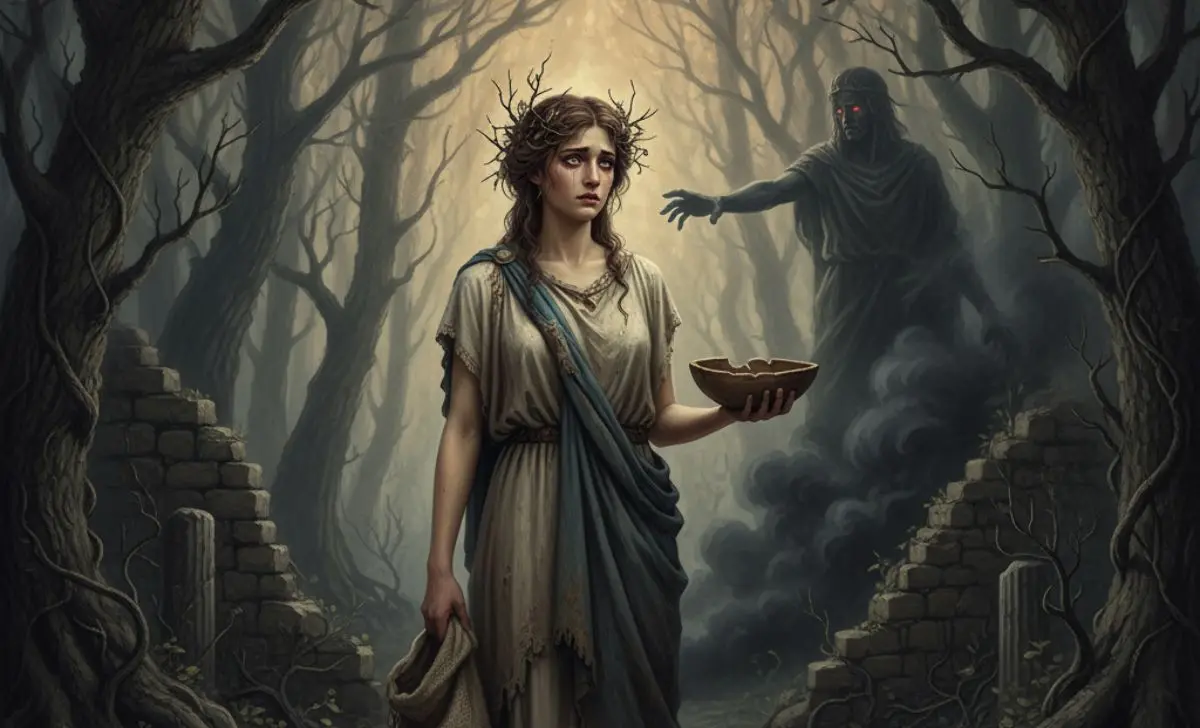
Erysichthon’s appetite, born from divine wrath, finally consumed what little humanity he had left. As Mestra returned one day in yet another guise, she found her father’s grand palace hollow and echoing with decay. On the floor lay his emaciated body—he had eaten himself, driven to madness by insatiable need.
For the first time, the relentless hunger had met its silent end.
Mestra’s Liberation
As Mestra gazed upon her father’s remains, she felt no triumph—only release. She was no longer the daughter of a cursed king or the victim of divine retribution. The cycle of hunger, greed, and exploitation ended with Erysichthon’s death. With her ability to change form at will, Mestra could now live unbound by anyone’s desires or expectations.
Her story, though steeped in tragedy, becomes a symbol of resilience and autonomy. Mestra took the pain forced upon her—her father’s betrayal, Poseidon’s violation, the gods’ indifference—and transformed it into power. She became the embodiment of adaptability, a living testament that even amid ruin, one can redefine their fate.
Legacy of Mestra
In ancient myth, Mestra’s tale reflects the consequences of unchecked arrogance and divine punishment. Yet at its core, it is her transformation—from victim to survivor—that endures. She stands as one of mythology’s earliest figures of independence, deftly navigating a world ruled by gods and men who sought to control her.
While her father perished trapped in his own appetite, Mestra’s hunger was of a different kind—a hunger for freedom, purpose, and self-reinvention. And unlike her father’s, it was one that could finally be satisfied.