
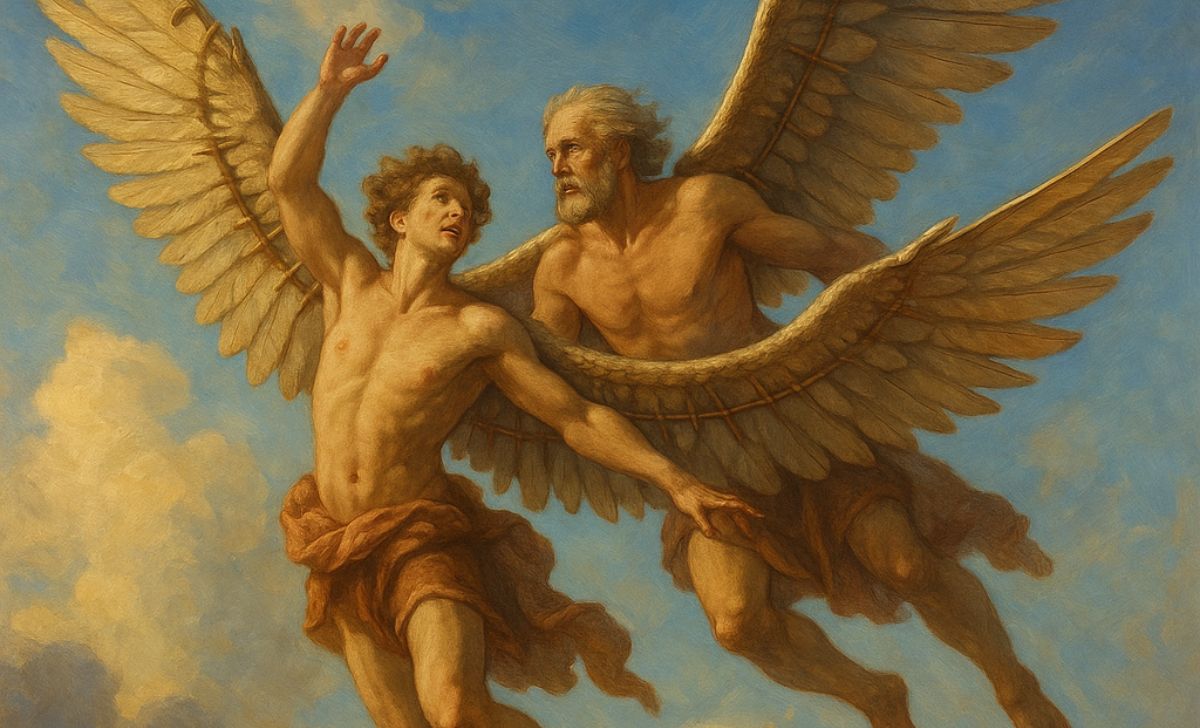
In the world of ancient Greek mythology, the tale of Icarus and Daedalus stands as a haunting reminder of the dangers of unchecked ambition and the thin line between brilliance and pride. This story, which begins with invention and hope, ends with loss and bitter regret. Let’s explore The Tragic Story of Icarus and Daedalus, whose fatal flight became one of mythology’s most iconic cautionary tales.
Daedalus: The Brilliant Mind with a Fatal Flaw
Long before Icarus took to the skies, his father, Daedalus, was a celebrated figure in Athens. Known for his unmatched skill in invention, architecture, and sculpture, Daedalus changed the world around him. He is credited with inventing carpentry and all its tools, crafting lifelike statues that even Hercules mistook for living men, and creating the first public bathhouse and dance floor.
But Daedalus’s genius came with a dark side. He was proud, possessive of his craft, and unable to bear competition. When he noticed that his nephew was beginning to surpass him in skill, jealousy consumed him. Rather than nurture the young talent, Daedalus murdered him in cold blood. That act led to his exile from Athens, forever changing the course of his life.
A New Home in Crete and a Dangerous Task
After his banishment, Daedalus fled to the island of Crete. There, King Minos welcomed him with open arms, eager to harness the talents of the famed inventor. Daedalus did not disappoint—he created animated mechanical toys for the king’s children and even invented the ship’s sail and mast, empowering humans to harness the wind.
But Daedalus’s ambition knew no bounds. When Queen Pasiphaë, under a cruel curse from Poseidon, fell in love with a majestic bull, she asked Daedalus to help her act on this unnatural obsession. He agreed. With shocking audacity, he designed a hollow wooden cow so realistic that it fooled the bull. The result was the birth of the Minotaur—a monstrous half-human, half-bull creature.
King Minos was horrified and furious. Though Pasiphaë had been cursed, it was Daedalus’s invention that made the unnatural union possible. As punishment, Minos ordered Daedalus to construct a massive labyrinth beneath the palace to house the creature. Once the maze was complete, Minos did something even more cruel—he imprisoned Daedalus and his young son Icarus in a tall tower on the island, condemning them to a lifetime of isolation.
Dreaming of Freedom: The Invention of Wings
Daedalus, despite his confinement, never stopped observing the world. From his tower, he watched birds soar across the sky, free and unbound. And from their flight, he found inspiration.
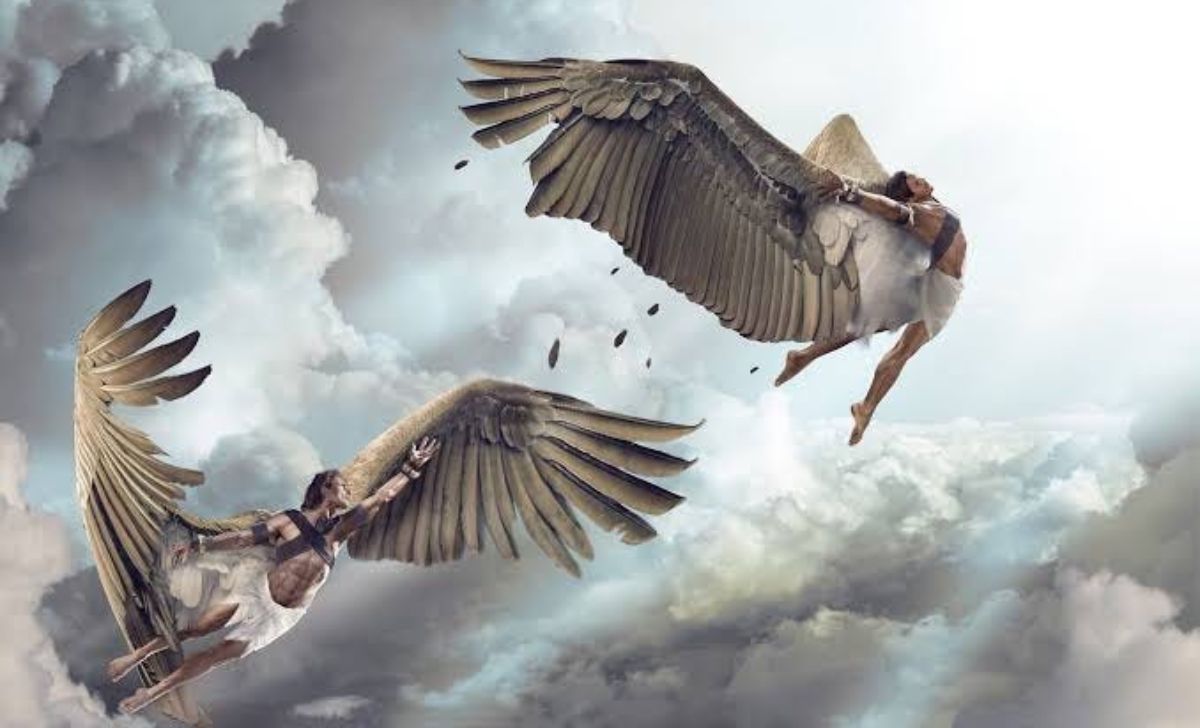
Using feathers from the birds that perched on the tower and wax from candles, Daedalus began crafting wings—two pairs, one for himself and one for Icarus. When they were complete, he carefully strapped them onto his son’s back. But before they took flight, he issued a critical warning: fly neither too high nor too low. If they flew too close to the sea, the moisture would weigh the wings down. Too close to the sun, and the heat would melt the wax. Their survival depended on maintaining a middle course.
With those words, the two launched themselves from the tower. For the first time in history, mortals flew.
The Ecstasy of Flight and the Fall of Icarus
At first, everything went according to plan. Daedalus maintained his careful path through the sky, steady and focused. But Icarus—young, exhilarated, and drunk on the sheer joy of flying—felt something else. As he climbed higher and higher, the world below shrank. He felt invincible, like a god.
From the ground, those who saw him marveled at the boy soaring above, believing he might be divine. And perhaps in that moment, Icarus believed it, too. He forgot his father’s warning. He forgot his own limits.
The sun blazed above him, merciless and bright. As he rose toward it, the heat began to melt the wax that held his wings together. One feather slipped, then another, until his wings were nothing more than loose sticks and tufts of down.
Icarus plummeted from the sky.
Daedalus, helpless and horrified, watched his son fall to his death—lost to the sea below.
Hubris and Regret: The Moral of the Myth
The story of Icarus is not just about flight—it’s about hubris, that classic Greek concept of excessive pride or self-confidence that invites downfall. In many ways, Icarus was simply echoing the behavior of his father. Daedalus had, time and again, pushed the boundaries of nature and morality—from constructing lifelike statues, to assisting in Pasiphaë’s unnatural desire, to inventing wings that imitated the divine.
But while Daedalus had the wisdom of experience, Icarus had only the thrill of possibility. He didn’t see danger—he saw freedom. He didn’t feel fear—he felt power.
Both paid the price. Icarus lost his life. Daedalus, his brilliant mind and hands now stained with grief, carried the weight of his decisions forever. The joy of flight, born from genius, ended in sorrow because neither father nor son heeded the importance of balance and moderation.
Why the Tale Still Matters
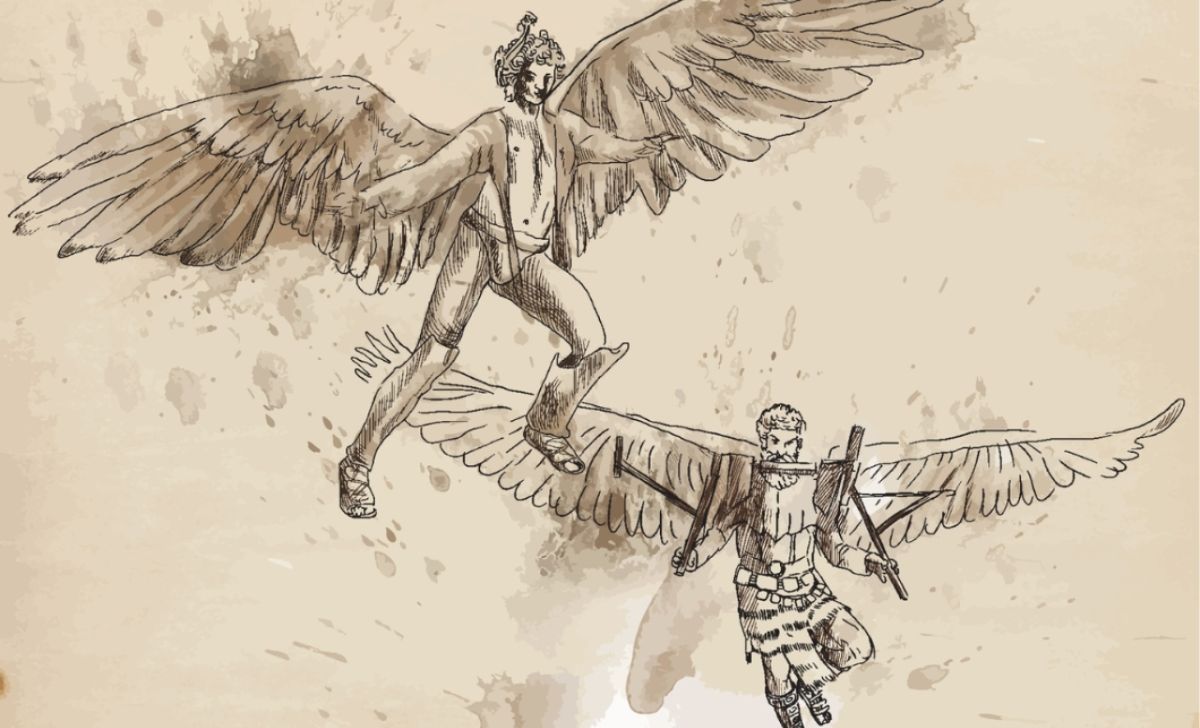
The myth of Icarus and Daedalus has echoed through the centuries because its message is timeless. It warns against arrogance and reminds us that brilliance without humility can be dangerous. It also shows us how the actions of one generation can ripple into the next, bringing unforeseen consequences.
In Daedalus, we see a mind that challenged gods and changed the world, but also a man whose ego led to destruction. In Icarus, we see the youthful dreamer—full of wonder, blind to risk, and undone by his own soaring ambition.
Their story lives on as a symbol of what happens when we ignore the balance between aspiration and restraint, reminding us all to fly—but never too high.