

It’s strange to think that something as ordinary as summer heat or winter cold traces back to a moment of utter chaos billions of years ago. Before there were oceans, before land hardened into continents, before life had any chance of existing, Earth was struck by another world.
This wasn’t a gentle bump. It was a catastrophic collision—one powerful enough to melt the planet’s surface and permanently change how Earth moves through space. That single event shaped not only the Moon in our sky but also the very rhythm of our lives. The seasons we take for granted, the climate patterns that allow crops to grow, and even the long-term survival of life itself all stem from that ancient impact.
To understand why, we need to talk about Earth’s tilt—and why it matters far more than it sounds.
A Young Earth Meets a Violent Visitor
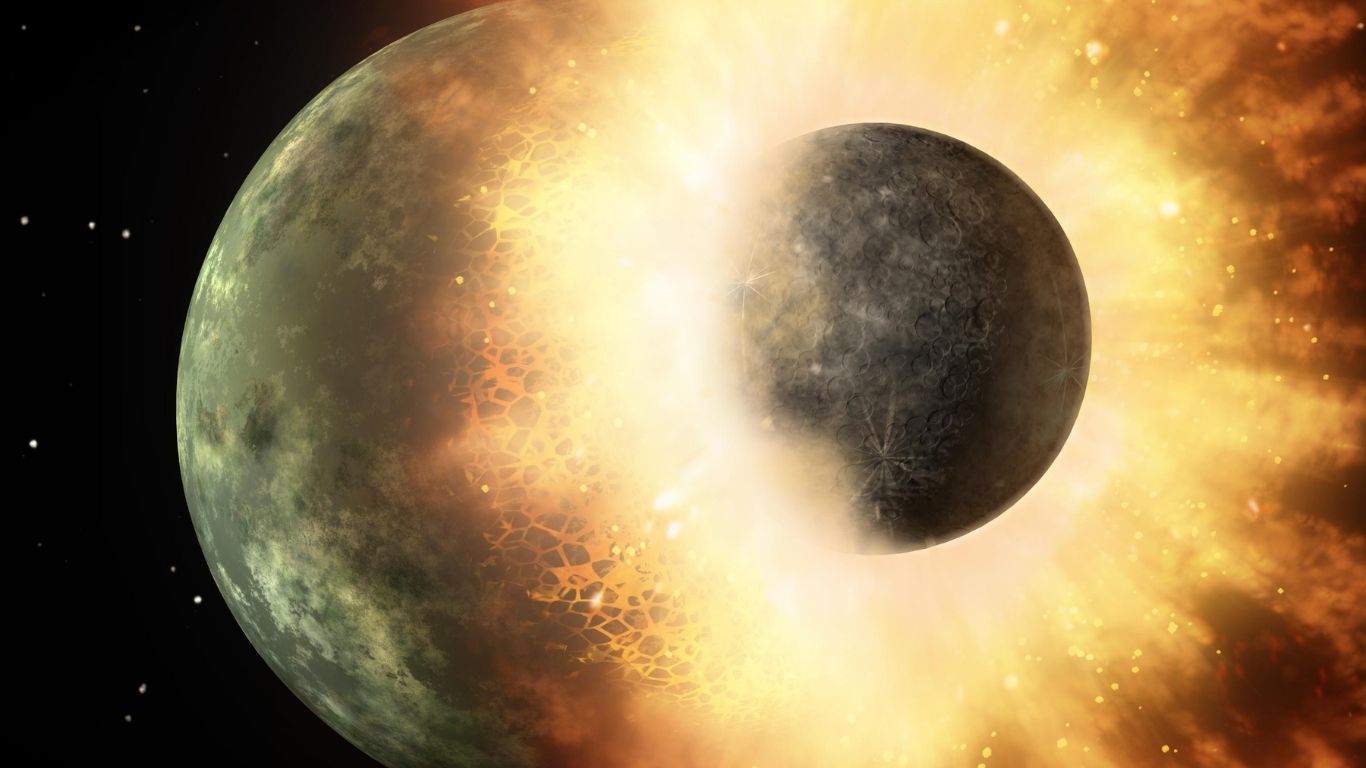
Around 4.5 billion years ago, the solar system was still settling into place. Planets were forming, drifting, and frequently colliding. Earth was young and unstable, still gathering mass and heat, when it was struck by a massive object roughly the size of Mars.
The impact was devastating. The force released was so intense that huge portions of both bodies vaporized instantly. Earth’s surface became a global ocean of molten rock, glowing with heat. Debris from the collision was flung into space, forming a swirling cloud around the planet.
Over time, gravity pulled that debris together. Bit by bit, it clumped into a single body—the Moon.
But the Moon wasn’t the only lasting result of this collision. Earth itself was changed. The impact knocked the planet off balance, leaving it spinning at a slight angle instead of upright. That tilt never went away.
Earth’s Axis: A Quiet Detail With Enormous Consequences
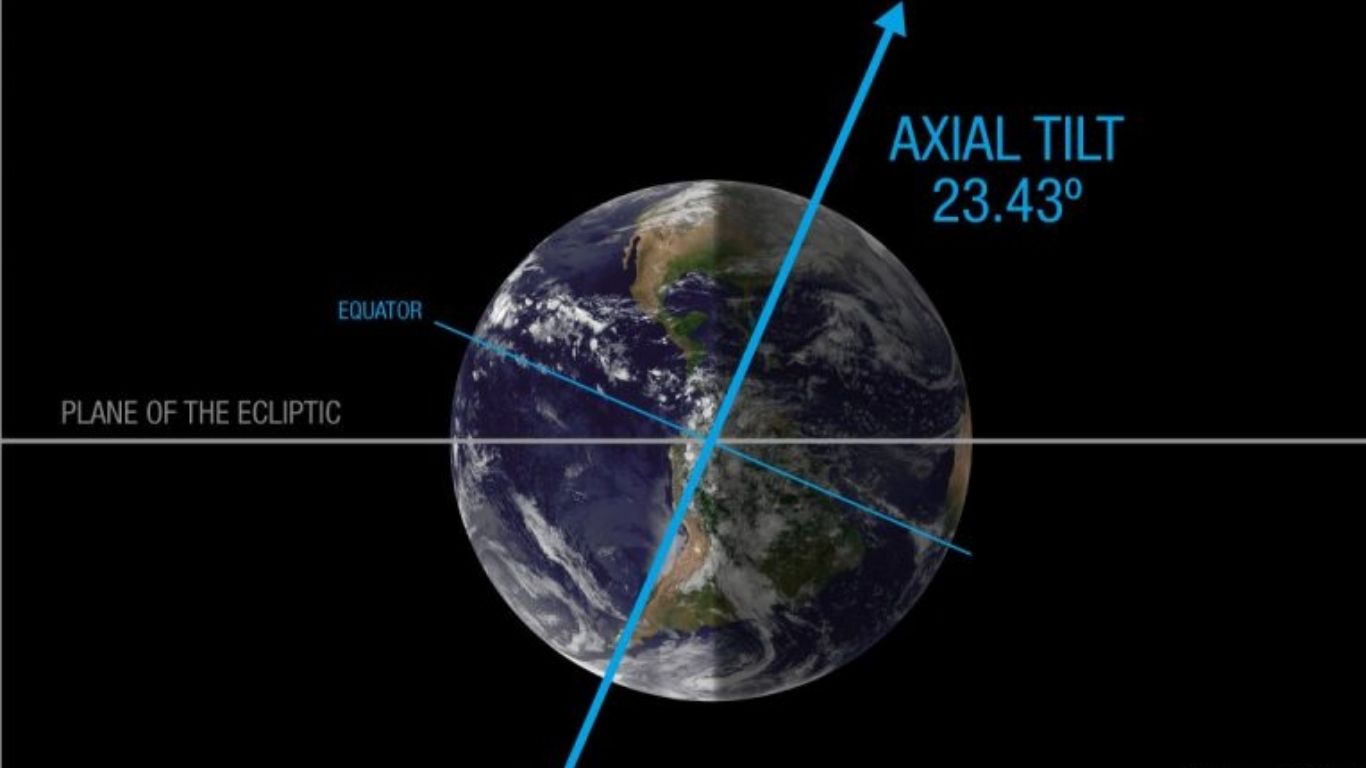
Every spinning object rotates around an axis—an invisible line running through it. For Earth, that axis passes through the North and South Poles. Once every 24 hours, our planet completes a full rotation, giving us day and night.
What makes Earth special is that its axis isn’t straight up and down. Instead, it leans at about 23.5 degrees relative to its orbit around the Sun. Scientists call this angle Earth’s obliquity, but most of us just know it as “the tilt.”
At first glance, 23.5 degrees doesn’t seem dramatic. It’s easy to imagine that such a small angle couldn’t matter much. But on a planetary scale, that lean changes everything.
Without it, Earth would still orbit the Sun. It would still rotate. But it would be a far harsher and more monotonous world.
Why Tilt Changes How Sunlight Behaves
To understand why Earth’s tilt matters, picture shining a flashlight onto a table. When you point it straight down, the light is concentrated and bright. When you tilt the flashlight, the same light spreads over a larger area and becomes weaker.
Sunlight behaves the same way.
On a spherical planet, sunlight never hits every location equally. The equator always gets more direct light than the poles. But tilt adds a layer of motion to this system. It causes different parts of the planet to receive more or less sunlight at different times of the year.
That shifting pattern of light is the reason seasons exist.
How Earth’s Lean Creates the Seasons We Know
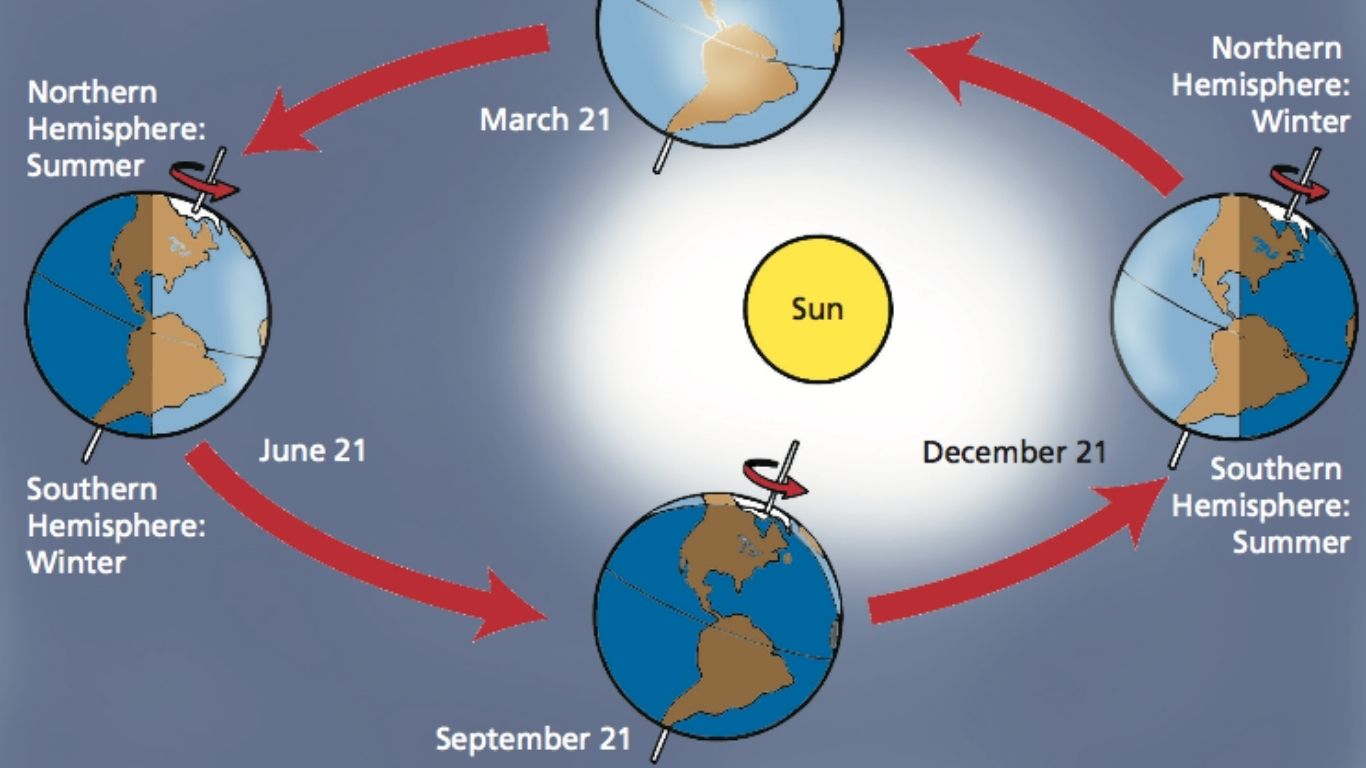
As Earth travels around the Sun, its axis keeps pointing in the same direction in space. This means that for part of the year, the Northern Hemisphere leans toward the Sun. Sunlight hits it more directly, days become longer, and temperatures rise. This is summer.
Half a year later, the Northern Hemisphere leans away from the Sun. The sunlight arrives at a shallower angle, spreads out, and delivers less warmth. Days shorten, temperatures fall, and winter takes over.
At the same time, the Southern Hemisphere experiences the opposite cycle. When it’s summer in the north, it’s winter in the south.
This back-and-forth pattern feels natural to us because we’ve lived with it our entire lives. But it exists only because Earth spins at an angle.
The Moon’s Quiet Role as Earth’s Stabilizer
Earth’s tilt isn’t frozen in place. Like a spinning top, the planet wobbles slightly over long periods of time. What keeps that wobble from becoming extreme is the Moon.
The Moon’s gravity acts like a stabilizing anchor, preventing Earth’s axis from swinging wildly. Without the Moon, Earth’s tilt could vary dramatically—possibly shifting from almost no tilt to extreme angles over millions of years.
Such instability would create chaotic climate changes. Seasons could become unpredictable or disappear entirely for long stretches of time. The relative climate stability that allowed complex life to evolve might never have existed.
In that sense, the Moon isn’t just a companion in the night sky. It’s a silent guardian of Earth’s long-term balance.
Earth’s Tilt Is Stable—but Not Perfectly Still
Although Earth’s tilt is remarkably steady, it does change slightly over time. Over a cycle lasting about 41,000 years, the tilt gently shifts between roughly 22.1 degrees and 24.5 degrees.
These changes may seem tiny, but their effects are surprisingly large.
When Earth’s tilt is closer to the higher end of that range, seasons become more intense. Summers grow hotter, winters grow colder, and temperature differences between regions soften slightly.
When the tilt decreases, seasons become milder—but the climate contrast between the equator and the poles increases. Polar regions receive less summer sunlight, making it harder for ice to melt.
The Link Between Tilt and Ice Ages
For much of Earth’s recent geological past, ice ages followed this 41,000-year rhythm closely. Lower tilt meant cooler polar summers, allowing snow and ice to linger year after year. Over time, massive ice sheets formed, spreading across continents.
Higher tilt reversed the process. Warmer summers melted ice, ending glacial periods and returning the planet to a warmer state.
In the past million years, ice age cycles have grown more complex, influenced by ocean currents, atmospheric chemistry, and the sheer size of existing ice sheets. Even so, Earth’s obliquity remains a key player in long-term climate change.
Imagining a World Without a Tilt
Now imagine Earth without its tilt at all.
No lean. No seasonal shift. Just a planet spinning upright as it orbits the Sun.
In this scenario, the Sun would hover over the equator year-round, blasting tropical regions with constant, intense heat. Meanwhile, the poles would receive only weak sunlight, never experiencing a true summer.
Ice at the poles would never fully melt.
Over time, ice sheets would expand. Ice reflects sunlight, so as it spread, Earth would absorb less heat. That cooling would allow even more ice to form, reinforcing the process. Eventually, the planet could become locked in a deep freeze—a global ice-covered world.
Scientists can’t say exactly how such a scenario would unfold, but we already know one important fact: reducing Earth’s tilt by just two degrees can help trigger an ice age. Removing it entirely would push the planet into unknown and likely extreme territory.
Why Seasons Matter More Than We Realize
Earth’s tilt doesn’t just shape weather—it shapes life.
Seasonal cycles regulate plant growth, animal migration, and breeding patterns. Ecosystems rely on predictable changes in temperature and daylight. Human agriculture depends on seasonal rhythms, from planting to harvest.
Even human culture—holidays, traditions, and daily routines—is deeply tied to the cycle of the year.
A world without seasons would demand entirely different forms of adaptation. Life might still exist, but it would face far greater challenges maintaining balance and diversity.
A Violent Accident That Made Life Possible
There’s something humbling about realizing that one of Earth’s most life-friendly features came from an act of pure cosmic violence. The collision that tilted our planet was random, destructive, and chaotic.
Yet from that chaos came the Moon, the seasons, and a climate system stable enough to support life for billions of years.
Earth wasn’t carefully designed. It was shaped by chance—and that chance happened to work out extraordinarily well.
Gratitude for a Cosmic Mistake
Every warm summer afternoon and every crisp winter morning carries the legacy of that ancient impact. Earth’s 23.5-degree tilt quietly governs the patterns we rely on, rarely drawing attention to itself.
It’s easy to forget how fragile that balance is—or how different things could have been.
So the next time the seasons change, it’s worth remembering that they exist because a wandering rock once slammed into a young planet and knocked it slightly off-center.
That small, accidental tilt turned a molten world into a living one.