
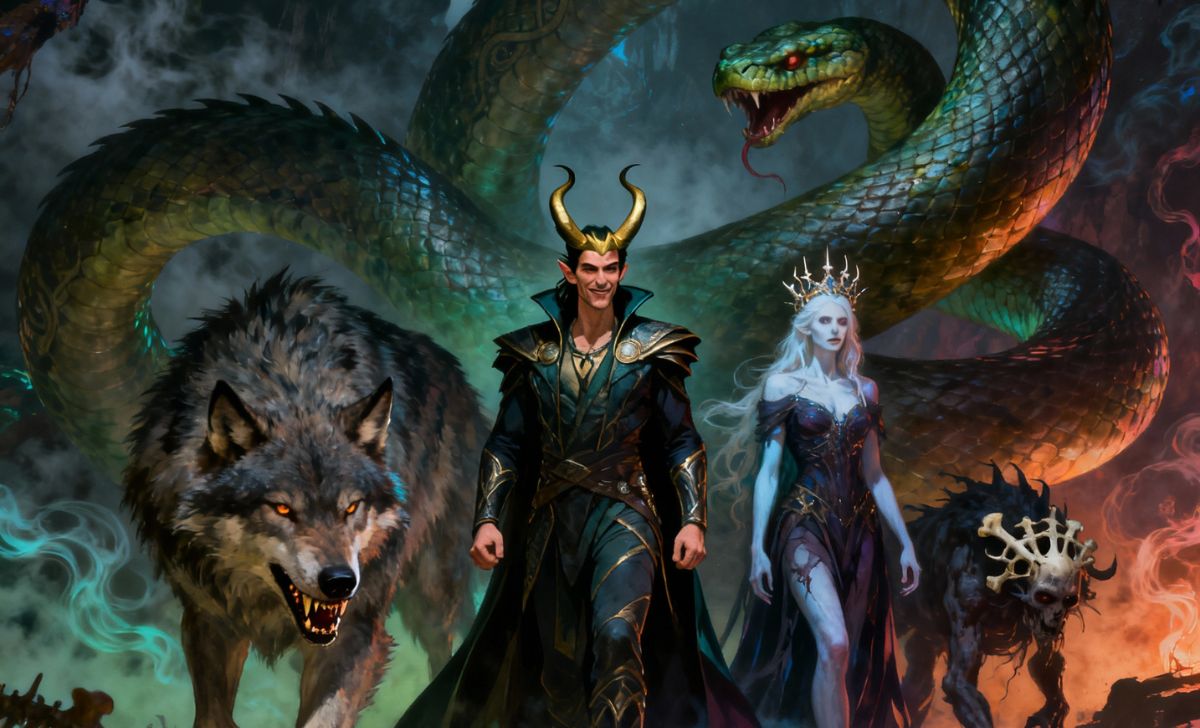
In Norse mythology, fate is an unstoppable force—even for the gods themselves. Odin, the all-father and ruler of Asgard, spent much of his life trying to outwit destiny, but his greatest fears always found ways to manifest. At the heart of these fears lay Loki, the trickster whose complicated bloodline brought about Asgard’s gravest threats. The story of Loki’s monstrous children—Jörmungandr, Hel, and Fenrir—captures the tension between destiny and desperation, friendship and betrayal, and power and doom.
Odin’s Nightmares Begin
The tale begins with Odin haunted by visions. Night after night, three terrifying images plagued his sleep: a writhing serpent, a rotting corpse, and a monstrous wolf with a deadly bite. Their identities remained hidden, but Odin sensed their roots lay in Asgard’s most troublesome figure—Loki. Despite his life in Asgard with his wife and sons, Loki continued to interact with giants, particularly the giantess Angrboda. Their union bore three children whose existence shook Odin to his core.
To understand his dreams and prevent a dark future, Odin commanded Thor, the God of Thunder, and Tyr, the courageous war god, to seek out Loki’s children in Jotunheim.
The Capture of Loki’s Children
When Thor and Tyr arrived at Angrboda’s dwelling, they faced each child in turn.
- Jörmungandr, the firstborn, met them with fangs dripping venom. Thor acted quickly, dodging the strikes and binding the serpent to a pine tree. Yet even in its youth, Jörmungandr’s sheer power was evident.
- Hel, the second child, was unlike anything seen before—half of her body appeared as a radiant young woman, while the other half resembled rotting flesh. Silent and solemn, she followed her captors without resistance, leaving flakes of decayed skin behind as she walked.
- Fenrir, the youngest, came as a small wolf cub. Though fierce, he was still manageable. Tyr playfully disarmed its claws and tucked the pup away, not yet realizing the wolf’s destiny would carve scars into both their lives.
When the three were presented to Odin, he recognized immediately that these were no mere creatures, but the embodiment of his dreaded dreams.

The Fates of Jörmungandr and Hel
Odin wasted no time deciding their fates.
- Jörmungandr was hurled into the farthest reaches of the sea. There, the serpent would grow so immense it eventually encircled the entire world, earning the name “Midgard Serpent.”
- Hel was cast into the underworld, a realm that would become her kingdom. With her dual form of beauty and decay, she rose as the ruler of the dead, her authority spanning across all who perished outside Asgard’s halls.
These decisions removed two threats from Asgard, but the third child, Fenrir, presented a more complicated problem.
Raising the Wolf
Fenrir was no ordinary wolf. He grew quickly and possessed not only raw strength but intelligence rivaling the gods themselves. Odin, wary of what Fenrir might become, tried to contain the beast while keeping him under close supervision. Tyr, however, felt compassion toward the wolf. He often spent time with Fenrir, sparring playfully, speaking as equals, and forging trust where Odin only saw danger.
Yet as Fenrir grew from a cub into a beast of enormous strength, Odin could not ignore his unease. The wolf’s very presence seemed to fulfill his nightmares.
The Chains and Trials
Odin attempted to shackle Fenrir, presenting it as a challenge of strength.
- First, Odin tried heavy chains of ordinary metal. Fenrir broke free effortlessly, tearing them apart like kindling.
- Next, Odin forged shackles that no mortal could lift. Even then, Fenrir shattered them into fragments, proving the futility of Odin’s efforts.
- Desperate, Odin turned to the dwarves, the finest craftsmen in all realms. Rather than forge with steel, they gathered the rarest elements: the sound of a cat’s footsteps, the roots of a mountain, the beard of a woman, the breath of a fish, and the sinew of a bear. From these impossibilities, they wove Gleipnir—a silken ribbon that concealed unimaginable strength.
This final test, however, awakened Fenrir’s suspicion. He sensed deception, and so he proposed terms: he would only consent if one god placed their hand in his mouth as a pledge of trust.
Tyr’s Sacrifice
Bound by loyalty to both Odin and Fenrir, Tyr stepped forward. He placed his hand inside the wolf’s jaws. This act sealed both friendship and betrayal in one stroke. As Fenrir strained, Gleipnir tightened, stronger than iron, unbreakable as fate. Realizing too late the gods had tricked him, Fenrir erupted in fury. He clamped down on Tyr’s hand, severing his wrist in both agony and vengeance.
The wolf howled with rage. His roar split the skies, his saliva spilling into a furious river, and he vowed to bring ruin upon Odin and all of Asgard.

Victory or Inevitable Doom?
Odin celebrated the so-called victory over Fenrir, believing his nightmare contained. But the seeds of his downfall had already been planted. For every effort he made to avoid fate, he set fate more firmly into motion.
- Beneath the waves, Jörmungandr continued to grow, coiling around the world.
- In the underworld, Hel spread her dominion, becoming a sovereign of shadows.
- And in Asgard, Fenrir strained endlessly against Gleipnir, each day drawing closer to breaking free.
In the end, Odin’s fear ensured Ragnarok, the great battle of the end times. His attempts to master destiny only bound him tighter to it.
The Legacy of Loki’s Children
The story of Odin and Loki’s children is not simply one of monsters and gods. It is an allegory on the futility of running from fate. Odin sought to control destiny through action, trickery, and foresight, yet his interference gave strength to the very nightmares he hoped to prevent.
Loki’s offspring—Jörmungandr, Hel, and Fenrir—were not merely terrors but natural forces: the sea, death, and chaos. By casting them out and binding them, Odin fractured the balance, ensuring those forces would rise in fury when Ragnarok came.