
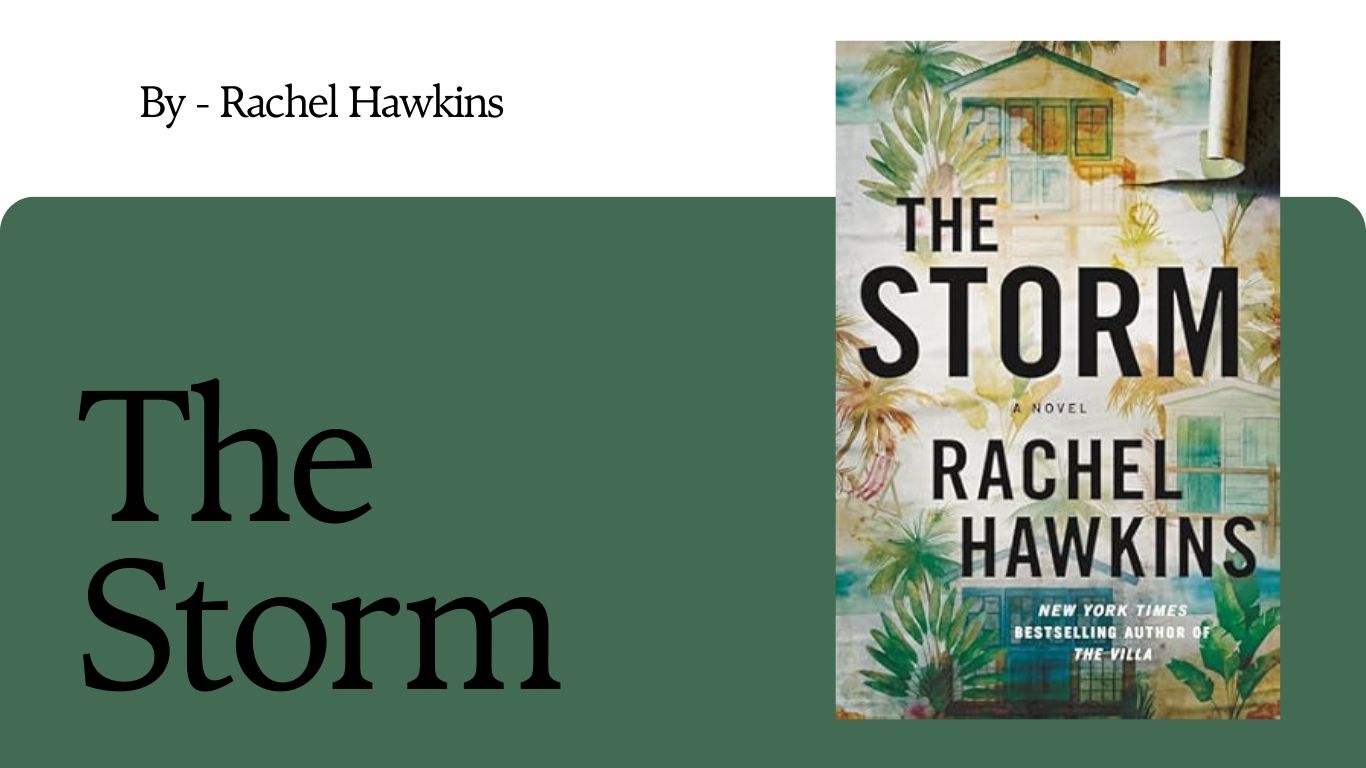
The Storm by Rachel Hawkins is a moody, character-driven thriller that leans heavily into atmosphere, fractured relationships, and the unsettling feeling that danger doesn’t always arrive with warning—it can creep in quietly, carried by old resentments and half-buried truths. Set against a storm-lashed backdrop, the novel explores how the past refuses to stay silent, no matter how carefully it’s buried. This is not a book that rushes to its twists. Instead, it pulls you in gradually, letting tension build through setting, psychology, and uneasy silences. Hawkins proves once again that her strength lies in blending emotional realism with suspense, making the threat feel intimate rather than sensational.
Hurricanes, Secrets, and One Very Unlucky Inn
The story is set in St. Medard’s Bay, Alabama, a small coastal town that knows hurricanes all too well. At the center of it all sits the Rosalie Inn—a century-old hotel that has somehow survived every major storm that’s torn through the area. The building feels cursed and blessed in equal measure, which is exactly the vibe of the book itself.
Geneva Corliss, the inn’s current owner, is barely holding things together. The business is struggling, her long-term relationship has fallen apart, and she’s quietly dealing with her mother Ellen’s fading memory. Geneva isn’t dramatic or flashy—she’s tired in a way that feels very real, the kind of tired that comes from being responsible for too much for too long.
Things shift when August Fletcher, a true crime writer, checks into the inn. He’s researching an infamous unsolved murder from 1984, and Geneva can’t help seeing dollar signs. True crime attention could be exactly what the Rosalie needs to survive.
Then August brings along a surprise.
Lo Bailey.
For forty years, Lo has been known as that woman—the one accused of killing Landon Fitzroy, the governor’s son. She was never convicted, but the town never forgave her either. Now she’s back, older, sharp-tongued, and claiming she’s finally ready to tell her side of the story.
Geneva is caught in the middle almost immediately. Is Lo here for justice? Closure? Or something much darker?

A Story Built in Layers, Not Lines
One of the most satisfying things about The Storm is how it’s structured. The story doesn’t move neatly from Point A to Point B. Instead, it unfolds in layers.
You get present-day chapters following Geneva as Lo’s return disrupts everything. You’re taken back to the summer of 1984, when friendships were messy, emotions were raw, and Landon Fitzroy was still alive. And woven through it all are letters, news clippings, interview transcripts, and manuscript excerpts that slowly fill in the gaps.
This kind of mixed-media storytelling can feel gimmicky when it’s done badly. Here, it works. Every piece adds tension or context, and nothing feels wasted. Instead of dumping information on the reader, Hawkins lets the truth emerge gradually, often in uncomfortable ways.
It feels less like reading a straight thriller and more like assembling a puzzle where some pieces don’t quite fit until the very end.
The Rosalie Inn and the Power of Place
The Rosalie Inn isn’t just a setting—it’s practically a living thing. You can feel the humidity in the walls, smell the salt in the air, and sense the weight of everything that’s happened there.
Hawkins is especially good at using weather as more than background noise. The hurricanes—Daphne, Audrey, Marie, and the looming Lizzie—mark turning points in the characters’ lives. Each storm brings destruction, but also revelation.
The symbolism is obvious, sure—but it works. The book quietly reminds you that people can be just as devastating as nature, especially when secrets are protected for the sake of power or reputation.
Lo Bailey: Unlikable, Unforgettable, Unavoidable
Lo Bailey is a character who dares you to make up your mind about her—and then refuses to let you.
Now in her sixties, she’s magnetic, sharp, and deeply unsettling. You understand immediately why people were drawn to her decades ago, and you also understand why they feared her. She’s charming in a way that feels practiced, self-aware in a way that may or may not be genuine.
Is she telling the truth? Is she rewriting history? Is she capable of murder—or just surviving in a world that decided her guilt long ago?
What makes Lo work is that Hawkins never forces an answer. You’re allowed to be suspicious, sympathetic, repelled, and fascinated all at once. That ambiguity is the point.
Geneva: Quietly Holding It All Together
If Lo is the storm, Geneva is the shoreline trying to endure it.
She’s not a flashy protagonist, and that’s exactly why she works. She’s exhausted, cautious, and constantly questioning her own instincts. Her connection to Lo—part curiosity, part attraction, part unease—feels messy and honest.
Geneva’s relationship with her mother adds another emotional layer, especially as long-buried truths begin to surface. Watching her realize that the past she grew up believing might not be the full story is genuinely affecting.
By the end, you care deeply about what happens to her—not because she’s heroic, but because she feels real.
The Pacing: Blink and It’s Midnight
Despite multiple timelines and a large cast, The Storm moves fast. It never feels confusing, just deliberate. Hawkins knows exactly when to withhold information and when to let something slip.
The approaching Hurricane Lizzie creates a ticking clock that works both literally and emotionally. As the storm draws closer, so do the consequences of long-hidden decisions.
This is absolutely a “just one more chapter” book—and then suddenly you’re done and wondering how it’s so late.
Twists, Truths, and Moral Gray Areas
Some twists will surprise you. Others you might see coming. But even when you suspect where things are headed, the why still hits hard.
The truth about Landon Fitzroy’s death isn’t neat or comforting. It’s tangled up in privilege, power, gender, and loyalty—the kinds of forces that allow certain people to be protected while others are sacrificed.
Hawkins doesn’t offer easy answers, and that’s what makes the ending satisfying. This isn’t a puzzle that clicks into place—it’s a mess you finally understand.
A Few Things That May Not Work for Everyone
If you prefer tight, procedural mysteries with clear heroes and villains, this may feel a bit indulgent. The drama leans soap-opera-adjacent at times, and the shifting timelines require attention.
There’s also a subtle romantic thread that adds emotional complexity, though some readers may feel it isn’t essential to the mystery itself.
Why This Book Stays With You
The Storm isn’t just about a murder—it’s about memory, blame, and the cost of silence. It’s about how communities protect themselves by choosing who to believe. And it’s about women who refuse to stay neatly categorized as victims or villains.
If you enjoy atmospheric thrillers, morally complex characters, and stories that linger after the last page, this one is absolutely worth your time.
Final Thoughts
The Storm is one of Rachel Hawkins’ strongest novels to date. It’s tense, moody, and emotionally sharp, with characters who feel uncomfortably real. This is a book you’ll want to talk about once you finish—and maybe even reread, just to catch what you missed the first time.
Rating: 4 to 4.5 out of 5 stars
Just don’t start it late at night unless you’re okay with losing sleep.