
The tale of the Sampo—one of the most mysterious artifacts in world mythology—is a cornerstone of the Finnish national epic, The Kalevala. It tells a story of power, greed, artistry, and the eternal struggle between creation and destruction. The Sampo saga begins not in glory, but in survival—on the stormy seas where Väinämöinen, the eternal sage of Kalevala, is pushed to his limits.
Shipwreck and the Land of the North
After eight relentless days battling the sea, Väinämöinen, exhausted and bruised by savage waves, was tossed ashore on the frozen coasts of Pohjola. Far from his lush homeland, he found himself among the icy dominion of Louhi, the formidable mistress of the North. Known as the “gap-tooth hag of the North,” Louhi was a cunning sorceress, feared and respected even among gods and heroes.
Nursing Väinämöinen back to health, Louhi did not offer her aid freely. In return for saving him, she demanded payment—but not in gold or precious metal. Louhi desired something that did not yet exist: the Sampo. This mythical device, destined to be a gateway to endless prosperity, symbolized creation itself. It was to be forged from impossible ingredients: the tip of a swan’s feather, the milk of a virtuous cow, a single barley grain, and the finest lamb’s wool.
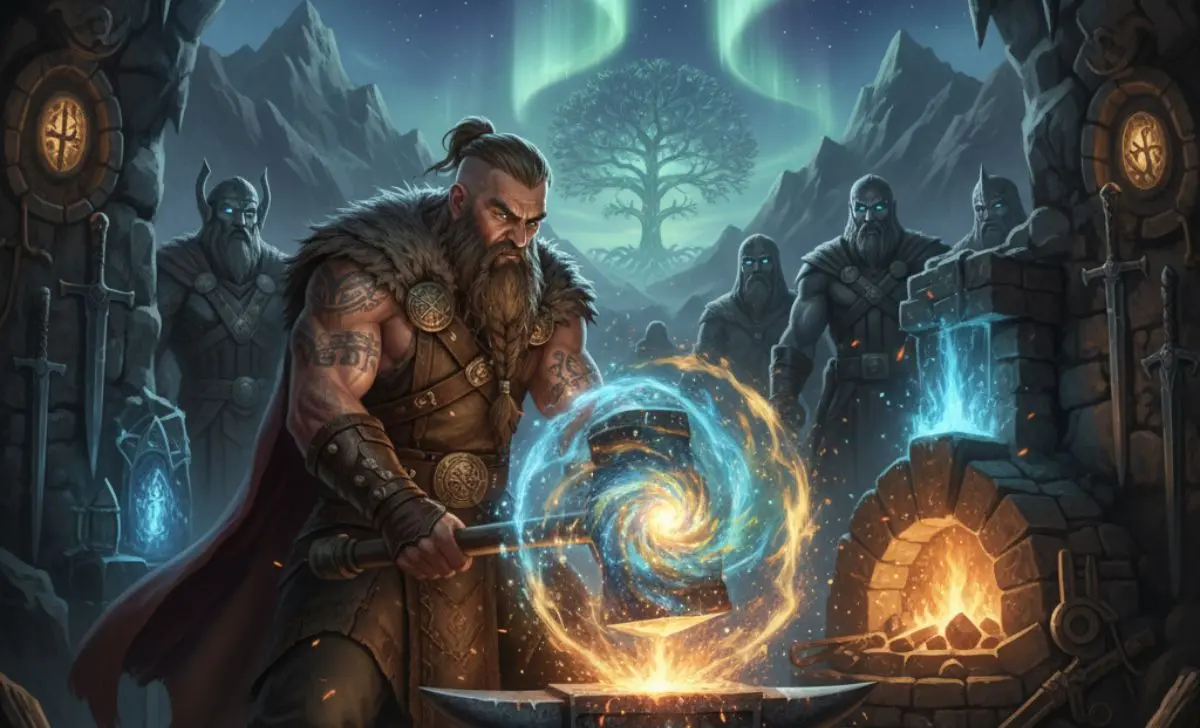
But Väinämöinen knew that only one being could craft such a wonder—Ilmarinen, the Eternal Hammerer, the blacksmith who once forged the very dome of the heavens.
The Trick and the Journey North
Väinämöinen promised Louhi the Sampo if she would let him return to Kalevala to fetch Ilmarinen. The witch agreed, and the bard set sail back home. Yet convincing the divine smith proved far harder than braving the seas. Ilmarinen had no desire to visit Pohjola, a land of witches and cannibals. He dismissed the bard’s plea outright.
But Väinämöinen, as wise as he was cunning, resorted to trickery. He lured Ilmarinen into climbing a mighty tree under a false pretense, then summoned powerful winds to carry the blacksmith off to the far North.
Battered but alive, Ilmarinen landed in Pohjola, captured now by destiny’s will.
The Forging of the Sampo
Louhi welcomed Ilmarinen lavishly, showering him with gifts and promises. Her greatest gift was temptation: the hand of her beautiful daughter, if he could forge the Sampo. The smith accepted and began his monumental task.
Days turned into nights as he stoked his celestial forge. But the fire birthed only restless artifacts—creations cursed by imbalance. A golden plow that ruined the fields it touched, a shining crossbow that thirsted for blood, and countless others that dazzled the eye but poisoned the world.
Refusing defeat, Ilmarinen called upon the North Wind, East, South, and West—bidding them to work his forge together. For three days and nights the anvil roared, until at last the miracle was complete. From the glowing heart of his furnace emerged the Sampo: a beautiful machine with a lid of many colors, decorated with the symbols of prosperity. One side milled grain, another salt, another gold—an endless fountain of life’s bounty.
Louhi rejoiced and swiftly hid her treasure deep within the mountain of Pohjola, sealing it behind rock and spell alike. But her promise faded as quickly as it was spoken. She denied Ilmarinen the fair maiden she had vowed to him, leaving him to return home empty-handed—his creation stolen, his heart embittered.

The Quest to Reclaim the Sampo
Years passed. Kalevala withered while Pohjola thrived on the Sampo’s abundance. Seeing this injustice, Väinämöinen swore to restore balance. He rallied Ilmarinen once more, joined this time by the daring hero Lemminkäinen. Together they sailed north to reclaim what was rightfully theirs.
Upon arriving, Väinämöinen appealed for peace, asking Louhi to share half the Sampo’s blessing. But greed, it seemed, ruled all hearts in Pohjola. Louhi refused, summoning her dark armies to crush the heroes.
Calmly, Väinämöinen reached for his kantele, a magic harp strung from the jawbone of a giant fish. As his fingers danced across the strings, the melody swept through the North like a dream. Soldiers, wolves, witches—all sank into enchanted sleep. Even Louhi’s heart slowed to its rhythm. Seizing the moment, the trio stole the Sampo and fled to their ship, hearts pounding with hope.
The Fall of the Sampo
For three days, the heroes sailed south in silence, their treasure safe in the hold. Väinämöinen warned his companions not to celebrate before they returned home. But pride is a dangerous flame. Lemminkäinen, consumed by joy, broke into song—his voice shattering the stillness of the sea.
His loud singing stirred a crane from the reeds, whose shrill cries echoed across the waters, revealing their escape. Awakened by the noise, Louhi unleashed her fury once more. She transformed into a monstrous eagle, her talons gripping warriors and shadows as she soared toward the trio’s ship.
A fierce battle erupted over the waves. Väinämöinen struck the sea with his runes, raising rocks to break their pursuer’s vessel. But in the chaos, Louhi seized the Sampo in her claw. The struggle tore it from her grip, and the artifact fell into the raging sea below. It shattered upon the cliffs, scattering its fragments across the ocean floor.
Though Louhi returned home defeated, the loss was bittersweet for all. Väinämöinen and his companions had denied her monopoly of power, but they too had lost the Sampo’s miraculous gift.
Still, Finnish legend says its remnants endure beneath the waves, grinding grain and salt in the domain of Ahti, the god of the sea. The oceans’ salinity, they say, is the last breath of the Sampo—forever turning, forever lost.
Legacy of the Sampo
The story of the Sampo is more than a myth—it is a reflection on human desire, creativity, and the fragile balance between them. Väinämöinen’s wisdom, Ilmarinen’s craft, and Louhi’s ambition represent the eternal triad of creation: intellect, skill, and hunger.
Yet the Sampo’s destruction reminds us that all power, no matter how divine, is destined to scatter back to the elements. Its myth endures not because of what it created, but because of what it taught—the cost of greed and the beauty of imperfection.