Most people who know the name Sisyphus know exactly one thing about him: he pushes a rock up a hill, and it rolls back down, and he has to do it again, forever. That’s the whole punchline. It sounds like the setup for a joke about office jobs or Mondays. But the actual story is older, stranger, and a lot more interesting than the meme version, and the philosophy that grew out of it — mostly thanks to one French writer in 1942 — turns the punishment into something closer to an instruction manual for living.
So let’s slow down and actually look at where this myth came from, what Sisyphus did to deserve his fate, and why a philosopher decided this miserable, eternal task was secretly the most honest image of human life he could find.
Who Sisyphus Actually Was
Long before he was a metaphor, Sisyphus was a king — the founder and ruler of Corinth, according to most Greek accounts, and by every description a man who was clever to the point of being dangerous. He wasn’t punished for a single dramatic crime the way Prometheus was punished for stealing fire. He was punished for a pattern of behavior: he was a trickster who kept outsmarting the gods themselves, and the gods, it turns out, do not enjoy being outsmarted twice.
The most famous version of his offense involves death itself. When Thanatos, the personification of death, came to chain Sisyphus and take him to the underworld, Sisyphus tricked him into demonstrating how the chains worked — and then snapped them shut on Thanatos instead. With death itself locked up, nobody on earth could die. Wars stopped meaning anything. Sacrifices to the gods stopped happening, because no one was dying to make way for them. Eventually Ares, unhappy that battle had lost its sting, freed Thanatos and handed Sisyphus over.
Even then, Sisyphus wasn’t finished. Before he died, he told his wife not to perform the usual funeral rites. When he arrived in the underworld, he complained to Persephone that he hadn’t been buried properly and begged to be allowed back to the world above just long enough to set things right. She agreed. Once back among the living, he simply stayed, refusing to return, living out the rest of a long life before death finally caught up with him for good.
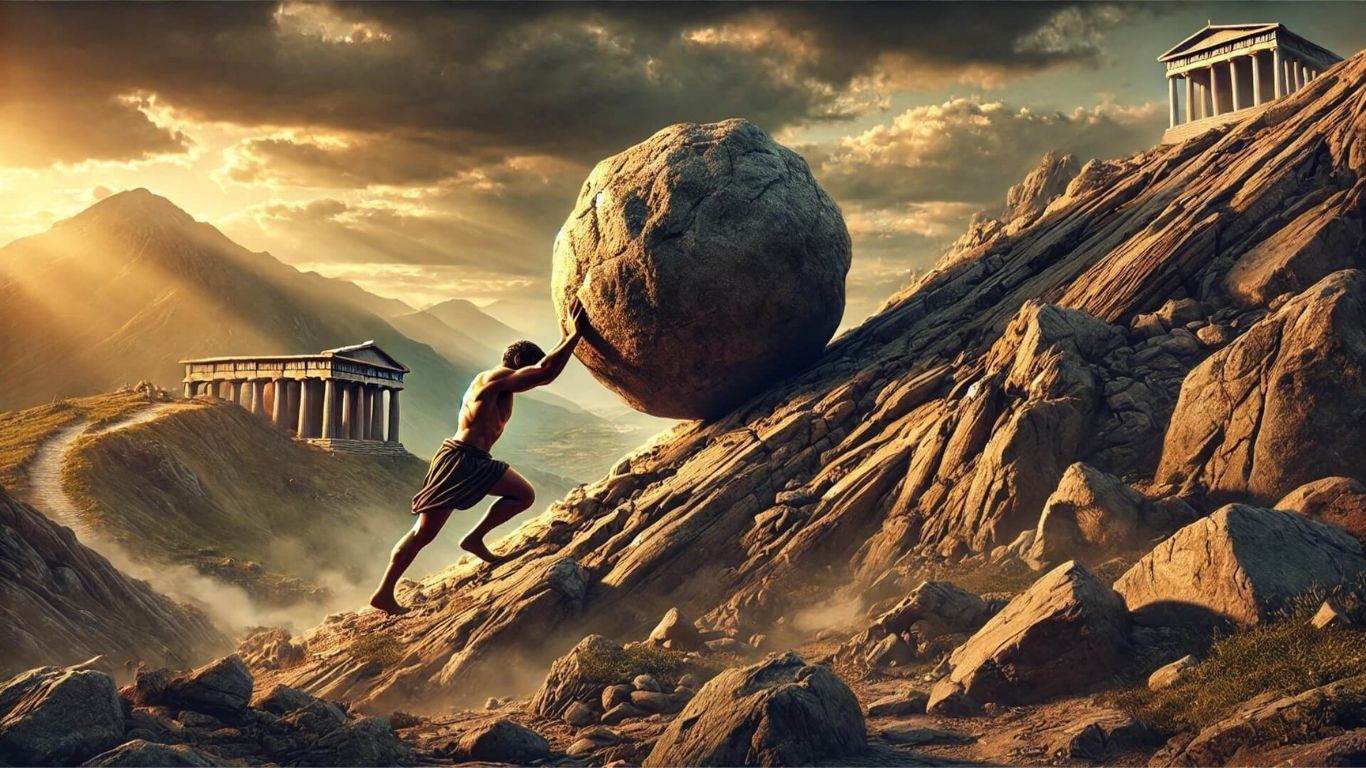
By the time the gods were done weighing his offenses, the verdict wasn’t death — he’d already cheated that twice. It was something worse: an eternity of labor with no possible finish line. He was made to roll a massive boulder up a mountain, and every time he neared the top, the stone would slip from his grasp and crash back down, and he would have to start again. Forever.

How a Punishment Became a Philosophy
For most of history, that was the whole story: a clever man, punished cleverly, doomed to pointless repetition. It stayed a cautionary tale about hubris — the Greek idea of overreaching pride that gets a person crushed by forces bigger than themselves.
Then, in 1942, the French-Algerian writer Albert Camus published a slim philosophical essay called The Myth of Sisyphus, and the rock has never looked the same since. Camus wasn’t interested in Sisyphus as a cautionary figure. He was interested in him as a mirror.
Camus opens the essay with one of the boldest lines in twentieth-century philosophy, arguing that there is only one truly serious philosophical question, and it is whether life is worth living at all. Everything else, he says, comes after that. He’s writing in the shadow of a world that has just watched two World Wars unfold, a world where old religious and philosophical certainties about meaning and purpose have started to feel hollow. Camus looks at that hollowness directly and gives it a name: the Absurd.
A working definition
For Camus, the Absurd isn't a feeling of meaninglessness sitting inside us, and it isn't a property of a cold, indifferent universe sitting outside us. It's the collision between the two — the gap between our deep human hunger for meaning, order, and clarity, and a universe that simply doesn't answer back.
We want reasons. We want the universe to explain itself. And it never does. That silence — that mismatch between the question and the missing answer — is the Absurd. And once you really see it, Camus argues, you can’t unsee it. The question becomes: now what? Once a person looks directly at the fact that the universe offers no built-in meaning, what stops them from concluding that nothing matters, and that suicide is therefore a reasonable response? This is the actual stakes of the essay, and it’s why Camus calls it the one serious philosophical question.
Sisyphus as Camus Saw Him
This is where Sisyphus walks back into the story. Camus uses him as the perfect image of the absurd hero — not because he triumphs over his task, but because of exactly how he fails at it, forever, with full awareness.
Picture the moment that interests Camus most. It isn’t the straining uphill push. It’s the walk back down. After the boulder slips and crashes to the bottom, Sisyphus has to walk down the mountain to retrieve it, and in that walk, there is no task to perform, no muscle to strain, nothing to distract him. He is fully conscious, in that descent, of exactly what’s coming next: the same impossible climb, again, forever. Camus calls this the hour of consciousness, and argues that it’s during this walk down that Sisyphus is either superior to his fate, or he is wretched. The rock doesn’t decide which. He does.
“The struggle itself toward the heights is enough to fill a man’s heart. One must imagine Sisyphus happy.”
— the closing idea of Camus’s essay, paraphrased
That final image is the one people remember, and it’s also the one most often misunderstood. Camus isn’t saying Sisyphus is happy because he’s found some secret meaning hidden in the task, and he isn’t saying the suffering doesn’t count. He’s making a stranger, more radical claim: that meaning was never the prerequisite for a worthwhile life in the first place. Sisyphus has nothing — no hope of finishing, no promise of reward, no audience, no explanation. And Camus argues that this is precisely the condition under which a person can become genuinely free, because there’s nothing left to lose and nothing left to wait for. Once you stop expecting the universe to hand you a reason, the weight of needing one disappears.
Revolt, Not Resignation
It would be easy to read all this as a fancy argument for giving up — a shrug dressed up in philosophy. Camus explicitly rejects that reading, and it’s the part of the essay that gets skipped most often in the shortened, meme-friendly version of the myth.
He lays out three possible responses to recognizing the Absurd. The first is what he calls philosophical suicide: deciding life has no meaning, then inventing one anyway through religion or ideology, essentially lying to yourself to make the silence bearable. The second is actual suicide: deciding that without meaning, life isn’t worth continuing. Camus rejects both. The third path, the one he actually argues for, is revolt — living in full, clear-eyed acknowledgment that there is no ultimate meaning, and choosing to live fully anyway, without flinching and without lying about it.
Sisyphus, in Camus’s reading, embodies exactly this third option. He doesn’t pretend the boulder will eventually stay at the top. He doesn’t kill himself to escape the task. He simply keeps pushing, with full knowledge of how it ends, and in that act of continuing — not in spite of the absurdity but with total awareness of it — he reclaims a kind of authorship over his own life that the gods never intended him to have.

Why the Boulder Still Resonates
It isn’t hard to see why this image has outlasted its original punishment. Most lives, looked at closely, are full of their own versions of the boulder: the inbox that refills the moment you empty it, the dishes that pile up again a day after they’re clean, the body that needs the same care tomorrow that it needed today, the work that has to be redone next quarter regardless of how well it went this quarter. Almost nothing we do stays finished. The myth resonates because the repetition it describes isn’t exotic — it’s just life, slightly exaggerated.
What Camus offers isn’t an escape from that repetition. It’s a different relationship to it. The myth doesn’t ask anyone to find some grand cosmic purpose buried in the daily climb. It asks something smaller and, in a way, harder: to keep climbing without needing the universe to justify the climb first, and to find something genuinely worth having in the strength of the climbing itself, rather than in the unreachable summit.
That’s the real meaning hiding underneath the punishment. Not “life is pointless, so it doesn’t matter what you do.” Closer to: “life doesn’t owe you a point, and you get to decide what you do with that anyway.” The rock still rolls back down. But the hands that push it back up belong, fully and only, to the one pushing.