
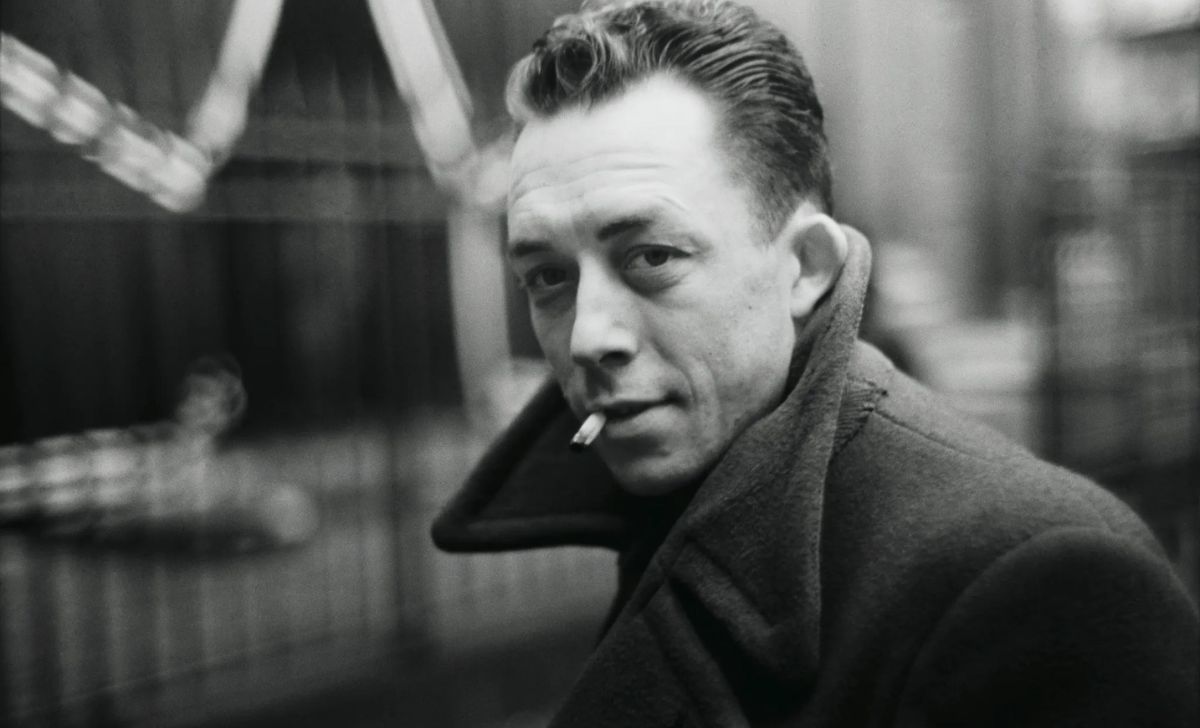
Albert Camus grew up surrounded by violence in Algeria, a land torn by conflict between native Algerians and colonizing French Europeans. His early experiences were marked by the trauma of war—his father was lost in the First World War, and Camus himself was deemed unfit to serve in the Second World War due to health issues. Struggling with tuberculosis in France and witnessing the devastation of war firsthand as a resistance journalist, Camus’s outlook on life became deeply affected, shaping The Life and Philosophy of Albert Camus. He grappled with the apparent meaninglessness of the endless bloodshed and suffering that defined his world.
The Question of Meaning
This personal anguish led Camus to confront a profound philosophical question: if the world itself is inherently meaningless, can individual lives still hold value? At the time, many intellectuals were exploring these existential doubts under the philosophy called existentialism. Existentialists held that humans were born as blank slates, tasked with creating their own meaning amidst the chaos of existence. However, Camus rejected this notion of a blank slate and instead argued that all people share a fundamental human nature binding them to common goals—one of which is to seek meaning despite life’s arbitrariness.
The Philosophy of the Absurd
Central to Camus’s thinking was the tension between humanity’s yearning for meaning and the universe’s deafening silence. He considered this clash fundamentally absurd because these two elements could never truly be reconciled. This contradiction became the core of his Philosophy of the Absurd, which posits that life is inherently futile yet insists on the human task of seeking purpose anyway.
The Cycle of the Absurd and “The Stranger”
Camus’s early works, which he referred to as his “cycle of the absurd,” explore how to live in a world without meaning. His first novel, The Stranger, presents a bleak outlook through its protagonist, Meursault. Detached emotionally, Meursault shows no conventional response to major life events, such as his mother’s funeral, and remains indifferent even after committing a violent crime. For Meursault, the world is pointless, and moral judgment is irrelevant. His attitude alienates him from society, culminating in a powerful climax that underscores the absurdity of existence.
Life’s Value Beyond Meaning
While Meursault’s case might suggest despair, Camus himself was celebrated for his honest, if stark, worldview. The Stranger brought Camus fame, and his later works continued to wrestle with the fundamental question: if life lacks inherent meaning, is suicide the only rational choice? Camus’s answer was a resounding no. Despite the world’s injustice and senselessness, choosing to live affirms our deepest freedom and individuality.
The Myth of Sisyphus
One of Camus’s most famous essays draws on the Greek myth of Sisyphus, a king doomed to eternally roll a boulder up a hill, only to see it roll back down. This futile punishment symbolizes humanity’s existence. Camus suggests that only by acknowledging the meaninglessness of life can one confront it with courage and defiance. When Sisyphus embraces his task, Camus famously concludes, “One must imagine Sisyphus happy.” This acceptance transforms despair into a triumph of the human spirit.

The Cycle of Revolt
In contrast to many existentialists who supported violent revolutions to overthrow oppressive structures, Camus advocated for a different approach through his “cycle of revolt.” In The Rebel, he portrayed rebellion as a constructive act rather than a destructive one. Camus believed revolutions that simply inverted power dynamics only perpetuated cycles of violence. Instead, he argued for building a communal understanding of our shared human nature to foster peace and cooperation.
Controversy and Legacy
Camus’s calls for peace and understanding sparked tensions with fellow intellectuals who favored more radical approaches. Nevertheless, he began work on what was to be his most personal novel, The First Man, intended as the start of a hopeful new theme—the cycle of love. Tragically, his life was cut short in 1960 by a car accident, a sudden event that embodied the very meaninglessness and absurdity he described.
Influence and Enduring Relevance
Although Camus never completed his cycle of love, his explorations of absurdity and revolt continue to resonate. His philosophy has become a cornerstone of 20th-century thought, influencing literature, philosophy, and even popular culture. In times of uncertainty, Camus’s work remains a beacon, inspiring resilience and courage rather than despair in a senseless world. His legacy challenges individuals to find meaning not in rational explanations but in the very act of living authentically and defiantly.