

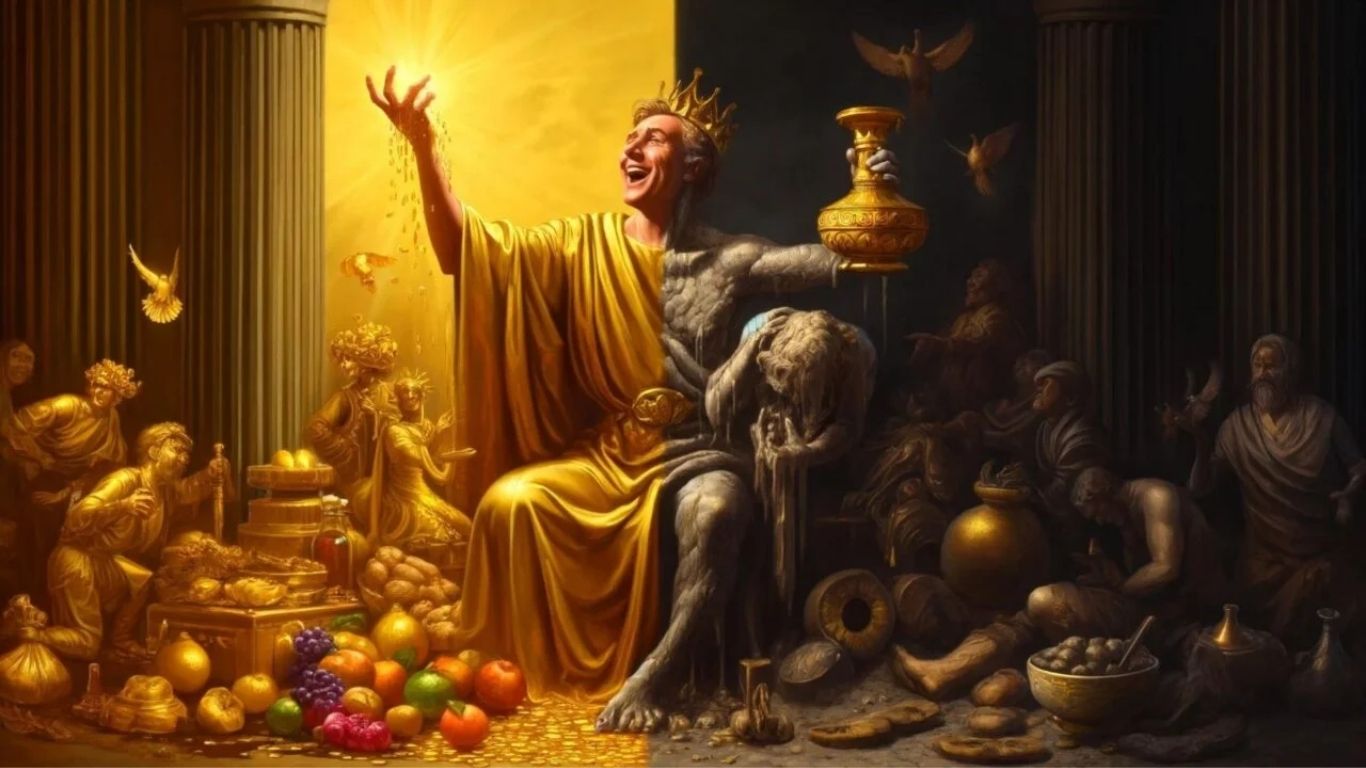
King Midas is one of Greek mythology’s most memorable figures—not because he was wise, strong, or heroic, but because his misadventures painted him as a ruler ruled by his own foolishness. His story, steeped in humor, tragedy, and moral warning, reflects humanity’s deepest flaws: greed, arrogance, and the inability to learn from one’s mistakes.
In this blog, we dive deep into the full tale as captured in the transcript: from the golden touch to the infamous donkey ears. Through these episodes, we uncover what made Midas both a comic figure and a timeless lesson woven into ancient lore.
Midas: A King of Excess and Absurdity
In the ancient kingdom-by-jo-nesbo/”>kingdom of Phrygia, King Midas governed not with balanced authority or thoughtful rule, but with a chaotic blend of indulgence and irrational whims. Known for harebrained schemes and questionable dealings with the gods, Midas earned a reputation that bemused his citizens and irritated celestial beings.
He lived in staggering splendor. Surrounded by luxuries, drenched in fine wines, and constantly feasting, he seemed less a king and more a caricature of indulgence. He adored his daughter, spoiled himself endlessly, and allowed his desires—not duty—to shape his daily life.
Little wonder he felt a natural closeness to Dionysus, the god of wine, revelry, and theatrical spectacle. Their shared affinity for excess set the stage for one of the most disastrous wishes in all mythology.
The Drunken Satyr in the Rose Garden
One day, as Midas wandered through his lush rose garden, he discovered a satyr—the mythological half-goat companion of Dionysus—fast asleep among the blooms. The creature was more than intoxicated by fragrance alone; he was clearly recovering from a night of Dionysian revelry.
Recognizing him as one of Dionysus’s loyal followers, Midas chose hospitality over annoyance. He welcomed the satyr into the palace, letting him nurse his monumental hangover in comfort.
When Dionysus learned of the king’s kindness, he arrived at the palace with gratitude. And as gods often do, he offered a reward: one wish—anything Midas desired.
A Greedy Wish That Changed Everything
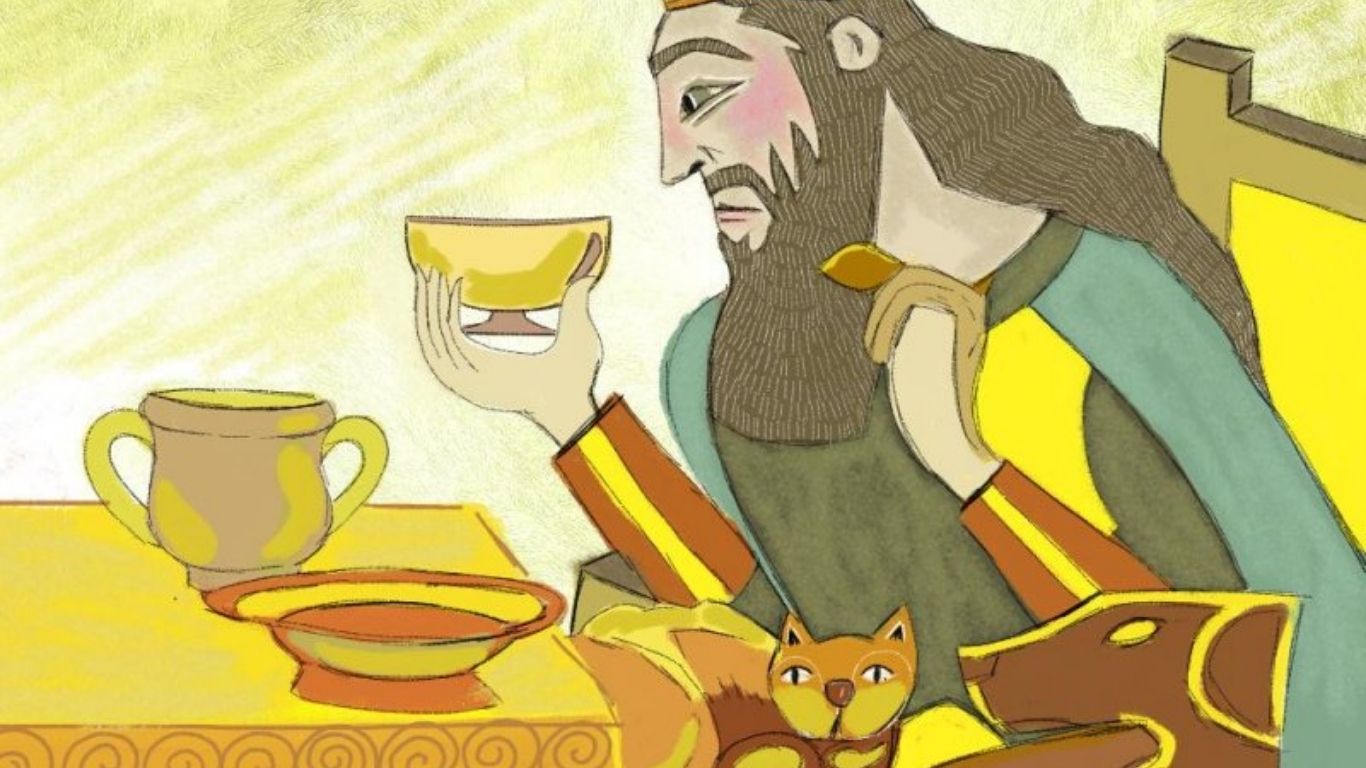
Despite the richness around him—precious jewels, gleaming silks, exquisite ornaments—Midas felt something was missing. Luxury no longer dazzled him. Comfort no longer satisfied him. What he craved was more. More wealth, more shine, more grandeur.
His eyes gleamed with greed as he made the fateful wish:
He wanted everything he touched to turn into gold.
Dionysus, amused and perhaps a little concerned, nonetheless granted the wish. A divine surge coursed through Midas’s hands. The gift—or curse—had begun.
The Frenzy of the Golden Touch
The moment Midas touched the palace walls, they shimmered into pure gold. Statues glowed. Goblets glistened. Floors sparkled with every step. Overcome with excitement, he raced through the halls, brushing his fingers against every object in sight.
He laughed wildly, intoxicated by the transformation. Soon, the palace was no longer a home but a gleaming monument to greed. Gold swallowed everything in sight.
But delight quickly turned to discomfort.
When Food Turns to Metal
After hours of manic transformation, Midas was ravenous. Reaching for a simple bunch of grapes, he took a bite—and nearly broke his teeth. The fruit had become solid metal the instant it touched his lips.
He tried bread next. It crumbled into hard, golden fragments in his hands. Panic flickered through him. The very essentials of life—food, water, rest—were slipping beyond reach.
In frustration, he collapsed onto his bed, only to find his soft pillows had solidified into cold, unyielding gold blocks.
The dream had become a nightmare.
The Most Tragic Touch
Hearing her father’s anguished cries, Midas’s beloved daughter hurried into the room. For her, he was not the foolish king or greedy monarch—he was simply her father.
But when Midas instinctively reached toward her, his world shattered. Before his horrified eyes, his child froze into a rigid, golden statue.
Her warmth vanished. Her expression stilled. She was beautiful, immortal—and lifeless.
In that instant, the golden touch became the heaviest burden imaginable. All joy drained from Midas, replaced by grief so deep it humbled him at last.
Seeking Mercy from the Gods
Broken and desperate, Midas begged the gods to take back the cursed gift. Dionysus, though initially entertained, now saw the true cost of the king’s greed. In compassion, he offered a path to redemption.
He instructed Midas to travel to the River Pactolus and wash his hands in its flowing waters.
Midas obeyed. As he submerged his hands, a miracle unfolded: the golden power seeped into the riverbed, draining from his skin like liquid sunlight. His fingertips softened, warmed, returned to flesh.
When he raced home, he found his daughter restored, alive once more. The palace returned to normal. Relief enveloped him, and for a fleeting moment, Midas embraced gratitude.
But this new humility wouldn’t last long.
Another Blunder: Midas Insults Apollo
Weeks passed before Midas stumbled into yet another divine disaster.
This time, he involved himself in a musical dispute between the wild god Pan, master of rustic melodies, and Apollo, the radiant god of music, harmony, and the sun.
When Midas boldly declared that Pan was the superior musician, Apollo’s eyes flashed with indignation. To disagree with the god of music himself was bold; to call someone else better was foolish.
Apollo scoffed at Midas’s judgment and declared, “Only a man with the ears of an ass could make such a claim.”
Then, with divine ease, he transformed Midas’s ears into long, furry donkey ears.
A King Hiding His Donkey Ears
Ashamed, Midas tried desperately to hide his new appearance. He wore elaborate headpieces and heavy turbans, shielding the humiliating ears from the public eye.
Only one person saw them: his barber.
During an agonizingly awkward grooming session, the barber discovered the secret. He was sworn to silence, though his stifled laughter and trembling lips betrayed how difficult the task would be.
The secret swelled inside him, pressing on his conscience until he felt he might burst.
The Whisper in the Earth
Unable to bear the weight of what he knew, the barber went outside the city one day, found a quiet patch of earth, and dug a small hole.
Bending down, he whispered into the darkness:
“Midas has ass’s ears.”
He covered the hole and walked away feeling lighter, believing the earth would keep his secret better than he ever could.
But the ground had other plans.
The Reeds That Revealed the Truth
Soon after, reeds sprouted from that very spot. When the breeze blew gently through them, they rustled with a strange, unmistakable whisper:
“Midas has ass’s ears… Midas has ass’s ears…”
The sound swept across fields, reaching farmers, travelers, and children. Donkeys perked their ears in recognition. People chuckled at the ridiculousness of their foolish king.
His humiliation was no longer a private shame—it had become a song carried by the wind.

A Legacy of Folly, Not Grandeur
While other rulers were honored with temples, statues, or songs of war and wisdom, Midas was remembered differently. His legacy lived not in stone monuments but in laughter and cautionary tales.
Two symbols defined him:
- The river that washed away his greed.
- The wind that revealed his foolishness.
These natural elements preserved his memory far better than any temple could. They served as reminders of a king whose desires exceeded his wisdom, whose mistakes became myths, and whose name became shorthand for the dangers of desire without restraint.
What King Midas Teaches Us Today
Though humorous on the surface, the myths of Midas carry enduring lessons:
- Greed transforms blessings into curses.
What Midas thought was the pinnacle of wealth nearly cost him everything. - Arrogance invites consequences.
Insulting a god of music while lacking discernment resulted in a very public humiliation. - Secrets are rarely kept forever.
Even whispered into the earth, truth finds a way to surface. - True value lies in balance, not excess.
Midas had everything, yet lost nearly all because he wanted more.
Midas was not evil—just human in his flaws, magnified by divine interactions. That humanity keeps his story alive centuries later.