
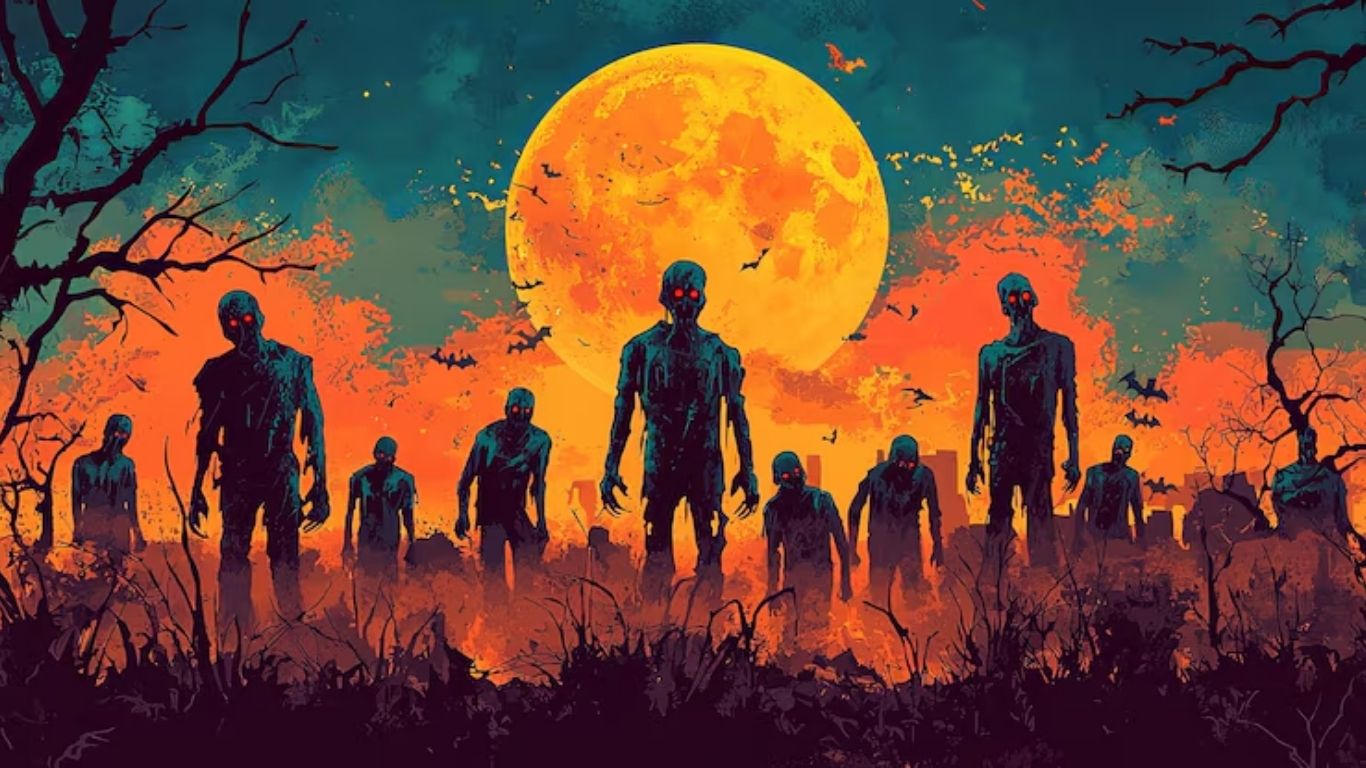
Zombies have shuffled, moaned, and devoured their way into nearly every corner of modern pop culture—from blockbuster movies to video games and television series. But behind the grotesque imagery and the endless apocalypse narratives lies a story far older, deeply rooted in African spirituality, colonial trauma, and cultural transformation. The zombie’s journey from an enslaved soul in Haitian folklore to a global symbol of fear and social commentary is one of the most striking examples of mythological evolution in human history.
The Ancient Roots of the Undead
The idea of reanimation—corpses returning from death—is not unique to any one culture. Throughout recorded history, civilizations across the globe have described entities that blur the line between life and death. Ancient Mesopotamian myths, Norse sagas, and even early Chinese folklore feature animated corpses or restless spirits that menace the living.
Yet the modern concept of the zombie traces its lineage most directly to Central and Equatorial Africa. Here, spiritual traditions, linguistic links, and funeral customs laid the groundwork for the story that would one day terrify and entertain audiences worldwide.
The linguistic origins of the word “zombie” remain somewhat mysterious. However, linguistic scholars have traced several possible ancestors:
- Among the Mitsogho people of Gabon, the word ndzumbi refers to a corpse.
- In the Kikongo language, nzambi can mean the supreme being, a powerful ancestor spirit, or a deity.
- In regions of Angola and Congo, zumbi denotes a spirit-infused object or a person returned from the dead.
These overlapping meanings— life, death, spirit, and divinity—demonstrate how the concept of reanimated existence was deeply spiritual rather than horrific. In African cosmology, the boundary between life and death was permeable, and the spirit’s power continued long after the flesh had perished.
Spirits, Souls, and Objects: African Beliefs About the Afterlife
In many Kongo and West African traditions, death was not viewed as an end but a transformation. The spirit of the deceased could reside in objects, serve as a guardian, or influence the physical world. Special rituals and ancestral veneration practices governed this relationship.
For instance, in Kongo belief, a person’s soul could inhabit a nkisi—a spiritual vessel that might be a charm, figurine, or sacred bundle. These vessels bridged the gap between living and spiritual realms, providing protection, guidance, or luck. Likewise, death rites ensured that the soul transitioned properly to the spiritual plane. Failing to do so risked unrest or imbalance between the worlds.
This spiritual structure would collide dramatically with European colonialism and the brutal transatlantic slave trade.
From Africa to the Caribbean: The Journey of a Belief
Between 1517 and 1804, hundreds of thousands of Africans were forcibly taken to the Caribbean by French and Spanish colonizers, particularly to the island of Hispaniola, which today includes Haiti and the Dominican Republic. The transported people carried their languages, stories, and religious beliefs with them. In the crucible of brutal plantation slavery, these African traditions mixed with enforced Catholicism, creating a new spiritual system: Vodou (often misrepresented in Western narratives as “voodoo”).
Vodou was not merely a religion—it was an act of resilience. It preserved African cosmology in a new world of unimaginable oppression. Within Vodou’s framework, new interpretations of life, death, and spirit emerged— including the figure that would become known globally as the zombie.
The Haitian Zombi: A Soul Enslaved Beyond Death
In Haitian Vodou, the zombi is not a flesh-eating monster but a tragic victim. This being appears in two main forms:
- The Soulless Corpse (Zombi cadavre):
A dead body reanimated by a bokor—a sorcerer or practitioner of dark magic—who uses it as a mindless laborer. - The Body-less Soul (Zombi astral):
The spiritual essence of a person captured and imprisoned, often used for magical or servile purposes.
In both cases, the horror lies not in the creature’s violence but in its enslavement. A zombi has been denied the peace of the afterlife—its agency, identity, and destiny stripped away.
This concept directly mirrored the trauma of slavery itself. To be turned into a zombi meant enduring eternal bondage, even beyond death. It was the most dreaded fate imaginable: a person’s soul enslaved forever, deprived of both freedom and spiritual rest.
Because of this, in Haitian culture, the zombi evokes not fear but pity. The zombified are seen as victims of exploitation, creatures deserving compassion and liberation rather than destruction.
Zombification as Social Allegory
In Haitian tradition, zombification symbolized social realities. Enslaved Africans worked relentlessly on plantations to enrich slaveholders, and in folklore, zombis performed endless labor without food, rest, or will. The myth became a means of expressing the psychological horror of enslavement under colonial powers—a metaphor for lives stolen, bodies controlled, and identities erased.
Even after Haiti became the first free Black republic in 1804, the zombi remained a potent emblem of what the Haitian people fought to escape. It warned against surrendering one’s autonomy and underscored the moral necessity of freedom.
Western Encounter: The U.S. Occupation of Haiti (1915–1934)
Zombies as the world knows them today began to take shape during the U.S. occupation of Haiti in the early 20th century. American military and business interests, steeped in racist stereotypes, frequently misrepresented Haitian Vodou as barbaric devil worship.
Journalists and travelers sensationalized Haitian religious practices, reducing complex belief systems to exotic horror stories. Among the many distorted tales that circulated, the zombi captured particular fascination.
In this period, American writers began to describe the zombi as a soulless, subhuman laborer, echoing their own colonial fears and prejudices. The myth was stripped of its symbolic meaning and reinterpreted through a Western lens.
“White Zombie” and Hollywood’s Obsession
In 1932, filmmakers Victor and Edward Halperin released “White Zombie,” widely considered the first zombie movie. Set in Haiti, the film portrays a white woman transformed into a mindless servant by a malicious Vodou master. While the movie introduced zombie mythology to mainstream cinema, it inverted its moral focus.
The original Haitian zombi was a victim of oppression; in White Zombie, the victim is a white woman, and the monstrous power lies in Black culture. The zombi laborers, once symbols of exploited humanity, are now reduced to exotic background figures. In effect, the film racialized the myth, reflecting Western anxieties about control, sexuality, and “the other.”
Despite its problematic framing, White Zombie established the zombie archetype as irresistible cinematic material. Over the following decades, Hollywood continued to adapt, distort, and reinvent the myth in countless forms.
Mid-Century Mutations: From Magic to Science Fiction
By the mid-20th century, zombie films diversified in tone and setting. Some borrowed from Haitian folklore, while others merged the undead with Cold War metaphors, alien invasions, or Nazi experiments. These creatures became metaphors for collective anxiety—fear of the unknown, of foreign threats, and of humanity’s capacity for evil.
But it wasn’t until 1968 that the zombie underwent its most radical transformation.
“Night of the Living Dead”: Birth of the Flesh-Eater
When George A. Romero released Night of the Living Dead in 1968, he redefined the undead forever. The film depicted a group of strangers barricaded in a farmhouse, fending off hordes of cannibalistic corpses. Romero never called them zombies, but audiences instantly recognized them as such.
Gone were the bokors, spells, and Caribbean settings. These new undead monsters weren’t enslaved by a master—they were driven by inexplicable hunger. Their menace was communal, unstoppable, and eerily human.
The movie’s impact was seismic. Suddenly, “zombie” no longer referred to a victimized soul but to a spreading contagion, a breakdown of order, and a mirror of human collapse.
The Rise of Flesh-Eating Mythology
Subsequent films and franchises built upon Romero’s foundation. In 1985’s The Return of the Living Dead, zombies were given an appetite for brains, cementing one of the most enduring horror tropes in pop culture.
The Haitian themes of enslavement and lost identity gave way to Western fears of infection, overpopulation, and moral decay. No longer servants of sorcery, zombies now represented chaos itself—a force without master or meaning.
This shift also mirrored cultural tensions of the late 20th century: fears of consumerism, nuclear fallout, biological warfare, and the fragility of civilization.
Rebirth Through Contagion: Modern Zombies
The early 2000s revitalized the genre with films like 28 Days Later (2002), which introduced fast-moving, rage-infected humans instead of the slow, shuffling corpses of earlier movies. The zombie became a symbol of pandemic anxiety and systemic collapse, reflecting societal concerns about global disease, technological alienation, and environmental destruction.
Television brought zombies into the mainstream via series like The Walking Dead, which explored moral survival and humanity’s struggle against both monsters and each other. The zombie apocalypse now functioned not only as entertainment but as a moral mirror—reflecting consumer culture, militarism, and social alienation.
The Social Mirror of Modern Zombie Narratives
Contemporary portrayals of zombies often serve as metaphors for what society fears most:
- Consumerism: Romero’s Dawn of the Dead (1978) famously set its undead inside a shopping mall, suggesting that modern humans are already “zombified” by material desire.
- Disease and Contagion: Films like World War Z (2013) transformed zombies into vehicles for commentary on globalization and pandemic response.
- Class and Oppression: In works from South Korea’s Train to Busan (2016) to Latin America’s Juan of the Dead (2011), zombies embody systemic inequality and government dysfunction.
- Technology and Identity: Modern interpretations explore digital zombification—humans enslaved by screens, algorithms, or corporate structures.
Each adaptation reinvents the zombie myth to express the era’s dominant fears, ensuring its continued relevance across cultures and generations.
Cannibalizing the Origins: Cultural Erasure and Rediscovery
Ironically, while zombies became global icons, their African and Haitian origins were largely erased from the narrative. Western pop culture consumed the mythology as hungrily as the creatures themselves devour flesh—appropriating without acknowledgment.
Yet in recent years, scholars, artists, and filmmakers have begun to reclaim and highlight the zombie’s Afro-Caribbean heritage. Works by Haitian and African diasporic creators reintroduce the figure of the zombi as a symbol of resilience, colonial resistance, and ancestral memory.
This resurgence reflects a broader trend toward decolonizing myth, restoring context to stories that were once distorted or stripped of cultural meaning.