

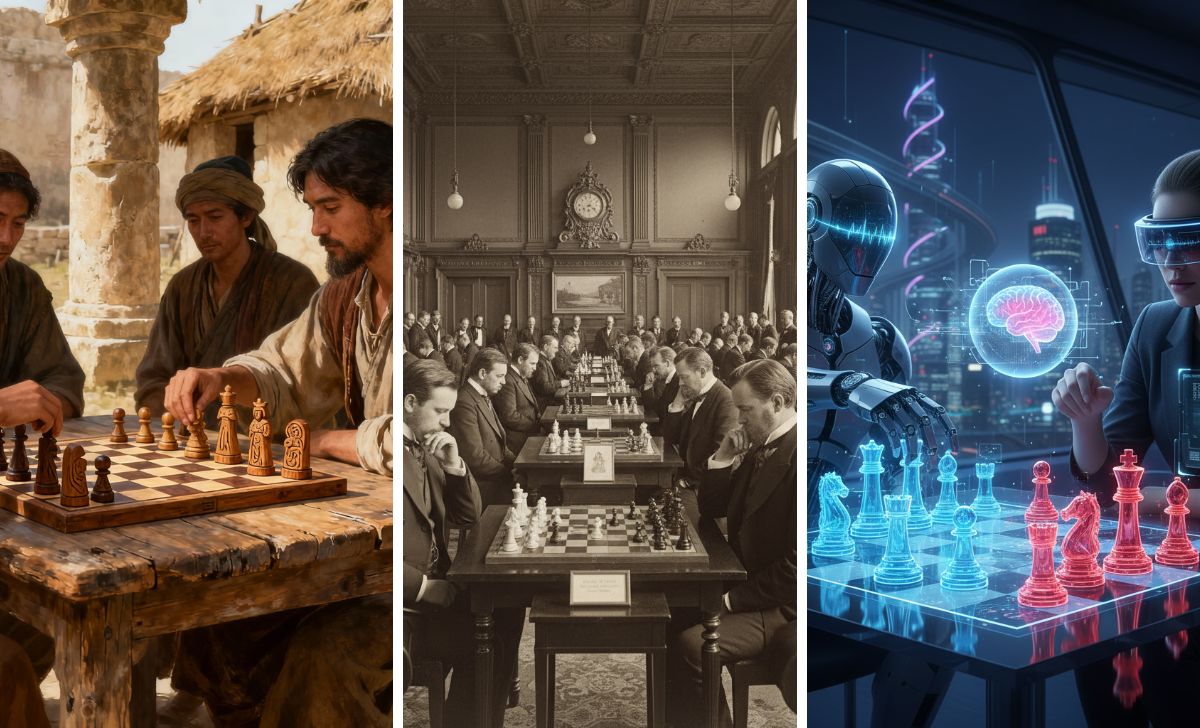
The attacking infantry advances steadily, their elephants already having broken the defensive line. The king tries to retreat, but enemy cavalry flanks him from the rear. Escape is impossible. But this isn’t a real war– nor is it just a game. Over roughly one-and-a-half millennia of its existence, chess has been known as a tool of military strategy, a metaphor for human affairs, and a benchmark of genius. Understanding the evolution of chess reveals why this ancient game remains endlessly rich and universally compelling.
Ancient Origins: Chaturanga and Its Military Roots
Our earliest records of chess are in the 7th century, but legend tells that the game’s origins lie a century earlier. Supposedly, when the youngest prince of the Gupta Empire was killed in battle, his brother devised a way of representing the scene to their grieving mother. Set on the 8×8 ashtapada board used for other popular pastimes, a new game emerged with two key features: different rules for moving different types of pieces, and a single king piece whose fate determined the outcome.
This game was originally known as chaturanga– a Sanskrit word meaning “four divisions.” These four divisions represented the military divisions of infantry, cavalry, elephants, and chariots, which evolved into the modern pawn, knight, bishop, and rook pieces. Chaturanga provided a military simulation that combined strategy with tactical calculation, mirroring the challenges of ancient warfare.
From Persia to the Arab World: The Birth of Chess Terminology
With the spread of the game to Sassanid Persia in the 7th century, it was adapted into chatrang, then shatranj after the 7th-century Islamic conquest of Persia. This cultural metamorphosis gave chess its current name and terminology—“chess” derived from “shah,” meaning king, and “checkmate” from “shah mat,” meaning “the king is helpless.” Players began to call out “Shāh!” when attacking the king, marking the origin of the modern check, and “Shāh Māt!” when a king was trapped.
Chess transcended its role as a tactical game to become a rich metaphor in Islamic culture. Diplomatic and poetic language incorporated chess imagery, with caliphs and rulers avidly playing. Historian al-Mas’udi lauded the game as an emblem of human free will, contrasting it with games of chance. The transformation from military simulation to intellectual and cultural symbol deepened chess’s enduring appeal.

Eastward Expansion and Local Variants
Medieval trade along the Silk Road carried chess eastward, where numerous local variants developed. In China, pieces were placed on board intersections rather than within the squares, aligning with the local game, Go. Under Mongol rulers like Tamerlane, expansions such as an 11×10 board with citadels (safe squares) appeared, adding complexity. In Japan, shogi emerged, featuring a unique mechanic where captured pieces could be redeployed by the opponent, enhancing strategic depth.
These adaptations reflected local cultures while preserving chess’s core strategic identity.
Medieval and Renaissance Europe: Chess as Social Allegory and Modern Form
By 1000 AD, chess had become a fixture of courtly education across Europe, used as an allegory for social order. The pieces represented various societal roles—from the peasantry and knights to the clergy and royalty—each performing their prescribed functions in a strict hierarchy. However, the Church remained wary of games, with moralists cautioning against excessive devotion to chess; in places like France, it was briefly banned.
The 15th century was pivotal. The relatively weak piece known as the advisor or fers was transformed into the powerful queen, likely inspired by the rise of strong female monarchs like Isabella I of Castile. This change greatly accelerated the game, introducing fierce tactical possibilities. Alongside, other modern rules emerged such as castling and the pawn’s double-step move, as well as the now-standard checkmate conditions.
Treatises analyzing openings and endgames emerged, establishing the foundations of chess theory.
The Romantic Era: Creativity and Drama in Chess
With the Enlightenment came the spread of chess beyond royal courts into coffeehouses and public spaces. Chess became a vehicle for creative expression, celebrating daring sacrifices and bold attacks.
The “Romantic” style of chess peaked in the mid-19th century, epitomized by Adolf Anderssen’s Immortal Game of 1851, where he achieved checkmate after sacrificing his queen and both rooks. This era valued spectacle and brilliance over cautious strategy.
However, the maturation of competitive play in the late 19th century led to a shift towards strategic calculation. International tournaments and championships fostered a more scientific approach, reducing the dominance of showmanship.

Chess as a Geopolitical Tool: The Soviet Chess Machine
By the 20th century, chess took on geopolitical importance, particularly during the Cold War. The Soviet Union invested heavily in chess schools and talent development, producing champions who dominated the international arena for decades.
Chess became a proxy battleground of intellectual supremacy, with players like Mikhail Botvinnik, Anatoly Karpov, and Garry Kasparov embodying national pride and cultural achievement.
The Digital Chess Revolution: Machines and Artificial Intelligence
The player who truly upset this human dominance was not a citizen of another country but an IBM computer called Deep Blue. Developed over decades, chess-playing computers evolved from primitive programs to formidable opponents.
In 1997, Deep Blue defeated Garry Kasparov, the reigning world champion, marking the first time a machine beat a sitting champion in a match. This watershed moment propelled chess into the digital era, where software now consistently outperforms all human players.
Despite this, these machines remain products of human ingenuity. Chess engines draw from millennia of human strategic knowledge, encoded in algorithms and refined by neural networks, redefining how humans understand the game.
The Modern Era: Chess Online and AI-Driven Mastery
Today, chess combines ancient roots with modern technology. Online platforms have expanded access to the game, enabling millions to compete and learn globally. Streaming, tutorials, and AI coaching have democratized skill development.
Engines like Stockfish and AlphaZero have revolutionized theory. While Stockfish uses brute-force computation and heuristics to analyze millions of positions, AlphaZero uses machine learning to develop intuitive, dynamic styles emphasizing long-term strategy and initiative.
Players incorporate these insights into opening preparation, middlegame planning, and endgame technique—deepening understanding and elevating human play to new heights.

Enduring Appeal: Why Chess Remains Timeless
Chess’s longevity stems from its delicate balance of simplicity and depth. Its rules are accessible, but mastering its vast strategic complexities remains a lifelong pursuit. The game’s evolution reflects cultural changes and technological advances without losing its essential character.
Chess endures as a symbol of human creativity, intellect, and resilience—inviting every player to engage in a battle of minds on the same 64 squares used by centuries of predecessors.