
When comic book fans discuss Marvel’s most terrifying transformations, they usually mention Carnage, Venom, or even the zombie universes. Rarely would anyone expect an old Golden Age hero—one that predates Captain America—to be reimagined as a creature worthy of nightmares. Yet, this is exactly what happened with Flexo the Rubber Man. Once an absurd relic of early Marvel history, Flexo the Rubber man has returned in one of the strangest and darkest ways possible.
The Eerie Allure of Early Comic Characters
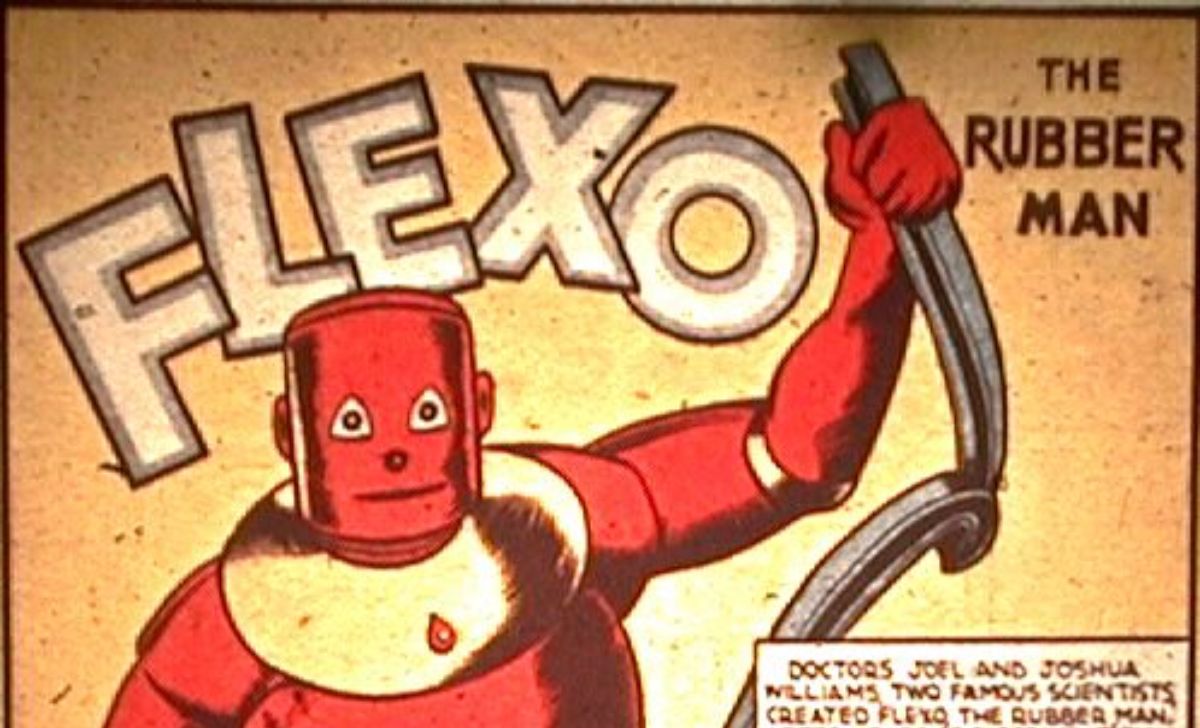
There’s something inherently unsettling about Golden Age comic characters. Their wide eyes, unrelenting smiles, and cheerfully stiff mannerisms have a surreal and uncanny quality that borders on eerie. While modern readers find them quaint, horror games and stories have long exploited this aesthetic—the cheerful façade masking something far more sinister. Flexo fits this mold perfectly. Originally a harmless rubber hero, his revival recontextualized him into a chilling figure of forgotten innovation and quiet horror.
The Strange Birth of Flexo in 1940
Flexo first appeared in Mystic Comics #1 in 1940, created by Will Harr and Jack Binder during Marvel’s early iteration as Timely Comics. Despite Mystic Comics hinting at magic and ghosts, he was a scientific marvel—a robot made from “living rubber” and powered by mysterious gas. His creators, twin scientists Joel and Joshua Williams, used a remote control to command their creation. Flexo could stretch, contort, and even fly, making him one of the earliest examples of body elasticity in superhero media.
Unlike other heroes of that era, Flexo’s mechanical body was bulletproof, fireproof, and could even seal up holes when damaged. Yet, despite these superhuman attributes, his stories followed a predictable rhythm—mad scientists, daring rescues, quick justice, and patriotic overtones. Still, the concept of an artificial creature with emotions and obedience raised intriguing questions, even if they were never directly explored.
From Forgotten Relic to Lost Hero
Flexo appeared in only four issues. His adventures escalated rapidly—from stopping minor crooks to toppling dictators—before vanishing from Marvel’s publishing line without explanation. Like so many wartime characters, he was simply left behind as trends changed and superheroes evolved into more psychologically complex beings. Outside a rare cameo photograph alongside other Golden Age icons, his existence faded into obscurity for over seventy years.

The Resurrection: Marvel Zombies Destroy (2012)
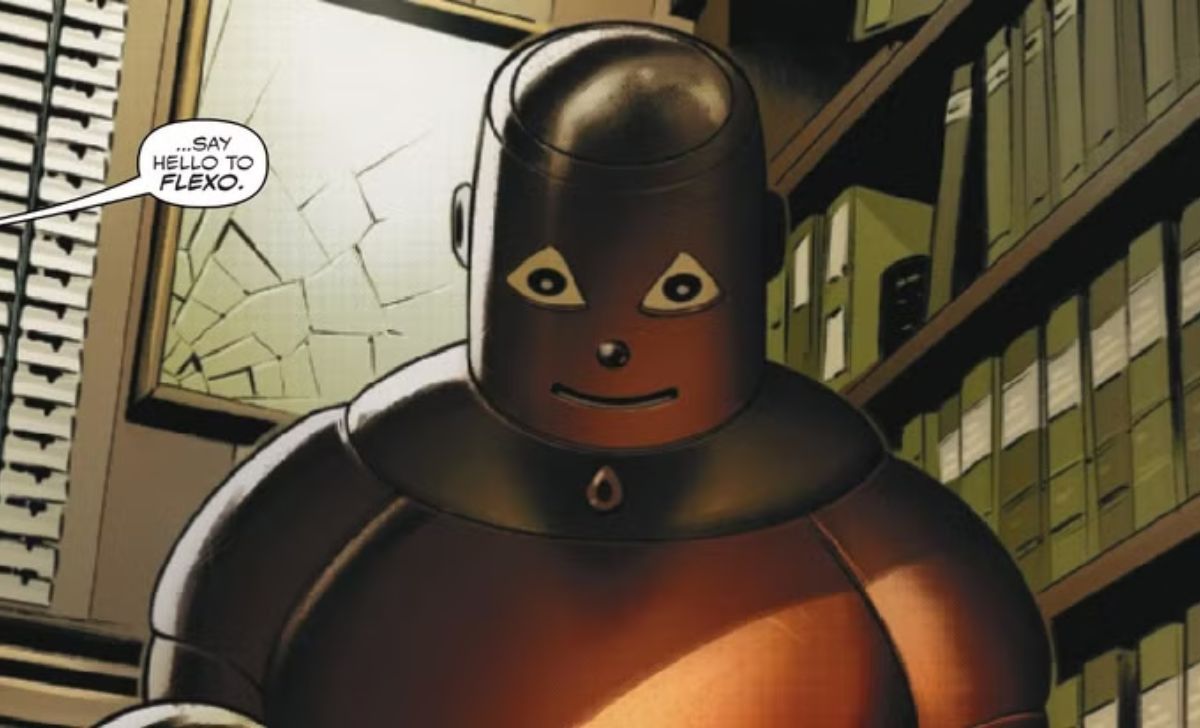
In one of the strangest revivals in Marvel history, Flexo reemerged in 2012’s Marvel Zombies Destroy!—a bizarre miniseries in which Howard the Duck and an agency called ARMOR fought zombified Nazi versions of Marvel characters. This Flexo was different: more mechanical, humanoid eyes, and now strangely equipped with pants. The redesign straddled the line between absurdity and horror, making him feel like a sentient war machine rather than a quirky robot.
Unfortunately, his return was brief and brutal. Flexo helped decimate hordes of undead Nazis before being torn apart by Thor’s zombified goats—a spectacularly grotesque end, even by Marvel standards. Yet his appearance planted a seed: what if the “living rubber” wasn’t mechanical at all, but something organic?
Al Ewing’s Revelation: Flexo as a Symbiote
Cut to 2023. Writer Al Ewing, known for pushing cosmic and biological boundaries in Venom, took an overlooked line from Flexo’s original description—“living rubber”—and reimagined it as a biological symbiote precursor. With that single reinterpretation, his legacy transformed from curious artifact to horrifying origin story.
In Ewing’s Venom continuity, the Williams brothers’ experiment began when they found a strange, dark organism inside a meteorite. When one brother cut his hand and bled into the sample, the alien substance grew, feeding on adrenaline. Later, they discovered that phenethylamine—a chemical found in chocolate—could stimulate similar growth. By feeding it vast amounts of chocolate, they created Flexo.
The “non-lethal gas” he used in the 1940s was just a sanitized retcon. In truth, Flexo consumed his victims to survive. What had once been cute pulp science fiction now became cosmic horror—a primitive symbiote creature hidden in plain sight since Marvel’s beginnings.
Symbiosis and Sentience: The Uncomfortable Truth
Flexo’s behavior in the new timeline revealed layers of tragedy. He wasn’t merely controlled through a remote; he obeyed because he was dependent. Like Venom needing adrenaline, Flexo’s symbiote nature meant he fed off emotion, energy, and biological sustenance provided by his creators. When the Williams brothers argued about deploying him as a U.S. weapon during World War II, one of them warned that the creature’s obedience relied entirely on captivity and nourishment. Without those controls—or under new commands—Flexo could become monstrous.
That warning turned prophetic.
Time Travel, Symbiotes, and Doom: The Twisted Modern Tale
Modern Marvel comics often blend cosmic chaos and time travel, and Flexo’s story found its way into this web through the Venom War event. Eddie Brock—now the god of symbiotes—stole Doctor Doom’s time machine during a confrontation. In the struggle, both men were thrown back to Nazi-occupied France. While there, Eddie’s psychic call for symbiotes summoned none other than Flexo, deployed by the U.S. military for a secret mission: to assassinate Hitler.
By summoning him prematurely, Eddie accidentally disrupted the past. Flexo’s mission failed, altering history’s trajectory. After Doom resumed his rampage against Nazis, the military discovered him amidst the ruins and assumed he caused the destruction. Deemed unstable, Flexo was frozen in cryostasis for decades, his existence classified.
Return from Cryosleep: The Venom War Awakens
Decades later, Dylan Brock—Eddie’s son—battled Norman Osborn and inadvertently damaged the facility containing Flexo. The ancient symbiote broke free, disoriented but functional. This set the stage for a new war: father against son, symbiote versus symbiote. Flexo joined Dylan’s rebellion, aligning himself with a generation far removed from his own creation.
During the climactic confrontation, Dylan fused with his armies into a massive symbiote composite. Eddie attempted reconciliation, reaching out as a father. But within Dylan’s form, Flexo acted on buried programming from Doctor Doom decades earlier—an assassination command implanted during World War II. Flexo fired upon Eddie, fulfilling Doom’s vengeance through time and tragedy.
Doom’s Manipulation and the Game of Gods
As the Venom War unfolded, it became clear that Doctor Doom had seen everything coming. His manipulation of Flexo as a sleeper agent was not merely revenge—it was part of a meta-game with Kang the Conqueror. Both villains had planted sleeper symbiotes, each betting on who could orchestrate the ultimate outcome through multiversal deception. Kang temporarily won by outmaneuvering Doom using the Fantastic Four, but Reed Richards turned the tables again using a clever imitation of Doom’s voice to summon Doombots against Kang—a bizarre, mind-bending resolution even by comic standards.
Amid all this 5D chess and cosmic absurdity, Flexo’s autonomy vanished again. Created as a tool, frozen as a weapon, and used as a pawn across time, his story reflected one of Marvel’s most enduring themes: creation without compassion leads only to horror.
The Horror and Humanity
Flexo’s revival is more than just another continuity twist—it’s a reflection of how modern writers reinterpret old pulp icons with psychological and emotional depth. His “rubber” body once symbolized cheerful flexibility; now it represents violated humanity. His blank stare once conveyed naivety; now it suggests suppressed trauma and alien sentience beneath artificial control.
In Ewing’s hands, Flexo becomes a fusion of body horror and philosophical tragedy, a being born from compassionless creation and endless exploitation. His reintroduction doesn’t just revive a forgotten Golden Age relic—it exposes the buried fears at the heart of early comic optimism.
Will Flexo Return?
The Venom War closed without confirming Flexo’s fate. Whether destroyed, dormant, or wandering the Marvel Universe unseen, his presence lingers as both a symbol of untapped storytelling potential and a macabre reminder of Marvel’s origins. If he does resurface, he might embody the bridge between early pulp science fiction and modern symbiote mythology—a being that outlived its creators and outlasted its purpose.
For now, Flexo remains one of Marvel’s most fascinating enigmas—a living echo from 1940, reborn in terror and tragedy.