
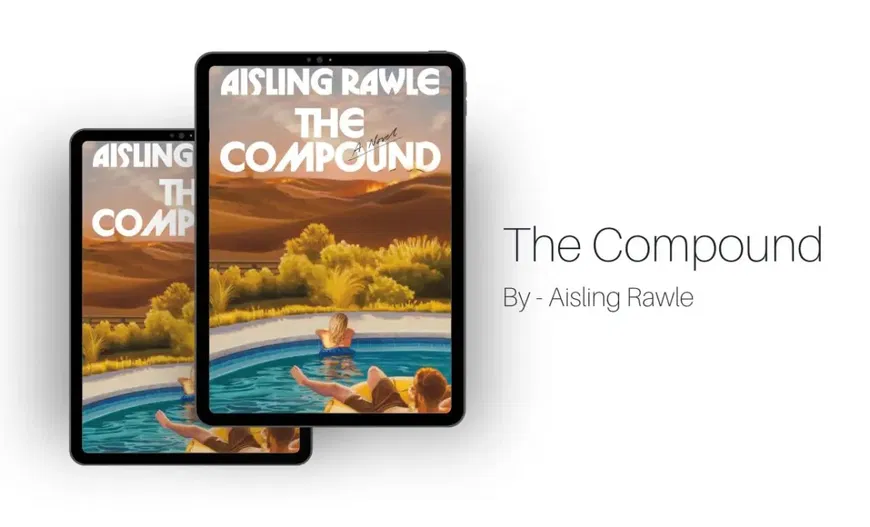
In a world obsessed with spectacle, The Compound by Aisling Rawle feels disturbingly familiar. Set in a remote desert where contestants compete for survival under constant surveillance, this debut novel blends reality TV absurdity with chilling psychological tension. What begins as a flashy game show soon unravels into something far more sinister—where manipulation, desire, and control reign supreme. Rawle taps into the anxieties of modern life: our need for attention, our thirst for validation, and how far we’ll go to feel seen. In this review, we explore how The Compound holds a mirror to entertainment culture—and what we see isn’t pretty.
🏜️ Plot Overview
Lily, a bored twenty-something with a stale retail job, finds herself waking up in a remote desert compound—surrounded by nine other young, attractive women. Their memory of the outside world is fuzzy, but they soon learn they’re part of a twisted reality TV experiment. Cameras shadow their every move, documenting group challenges for communal rewards (furnishings, food, appliances) and solo tasks for personal luxuries.
Soon, ten men arrive after a harrowing desert trek. Each night, a couple must form—those unpaired are banished at sunrise. As contestants flirt with each other and clash during tasks, their motives shift from winning prizes to simply surviving psychologically. What begins as superficial entertainment gradually turns into a ruthless game of manipulation, surveillance, and moral compromise. The stakes escalate until only one remains—but at what cost?

Subverting Reality TV Conventions
Rawle takes the familiar reality-show framework—think Love Island or Big Brother—and warps it into something chillingly dystopian. The compound isn’t just a setting; it’s a character: claustrophobic, watchful, and cruel. Rewards—extra food, a comfy bed, or champagne—come at a price determined by tasks that become progressively disturbing (like spitting in a partner’s mouth or eliminating a housemate) .
Early on, the narrative is paced like a binge-watchable show—light and poppy. But Rawle gradually peels back layers to expose its more sinister core: the erosion of human connection in exchange for material gain and audience ratings. The compound’s screens, the rules, the cameras—they drive home how even intimate moments can be gamified and commodified.
🌱 Lily’s Journey: From Enthusiast to Survivor
Lily begins as a passive participant, almost archetypal: retail worker, dissatisfied with life, eager for glamour. But as Rawle illustrates, her vulnerabilities are relatable—financial stagnation, a fractured family, the hunger for escape. She is painfully self-aware but not immune to manipulation. Despite being a fan of the show, her complicity grows as she becomes both puppet and performer.
Her character arc pivots around two men—one charismatic and volatile, the other quiet and thoughtful (Sam). Her attraction to Sam hints at deeper emotional instincts, yet material comforts offered by another lead her astray. When a contestant leaves in protest—“Do you really want to live here, in this… wasteland?”—Lily’s torn: the compound feels safer than the crumbling world outside. By the end, her “victory” leaves her materially rich but emotionally hollow—an apt commentary on success without substance.
✨ Themes: Capitalism, Control & Complicity
- Consumerism vs. Community
The compound grants everything at a request—but each item chases a hollow need. As one reviewer notes: “The accumulation of stuff is nothing without people to share it with”. Lily amasses luxuries, but they fail to fill the void. - Surveillance & Power
Candidates know they’re watched at all times. Tasks are delivered via screens; every misstep is recorded for an invisible audience. This omnipresent gaze drives fear—of failure, of shame, even of losing connection. - Intimacy as Leverage
Sexual pairing isn’t about romance—it’s survival. It’s a perversion of genuine connection, a mechanism producers use to force alliances and betrayals. - Reality TV as Dystopia
This world isn’t merely entertainment—it’s a crucible. As the narrative progresses, games become more brutal, punishing, and ethically bankrupt—just as “the line between playing and surviving it begins to blur”.
⚖️ What Works & What Falters
Strengths
- Timely Cultural Mirror: Rawle channelizes contemporary anxieties—economic despair, surveillance, performative living—into an addictive, cautionary tale.
- Prose & Structure: She echoes reality-TV beats—introductions, challenges, relationships—while subverting expectations, building tension carefully.
- Moral Ambiguity: Lily and the audience are complicit—we’re drawn in, entertained, even as we recoil. That tension is Rawle’s achievement .
Weaknesses
- Thin Secondary Characters: While Lily is fully drawn, others—especially the men—feel like archetypes rather than nuanced individuals.
- Vague World-Building: The political or environmental collapse outside is often hinted at but not deeply explored. The focus is tight, which works thematically, but leaves some readers hungry for broader context .
- Ambiguous Ending: The final image—Lily alone among her spoils—lands emotionally, but those seeking narrative closure may feel unsatisfied.
📚 Final Thoughts
The Compound is a powerful first novel—a cocktail of reality show entertainment and dystopian social dissection. Rawle brilliantly lures us into a world that feels dangerously close to our own, insisting that entertainment, fear, and capitalism don’t just coexist—they feed one another. Lily’s journey from dreamer to hollow victor serves as both cautionary tale and mirror: how easily we barter connection and empathy for comfort and fame.
At around 304 pages, it’s a brisk read but resonates long after. Ideal for anyone hungry for sharp social critique wrapped in high-stakes suspense, without glossing over the moral weight of it all.
Also Read: So Happy Together: By Olivia Worley (Book Review)