
Bold truth up front: the right Amazon KDP categories can make or break a book’s discoverability. Smart category selection helps your title rank faster, hit bestseller lists in sub-niches, surface in relevant browse paths, and attract readers who are actually looking for your kind of story or solution. This isn’t guesswork—it’s positioning. Treat categories like strategic shelf space in a digital bookstore, and you’ll give your book a measurable advantage from day one.
Below is a detailed, step-by-step guide to selecting, testing, and optimizing your Amazon KDP categories for maximum visibility and conversions. It covers fiction and nonfiction, no- and low-content titles, and long-term optimization strategies that align with how Amazon’s store actually works.
Understand How KDP Categories Work
Amazon KDP categories are not exactly the same as BISAC codes used by publishers. When you publish on KDP, you choose BISAC subjects, and Amazon maps those to its internal browse categories. That means two important things:
- You may see different categories in the KDP dashboard versus what appears publicly in the Amazon store’s browse paths.
- You can get your book placed in more granular categories (often beyond the two BISAC subjects you select) by contacting KDP support and requesting specific Amazon browse nodes.
Think of categories as discovery funnels. The broader the category, the more traffic but the higher the competition. The narrower the niche, the easier to rank but the smaller the audience. The goal is to balance competition and demand so your book gets traction, earns reviews, and builds rank over time.
Define Your Book’s Core Positioning
Before picking categories, articulate the core positioning of your book in a single sentence:
- For fiction: genre + subgenre + tone + audience. Example: “Dark urban fantasy with mythological elements for adult readers who love morally gray heroes.”
- For nonfiction: topic + angle + outcome + audience. Example: “Practical, beginner-friendly guide to SEO for small business owners focusing on local rankings.”
Use this positioning to filter out categories that may seem tempting but will mismatch reader expectations. Even if a trendy category has lower competition, misalignment kills conversions and drags down your book’s performance.

Map Your Book to Primary and Secondary Category Themes
Assign one primary theme that captures your main genre/topic and one to two secondary themes that reflect subgenre, setting, age group, or use case. This gives you a category framework:
- Fiction example:
- Primary: Science Fiction
- Secondary: Space Opera, Military Sci-Fi, Alien Invasion
- Nonfiction example:
- Primary: Business & Money
- Secondary: Entrepreneurship, Small Business, Marketing
This framework ensures coherence across category choices, keywords, subtitle, and cover design cues.
Research Categories Like a Strategist
Do structured research to find categories where you can realistically rank and that align with your audience. Work through the following:
- Browse Path Recon
- Navigate the Amazon store (for your target marketplace: .com, .co.uk, .in, etc.).
- Click through Books > your genre > subgenres and list the full browse paths that fit. Example: Books > Mystery, Thriller & Suspense > Police Procedurals.
- Note niche paths with three to four levels deep; these often have more targeted traffic and less competition.
- Bestseller Page Analysis
- Open the Best Sellers page for relevant categories and study the top 20–50 books.
- Check their covers, subtitles, price points, formats (eBook, paperback, hardcover, audiobook), and publication recency.
- Ask: Does your book visually and thematically fit here? If it feels out of place, try a different subcategory.
- Competition Proxy via Sales Rank
- On category bestseller lists, click into top-10 books and note their Amazon Best Sellers Rank (BSR).
- Lower BSR numbers indicate higher sales velocity. If every book in the top 10 sits under a very low BSR (e.g., under 2,000 in the Kindle Store), competition is fierce.
- Look for categories where #1–#5 have modest BSRs and #10–#20 are reachable for a new book with a solid launch plan.
- Cross-Reference Keywords
- Begin with seed keywords from your book’s positioning. Search those phrases in the Kindle Store and observe autocomplete suggestions.
- Notice which categories frequently appear among books ranking for those terms.
- Align categories and metadata; Amazon correlates customer search behavior with browse behavior.
- Reader Intent Alignment
- For nonfiction, assess whether the category maps to immediate problem-solving intent (e.g., “Job Hunting” vs “General Careers”). Shorter path to reader’s “job-to-be-done” boosts conversions.
- For fiction, match subgenre expectations: pacing, tropes, heat level, POV, and tone.
Use KDP’s Allowed Slots Strategically
KDP allows you to choose two BISAC categories at setup, but you can often get placed in additional Amazon browse categories by contacting KDP support. Use your two BISAC slots to capture the most accurate themes. Then, after publication:
- Identify two to six additional highly relevant Amazon browse categories (the specific browse node names).
- Open a support request through KDP’s Contact Us and politely ask to add your title to those categories, listing the exact paths.
- Ensure each requested category aligns with your book’s content; irrelevant placements risk discoverability and reader mismatch.
Balance Category Depth vs Audience Size
Avoid extremes:
- Too broad: “Fiction > Literary” for a tightly plotted space opera risks drowning in competition.
- Too narrow: “Nonfiction > Business > Taxation > Specialized State Code” for a general tax guide strangles potential.
Aim for two to four niche subcategories where your book can stand out, plus one or two broader paths for reach. Over time, as your rank improves, the book can surface more in related browse paths and organic recommendations.
Optimize with Metadata Synergy
Categories alone don’t carry the load. Combine them with:
- Title and subtitle phrasing that speaks the reader’s language.
- Series name and volume numbering if applicable (series perform better with clear continuity).
- Seven KDP keyword fields using a mix of short-tail and long-tail phrases your audience searches for.
- Strong cover design signaling the right genre (fonts, color palette, imagery, tropes).
- A hook-driven description with scannable structure (tagline, benefits/tropes, social proof, call to action).
This synergy signals relevance to Amazon’s algorithms and boosts both conversion rate and category rank.

Tailor by Book Type
Category strategy changes based on what you publish:
Fiction
- Prioritize subgenre-specific categories (e.g., Historical Fantasy, Cozy Mystery, Technothriller).
- Consider trope-anchored niches where applicable (e.g., Paranormal Romance > Shifters).
- Match heat level and age group accurately to avoid negative reviews from misaligned readers.
Nonfiction
- Focus on outcome-driven categories where readers expect practical results (e.g., Personal Finance > Budgeting; Health > Diets > Keto).
- If the book is reference-heavy, add categories indicating format/use case (e.g., Study Aids, Test Prep).
- Consider professional niches for premium pricing and value perception.
Children’s and YA
- Be precise with age bands and subject matter (e.g., Children’s > Early Learning > Alphabet; Teen & Young Adult > Coming of Age).
- Ensure the cover clearly signals age appropriateness; miscategorized children’s titles struggle to convert.
Low- and No-Content
- Many low-content areas are saturated. Target ultra-specific niches (e.g., “Gratitude Journal for Moms,” “Car Maintenance Log Book,” “Homeschool Planner, Undated”).
- Use niche categories tied to use cases (e.g., Crafts & Hobbies, Education, Self-Help journaling).
Diagnose Category Health Before Committing
Test each candidate category with quick checks:
- Relevance check: Do top-ranking covers, blurbs, and reviews match your book’s promise?
- Freshness check: Are recent titles succeeding, or is the category dominated by backlist blockbusters?
- Price check: Can your pricing fit the norms without undercutting your positioning?
- Format check: If the category skews to Kindle or paperback, ensure your primary format aligns.
- International check: Category availability and strength differ by marketplace; assess for each target region.
If a category fails multiple checks, drop it.
Launch Strategy: Pair Categories with Conversion Boosters
During launch, categories are leverage—not magic. Pair them with tactics that increase sales velocity and reviews:
- Build a warm audience pre-launch via a newsletter, ARC team, or social reach.
- Set a launch price aligned to your genre norms, with a planned increase after the initial momentum.
- Run targeted ads to audiences browsing your chosen categories and searching your target keywords.
- Encourage verified reviews ethically via ARCs, backmatter CTAs, and a reader magnet.
- Track your BSR and category ranks daily for the first two weeks to assess traction.
Momentum early on can secure top-10 placements in niche categories, opening the door to bestseller tags that further compound visibility.
Post-Launch Optimization: Iterate Categories Like a Pro
Category selection isn’t one-and-done. Treat it as a growth lever:
- Review conversion metrics and rank trends. If clicks are high but conversions are low, you might be miscategorized or signaling the wrong subgenre.
- Swap underperforming secondary categories for adjacent niches that better match reader expectations.
- Update keywords based on advertising data, customer queries, and autocomplete shifts.
- Refresh cover and subtitle if your category’s top sellers share strong visual or phrasing conventions you lack.
- Request additional browse nodes when you release a new edition, format, or series extension to broaden your shelf presence.
Advanced Tactics for Category Edge
Use these to outmaneuver entrenched competitors:
Micro-Niche Laddering
- Start with very specific categories to secure bestseller visibility.
- As reviews and rank grow, expand to broader adjacent categories where the halo effect helps you compete.
Seasonal and Topical Timing
- For nonfiction, align with seasonal demand (e.g., tax, fitness, back-to-school).
- For fiction, time launches to genre events or reading cycles (holiday romance, summer thrillers).
- Temporarily prioritize seasonal subcategories, then rotate to perennial niches afterward.
Format Diversification
- Offer multiple formats (Kindle, paperback, hardcover, audio) and align each to categories readers expect in that format.
- Some categories perform disproportionately well in Kindle; others in print. Test and adjust.
Series Frameworking
- Map categories across a series to create a consistent shelf presence.
- Consider varying a secondary category per entry to broaden lighthouse visibility across sub-niches while retaining a stable primary.
International Category Localization
- Categories vary across marketplaces. Localize category choices and keywords for .co.uk, .de, .ca, .in, etc.
- Study regional bestseller lists to identify culturally resonant subgenres and price sensitivities.
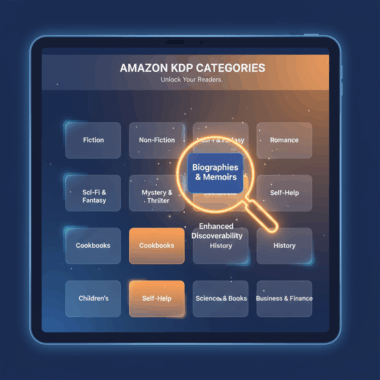
How to Request Additional Amazon Browse Categories
After your book is live:
- Gather exact browse paths you want (for example: Kindle eBooks > Science Fiction & Fantasy > Science Fiction > Space Exploration).
- In KDP, go to Help > Contact Us > Amazon Store & Product Detail Page > Update Amazon Categories.
- Provide your ASIN, marketplace (e.g., Amazon.com), and list the exact categories requested.
- Keep the request focused and relevant. KDP typically supports placement in multiple browse nodes if they clearly match your book’s content.
Common Category Mistakes to Avoid
- Chasing low-competition categories that don’t match the book’s promise. Short-term rank isn’t worth long-term poor reviews.
- Selecting only broad categories because they “sound big.” You’ll fade into noise.
- Ignoring international marketplaces where your niche may be underserved and easier to rank.
- Failing to revisit categories after cover or subtitle changes alter market fit.
- Overlooking how categories interact with keywords and ads; misalignment confuses both the algorithm and readers.
Practical Walkthrough: Fiction Example
Suppose launching a fast-paced post-apocalyptic sci-fi with a strong survival element.
Positioning: “High-tension post-apocalyptic survival sci-fi for readers who love found-family dynamics and tactical realism.”
Research yields several relevant browse paths:
- Kindle eBooks > Science Fiction & Fantasy > Science Fiction > Post-Apocalyptic
- Kindle eBooks > Literature & Fiction > Genre Fiction > War
- Kindle eBooks > Science Fiction & Fantasy > Science Fiction > Dystopian
Strategy:
- Choose BISAC subjects that map cleanly to Science Fiction / Post-Apocalyptic.
- Ask KDP to add the two secondary browse paths above.
- Align keywords with subgenre tropes: “EMP survival,” “collapse fiction,” “post-apocalyptic series,” “military sci-fi survival.”
- Ensure cover uses genre conventions: stark landscapes, tactical silhouettes, industrial color grading.
- Price within subgenre norms and run ads targeting those browse paths and matching keywords.
Iterate after two weeks:
- If Dystopian underperforms due to tonal mismatch, swap in “Genetic Engineering” or “Alien Invasion” if relevant to the plot arc.
Practical Walkthrough: Nonfiction Example
Launching a practical guide titled “30-Day Local SEO Playbook for Small Businesses.”
Positioning: “Step-by-step local SEO system for brick-and-mortar owners to rank in Maps and drive calls.”
Candidate categories:
- Kindle eBooks > Business & Money > Marketing & Sales > Search Engine Optimization
- Kindle eBooks > Computers & Technology > Internet > Web Marketing
- Kindle eBooks > Business & Money > Small Business & Entrepreneurship
Strategy:
- Primary focus on SEO subcategory, with secondary on Small Business to capture owner intent.
- Keywords: “local SEO,” “Google Business Profile,” “rank in Google Maps,” “small business marketing.”
- Subtitle emphasizes outcome and timeframe: “Rank in Google Maps in 30 Days with Actionable Checklists.”
- Backmatter includes a lead magnet to grow an email list for upsells.
- If “Web Marketing” skews too general, test “Advertising” or “E-Commerce” depending on content emphasis.

Align Categories with Your Long-Term Catalog
If building a catalog or series, create a category architecture:
- Pick a consistent primary category that anchors brand identity.
- Rotate secondary categories per title to probe adjacent niches and grow audience breadth.
- Use anthology or spin-off entries to enter adjacent categories without confusing the core brand.
This approach compounds discoverability: each new release cross-pollinates readers across your category footprint.
Checklist: Selecting and Optimizing KDP Categories
- Clearly define book positioning (genre/topic, audience, promise).
- Build a primary and secondary theme map.
- Research browse paths three to four levels deep; assess BSR competition and fit.
- Choose two BISAC subjects that map to ideal Amazon browse categories.
- Post-publication, request additional relevant browse nodes from KDP support.
- Align title, subtitle, cover, and keywords with category conventions and reader intent.
- Track BSR and ranks; iterate categories if conversion lags.
- Localize categories and keywords for each international marketplace.
- Revisit categories with every cover/metadata update or sequel release.
Final Takeaway
Treat Amazon KDP categories as strategic levers, not administrative checkboxes. Start with a clear positioning statement, pick categories where you can win early, and reinforce them with aligned metadata and marketing. Use launch momentum to secure visibility in targeted sub-niches, then iterate based on rank and conversion data. Over time, this disciplined approach compounds discoverability, builds brand equity in your genre, and turns each new release into a stronger performer than the last.