
Movie Review: Dan Trachtenberg’s Predator: Badlands reimagines the long-running sci-fi franchise by blending primal bloodlust with emotional evolution. Known for his anthropological reading of the Predator mythos, Trachtenberg again delivers more than a survival story. Following his acclaimed Prey (2022) and the animated Predator: Killer of Killers, his latest film dives deep into the psyche of the Yautja race, exploring themes of masculinity, empathy, and cooperation beneath layers of thrilling carnage.
A New Kind of Predator Tale
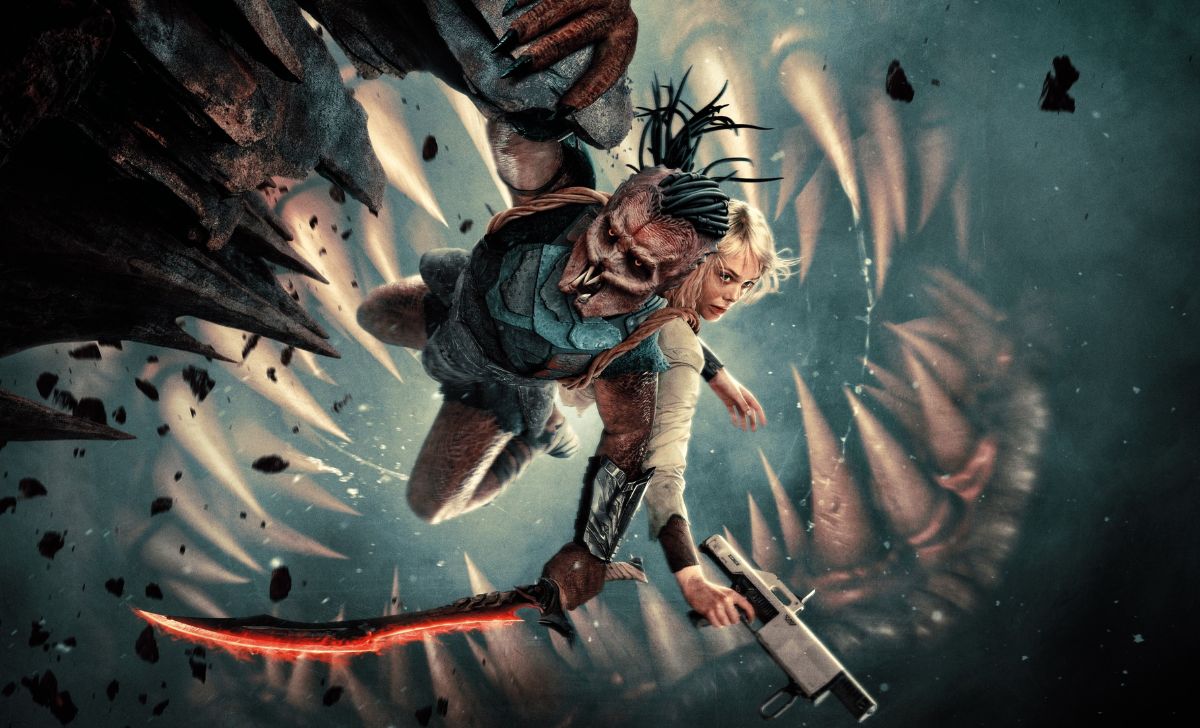
The film centers on Dek (Dimitrius Schuster-Koloamatangi), a young Yautja shunned by his clan for being too small and weak. His father’s disgust and his brother Kwei’s sacrifice push Dek into exile on the hostile planet Genna, where he must regain honor by killing the Kalisk—a monster so lethal that even the galaxy’s top hunters fear it. Genna itself is a nightmare ecosystem filled with dangerous flora and fauna: tree tentacles, blade-like vegetation, and grotesque hybrid predators that embody nature’s own madness.
Trachtenberg treats Genna not as a backdrop but as a living organism. Every element of its wild terrain seems intent on destroying intruders. Cinematographer Jeff Cutter captures this chaos with striking physicality—light feels tangible, shadows sticky and wet, every frame breathing with an unsettling life. The environment gradually dismantles Dek’s arrogance, forcing him to shed his inherited machismo and survive on instinct rather than pride.
The Machine with a Soul
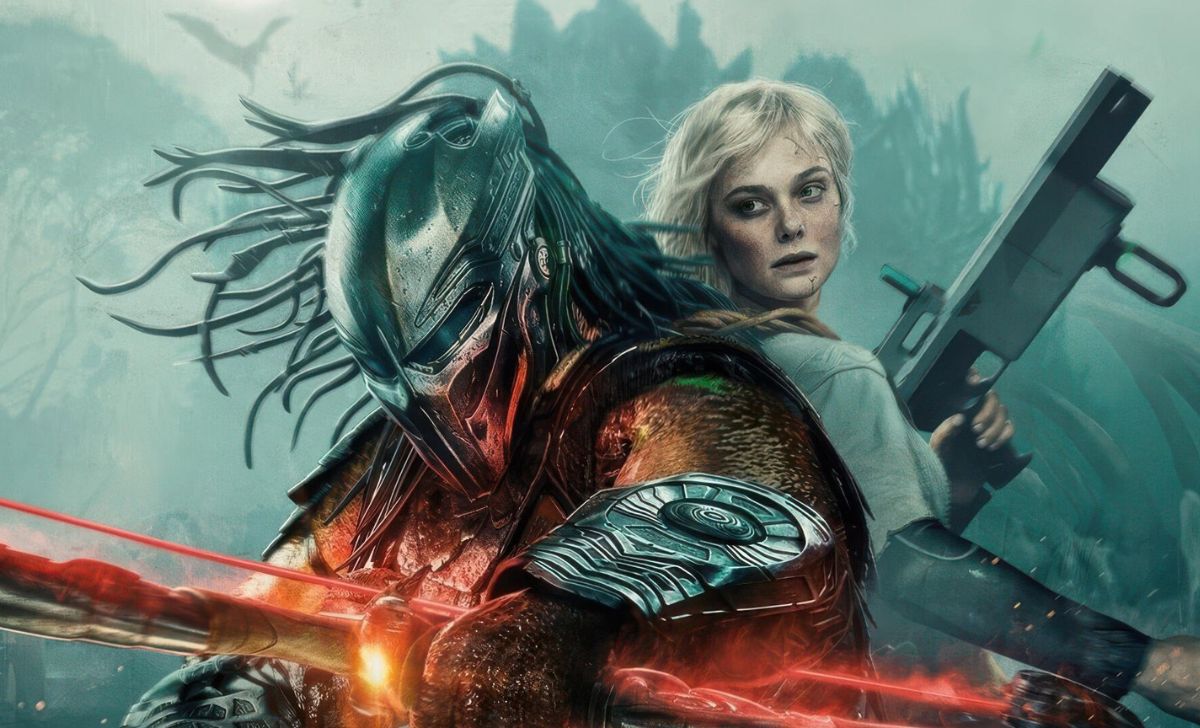
Dek’s journey changes when he meets Thia (Elle Fanning), a half-destroyed synthetic marooned from a bygone Weyland-Yutani mission. Despite being torn in half, Thia is bright, talkative, and strangely philosophical. She first saves Dek from certain death and becomes his reluctant partner in survival. Strapped to his back, Thia’s cheerful chatter contrasts with Dek’s gruff silence, creating a dynamic that alternates between absurd comedy and genuine connection.
Their relationship is the film’s emotional core. Thia may be only half a body, but she feels more human than anyone else in the story. Her attempts to teach Dek empathy—by reframing strength as protection rather than dominance—gradually reshape him. One of her observations, that an alpha leads by care rather than violence, becomes the film’s moral center. This unlikely companionship turns the alien hunter’s quest into a study of emotional literacy and mutual dependence.
Humor, Heart, and Hyperviolence
Though Badlands delivers all the gory spectacle expected of a Predator film—ruthless battles, elaborate alien weaponry, and tons of viscera—it also knows how to have fun. The absurdity of Thia’s detached legs performing kung-fu mid-battle could have sunk the tone, but Trachtenberg executes it with perfect comic energy. A mischievous sidekick named Bud, a gremlin-like creature, adds moments of levity without cheapening the tension.
Composer duo Sarah Schachner and Benjamin Wallfisch match the chaos with a tribal-meets-electronic score, blending throat-sung intensity with pulsing modern beats. It’s part war chant, part cosmic rave, perfectly syncing with the film’s primal yet futuristic mood.
Despite its depth, Predator: Badlands still embraces its B-movie DNA. With nods to the Alien franchise’s Weyland-Yutani legacy and sly references to the earliest Predator films, it invites longtime fans to join in the fun. The dialogue—theatrical, witty, and occasionally ridiculous—fits the spirit of a movie meant to be watched with a grin, maybe even a beer in hand.
Masculinity, Empathy, and Evolution
Beneath the spectacle, Predator: Badlands dismantles the macho identity the franchise was built on. Trachtenberg recasts Yautja initiation rituals as rites of self-discovery rather than dominance. Dek’s belief in violence as the marker of worth is slowly replaced by understanding and connection. There are even hints of queerness in his transformation—a rejection of rigid hierarchies in favor of emotional openness.
Thia’s line, “I could survive on my own, but why would I want to?” encapsulates the film’s message. The Yautja may worship strength, but true evolution lies in cooperation. It’s a lesson neither alien nor human can afford to ignore.
The Verdict
Predator: Badlands is both brutal and tender—a cosmic survival story that doubles as an unexpected parable about empathy. It trades the muscle-bound machismo of the original 1987 film for something smarter and stranger, without diluting the visceral thrill that made the franchise iconic. Between its lush visuals, inventive action, and oddly touching heart, Trachtenberg has achieved what few could: he made the Predator feel human.
Predator: Badlands is now playing in theatres, inviting viewers to witness a galaxy where even the deadliest hunter must learn how to care.