
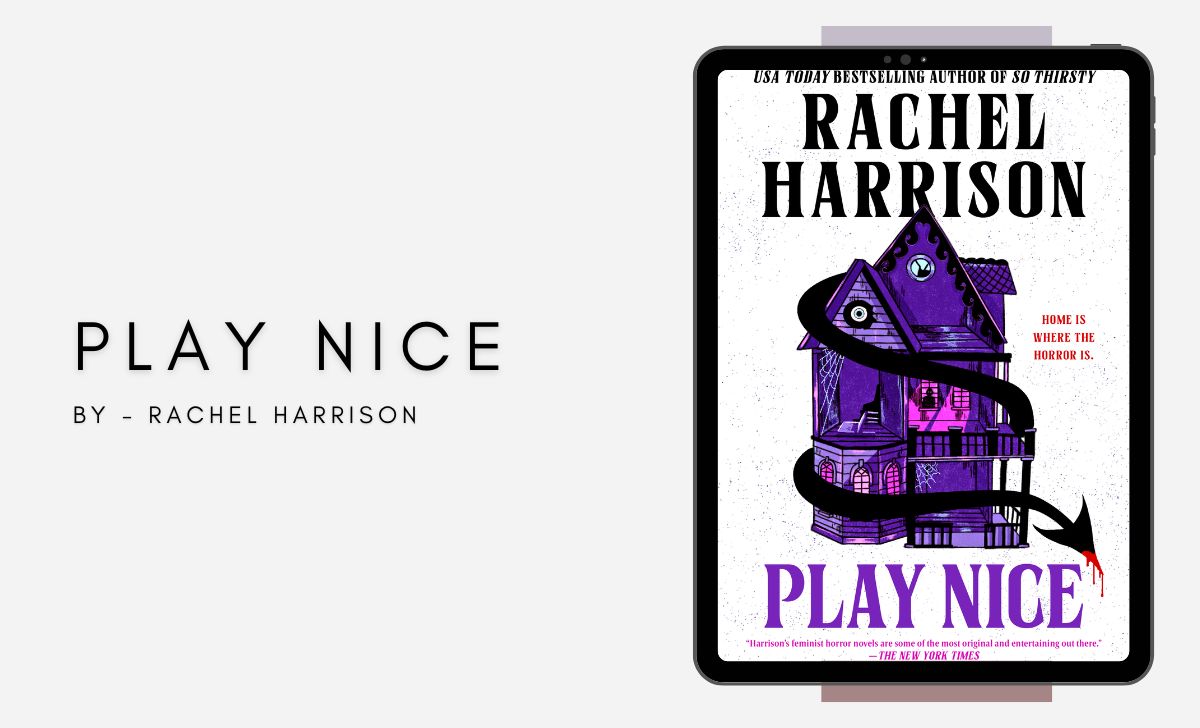
Clio Louise Barnes has built a life that looks effortless on camera: a well-curated wardrobe, a steady stream of sponsorships, and an influencer’s knack for turning ordinary chores into marketable content. In Play Nice, Rachel Harrison peels back that glossy veneer and drags the rot underneath into the light. This is a haunted-house story that prefers examining people to showing jump scares—though it does both—and Harrison uses the inversion to ask what we do to one another when the world expects us to be small, likable, and easily digestible.
What the book is about (plot summary — spoiler-aware)
After a messy childhood defined by divorce and a mother who insisted their family home was possessed, Clio and her sisters were split apart—legally and emotionally. Years later, Clio, now an influencer and stylist whose public life is immaculate, unexpectedly inherits that childhood house when her mother dies. Where her sisters see only the scars of a difficult past, Clio sees content: a high-visibility house-flip that could boost her brand. But as renovations proceed, odd things start to happen. Objects move, memories she’d tucked away resurface, and the dusty pages of a memoir her mother published about “the demon of Edgewood Drive” grow harder to dismiss. The house—if it is the house—resists being simplified into a single explanation, and the creeping supernatural forces force Clio to reckon with whether the real haunting was a thing in the walls, or something that was done to them all long ago.

Style, tone, and the book’s strengths
Harrison writes with a dry, sometimes gleeful cruelty toward the culture she’s describing: influencers, the attention economy, and the public appetite for spectacle. The prose is sharp and often funny, and she balances that levity with genuinely unnerving moments—the sort that don’t rely on a cheap scare but on sustained unease. What the novel does very well is let the reader occupy two uncomfortable positions at once: we understand Clio’s desire to monetize pain (who wouldn’t, given the pressures and incentives of social media?), and we also feel resentful of the way that pursuit can flatten human complexity into thumbnails and metrics. Those contradictions power the book. Reviewers have noted Harrison’s millennial spin on the haunted-house genre and praised her ability to fuse social commentary with creepiness.
Characters and relationships — why the book cares about family
At its center, Play Nice is a family book as much as a horror book. Clio’s relationship with her late mother, Alex, creates the gravitational pull of the story: a woman publicly labeled unstable, who wrote about being tormented by something the rest of the world refused to see. Clio’s sisters function as mirrors, showing different versions of how people remember trauma—and how courts and communities decide which memory is “real.” Harrison avoids tidy moralizing; characters rarely behave as pure victims or villains. Instead, she draws a messy portrait of how people cope, blame, and sometimes weaponize narratives (including the narrative of “possession”) to survive or to win sympathy. That complexity is where the novel earns its emotional stakes.
Pacing, structure, and a note on the horror elements
The story oscillates between domestic detail and escalating dread. Harrison is not interested in a relentless, adrenaline-only pacing; she lets claustrophobia accumulate. There are chapters that read like lifestyle copy—meticulous descriptions of renovations, aesthetics, and brand-friendly choices—and then chapters where that domesticity curdles into horror. This push-pull can feel uneven to some readers: if you expect non-stop shocks, the quieter sections might feel slow. But if you appreciate a book that builds mood by letting ordinary life become uncanny, the pacing rewards patience. Publishers Weekly, for instance, observed Harrison’s willingness to fuse millennial concerns with haunted-house tropes, even as some reviewers felt certain ideas could have been more fully developed.
Themes that linger after the last page
There are three themes Harrison returns to: the public/private split in modern life, the ways communities police women who don’t conform, and the slipperiness of memory. The novel asks: when a mother claims a house is possessed, is the “possession” a literal extra-physical presence, or a language someone uses to describe abuse, addiction, or societal failure? Harrison refuses to hand a single answer to that question; the ambiguity is the point. It’s also a book about performance—about the constant curation of the self—and how that performance sometimes collapses under the weight of things the algorithm can’t monetize. Several reviewers praised how the book uses genre trappings as a means to a larger cultural critique.
What didn’t quite land (a fair critique)
The flip side of ambiguity is that some plot threads feel under-explored. A few critics and readers noted that Harrison sprinkles promising ideas—about media treatment of women, legal outcomes, and the culture of “likability”—and doesn’t always let them resolve in a satisfying way. If you prefer horror that ties its mysteries into a neat explanatory bow, Play Nice might frustrate you. Also, the novel’s satirical treatment of influencer culture occasionally teeters into caricature; when that happens, the emotional beats lose some of their punch. Still, for many readers these are quibbles beside the novel’s sharper pleasures.
Final verdict — who should read Play Nice?
If you like your horror to be less about constant screams and more about how the everyday becomes alien, Play Nice will stick with you. Fans of Rachel Harrison’s earlier work—readers who enjoyed her knack for combining wit, social observation, and a genuine desire to unsettle—will find much to admire. And if you’re curious about novels that interrogate image-making, trauma, and the ways we tell (and retell) stories about who is believed, Play Nice offers a smart, often unnerving ride. It’s not the only haunted-house book you’ll read this season, but it’s one that keeps returning your attention to how we actually make things haunted: with silences, with laws, with public shaming, with the stories we choose to repeat.