
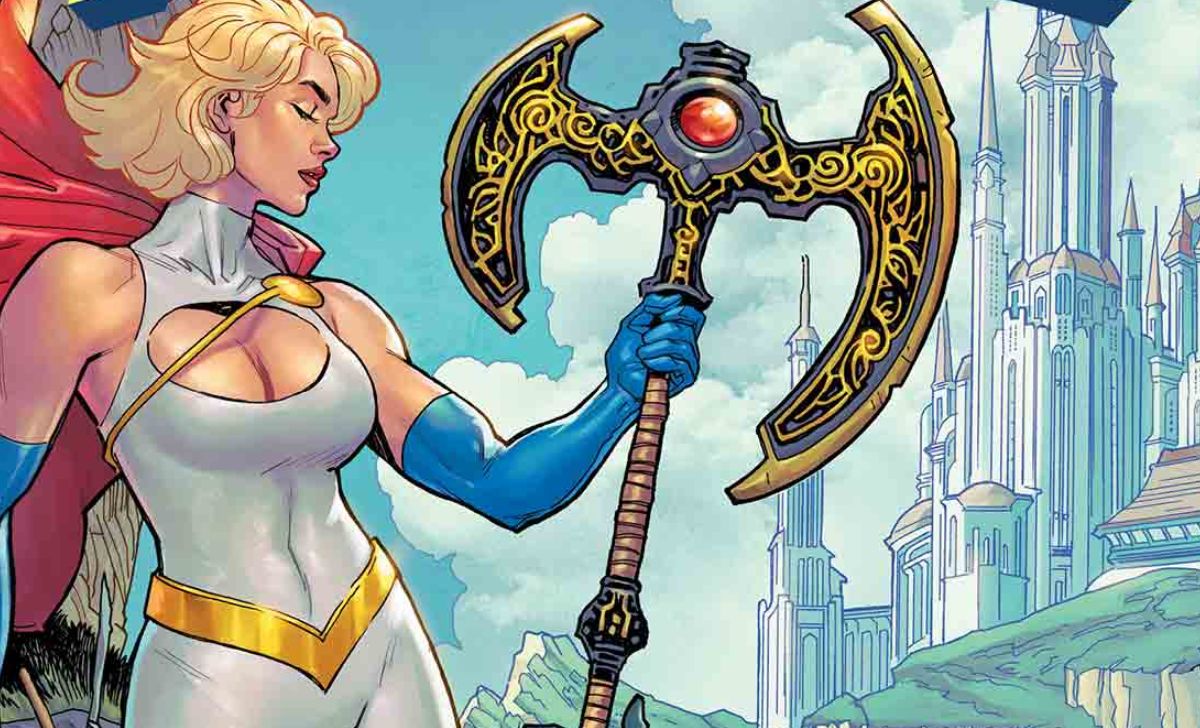
Power Girl has one of the most fascinating—and famously tangled—origin stories in superhero comics. She begins as the bold, no-nonsense cousin of Superman from an alternate Earth; then she’s retconned into an Atlantean mystic; later she’s restored to Kryptonian status; and in the latest era she’s stepped into a new identity with new powers and a new civilian life. If you’ve ever wondered how we got from Kara Zor-L of Earth-Two to Dr. Paige Stetler of Metropolis, this detailed guide is for you.
Bronze Age beginnings: a new hero for the Justice Society
Power Girl debuted in All-Star Comics #58 in 1976, created by Gerry Conway, Ric Estrada, and Wally Wood. She arrived as Superman’s cousin from Earth-Two, the parallel world where DC’s Golden Age heroes lived. From the beginning, she was designed as the Earth-Two equivalent of Supergirl—but older, more independent, and determined to forge her own heroic path.
When the Justice Society stories shifted across titles during the late 1970s, she became one of the standout characters. Her solo try-out issues in Showcase #97–99 (1978) expanded the details of her pre-Crisis origin. These issues introduced the idea of a “symbioship”—a Kryptonian vessel that kept her in stasis while simulating a full Kryptonian upbringing. This explained why she arrived as an adult rather than as a teen like Supergirl.
Two defining character features emerged early:
- She did not wear the “S” shield, signaling her independence.
- She had an outspoken, assertive personality that made her stand out among DC heroines of the time.

Crisis, erasure, and reinvention: the Atlantean detour
In 1985–86, DC radically reshaped its entire universe with Crisis on Infinite Earths, merging all parallel Earths into one. Because Power Girl’s identity depended on Earth-Two existing, the event created a continuity problem. To fix this, DC reinvented her origin in Secret Origins #11 (1987): Power Girl was declared not Kryptonian, but instead the descendant of the ancient Atlantean sorcerer Arion.
In this revised story, she was placed into suspended animation centuries ago and awakened in modern times. Her powers were explained as mystical in nature, not solar-based. This version was further expanded in her 1988 miniseries, which leaned more heavily into fantasy and magic than her previous sci-fi origins.
Although creative, the Atlantean retcon never fully resonated with readers. Fans continued to associate her with the JSA and the lost Earth-Two Superman. The character often felt caught between editorial mandates and her natural place in the mythos.
“It was always Krypton”: Infinite Crisis and restoration
Everything changed again with Infinite Crisis (2005–2006). The event returned the multiverse concept, and with it, the restoration of Power Girl’s classic history. DC reestablished her as Kara Zor-L, the Kryptonian cousin of Earth-Two’s Superman (Kal-L).
Her years of conflicting memories and fluctuating power levels were explained as the result of cosmic disruptions. After this, Power Girl rejoined the Justice Society of America, grounding her once more in her original world’s legacy—even though Earth-Two itself had changed.
This restoration brought back key elements from her Bronze Age origins, including the symbioship upbringing, which once again became an official part of her history.
The New 52: Earth 2 refugee and Worlds’ Finest
DC rebooted its continuity again in 2011 with The New 52. In this version of events, Karen Starr originated on Earth 2, where she served as Supergirl. A catastrophic war forced her and her best friend Helena Wayne (the Huntress) into a dimensional rift, leaving them stranded on the main Earth.
Their ongoing adventures were chronicled in the series Worlds’ Finest, where Power Girl tried to balance her superhero life with a high-profile tech entrepreneur identity. This era kept core aspects of her character—her confidence, her practicality, her bond with Helena—while giving her a more modern voice and visual style.
Rebirth, Doomsday Clock, and the JSA’s return
When DC launched Rebirth in 2016, the goal was to restore legacy to the DC Universe. Through events like Doomsday Clock (2017–2019), the Justice Society—including Power Girl—was reintegrated into mainstream continuity. This allowed Kara to reconnect with the rich history of the JSA and return to the role she held prior to The New 52.

Dawn of DC (2023–present): a new name, new powers, same resolve
The Dawn of DC initiative in 2023 brought another major evolution for Power Girl. After the events of Lazarus Planet, she temporarily developed psychic abilities, allowing her to enter minds and even manifest an “astral punch.” She explored a new civilian identity, Dr. Paige Stetler, which gave her a grounded role in Metropolis.
Her modern series blends her classic Kryptonian powers with emotional intelligence, mentorship, and her work as a science columnist for the Daily Planet. Writers have emphasized her longstanding theme: Power Girl carves her own space within the Superman Family while maintaining complete independence.
This era also focused heavily on distinguishing her from Supergirl—not in opposition, but in identity. Power Girl is no longer “the other Kara.” She is a fully realized hero in her own right.
Why her origin kept changing
Power Girl’s constantly shifting origin is a direct result of her position in DC’s structure. She is tied to:
- The multiverse (which DC frequently reboots)
- The Superman family (one of the company’s strictest continuity frameworks)
- The Justice Society (whose existence has been erased and restored many times)
Whenever DC resets its universe, characters with multiversal roots are heavily affected. Power Girl often became the symbol of how DC tried to balance new continuity rules while preserving fan-favorite characters.
Despite all the retcons, Kara’s personality remained one of the strongest constants: direct, confident, practical, and determined.
Costume, symbols, and the “S” she doesn’t wear
Power Girl’s classic white costume with a red cape and the iconic keyhole emblem has remained one of the most recognizable outfits in superhero comics. Her refusal to wear the “S” shield is a thematic choice: she has always sought to build her identity independently from Superman.
This choice reinforces her character’s core idea—legacy without being defined by it.
The throughline: what never changed
Throughout all continuity shifts, three elements of Power Girl have stayed consistent:
- Self-determination
She shapes her own identity rather than inheriting one. - Connection to the Justice Society
From her debut to modern stories, she remains a key bridge between Golden Age legacies and new generations. - Kryptonian heritage
Aside from the brief Atlantean retcon, she has always circled back to her original origin as Kara Zor-L of Earth-Two.

A quick timeline of important eras
- 1976–1984: Debut in All-Star Comics; the symbioship origin introduced; showcases her early independence.
- 1985–1995: Crisis removes Earth-Two; Power Girl reimagined with Atlantean origins.
- Late 1990s–2000s: Rejoins the JSA and regains narrative stability.
- 2005–2006: Infinite Crisis restores her true Kryptonian origin.
- 2011–2016: New 52 reimagines her as Earth 2’s Supergirl, stranded on the main Earth.
- 2017–2019: Rebirth brings back the classic JSA continuity.
- 2023–present: Dawn of DC redefines her with new abilities, a fresh civilian identity, and a firm place in the Superman Family.
Where to start reading
If you want to explore Power Girl’s history, recommended starting points include:
- All-Star Comics #58
- Showcase #97–99
- Secret Origins #11
- Infinite Crisis
- Worlds’ Finest (2012–2015)
- Power Girl Special (2023)
- Power Girl (2023–present)
These stories collectively give a full picture of her evolution across multiple eras.