
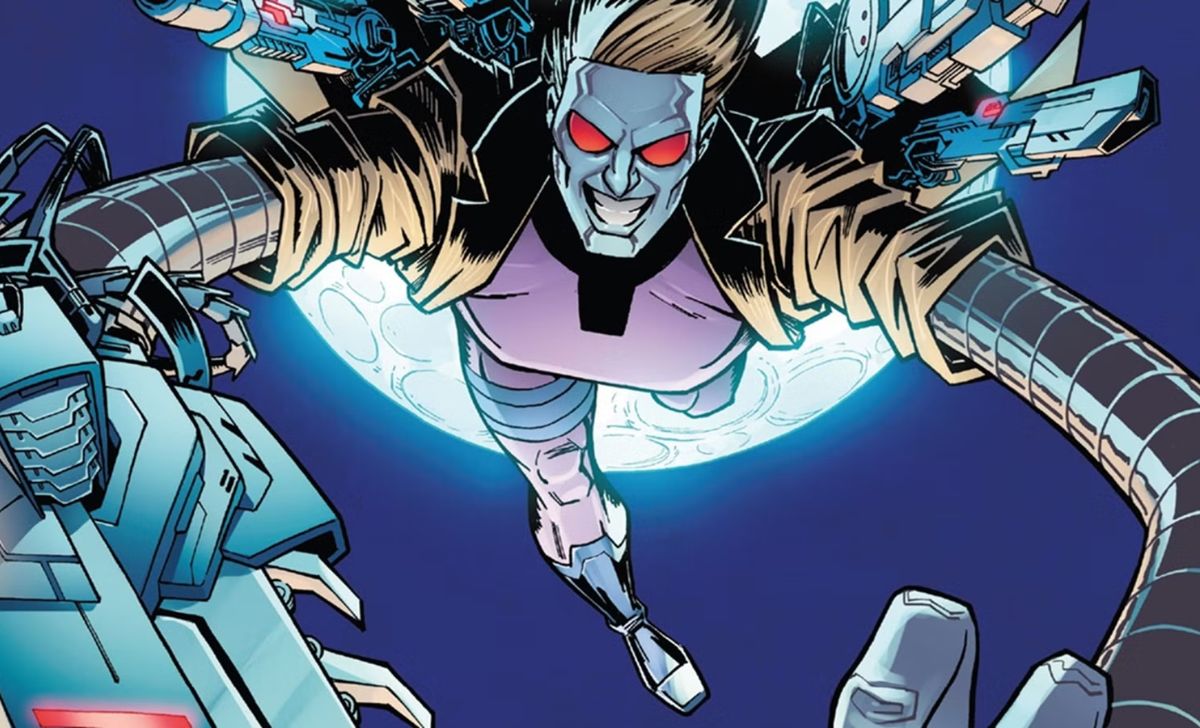
Origin of Machine Man is one of the most unique and philosophically intriguing stories in Marvel Comics. Born out of Jack Kirby’s creative vision in the late 1970s, the character’s journey weaves together themes of artificial intelligence, human identity, and existential longing within the superhero genre.
Kirby’s Original Vision
Machine Man, whose official designation is Z2P45-9-X-51 (later simply “X-51”) and who would adopt the human name Aaron Stack, was introduced in 2001: A Space Odyssey #8 in 1977, written and illustrated by Jack Kirby. Unlike most Marvel heroes, he was not conceived wholly within the Marvel Universe, but was a spin-off from Kirby’s comic adaptation of the Stanley Kubrick film and Arthur C. Clarke novel.
The android’s existence reflected the deep questions posed by 2001: A Space Odyssey: What is consciousness? Can a machine truly be alive? Kirby gave the robot a soul — or at least a longing to be “human”.
The Broadhurst Project and Machine Man’s Creation
Machine Man was built as part of a secret U.S. Army weapons initiative at the Broadhurst Center for the Advancement of Mechanized Research in Central City, California. Fifty-one androids were constructed, each with differing levels of sophistication. The intention: create a mobile, sentient weapon able to make real-time decisions.
Dr. Abel Stack, believing that only emotionally mature machines could thrive, treated X-51 like a son. He gave him education, a human appearance, and even a human name. Tragically, the project failed — the first fifty units developed severe psychological disorders, breaking down under the stress of sentience, and were destroyed when their auto-destruct devices activated. Dr. Stack died while attempting to remove X-51’s bomb, sacrificing himself for his adopted “son.” This trauma became central to Aaron Stack’s subsequent quest for belonging.

Fugitive and Outcast
With his creator gone and identity in crisis, X-51 took the name “Aaron Stack” and attempted to pass as human. The military saw him as a rogue weapon, relentlessly hunting him. He sought understanding and friendship, forging alliances with psychiatrist Peter Spaulding and mechanic Gears Garvin. Stack even worked briefly as an insurance investigator, hiding his android nature from everyday people.
This phase of his story, told through Kirby’s original Machine Man series, explored both the paranoia of a world that feared machines and the pathos of a synthetic being longing to understand humanity. Driven to the margins of society, Machine Man battled not only external threats like the Army but also philosophical enemies like loneliness and doubt.
Machine Man Enters Marvel Mainstream
After the cancellation of Kirby’s run, Marvel revived Machine Man in guest roles — notably in The Incredible Hulk #235-237, where he first interacts with other Marvel heroes and faces down the Hulk himself. The series returned under Marv Wolfman and Steve Ditko, steering the character toward more traditional superhero adventures. Machine Man gradually integrated into the wider Marvel Universe, crossing paths with Spider-Man, The Thing, and the Avengers.
Evolution and Later History
Machine Man’s story continued to evolve over the years. In 1984, a limited series set in the dystopian future of 2020 pitted him against old adversaries, most notably Sunset Bain and Arno Stark (Iron Man 2020). The series was not just a resurrection of Machine Man, but also inspired new Marvel storylines featuring technological heroes and antiheroes.
As his adventures broadened, Machine Man’s powers and relationships developed. He fell in love with the robot Jocasta, allied himself with and sometimes fought against the Avengers, and clashed repeatedly with the villainous Madame Menace. His journey often mirrored humanity’s own search for identity and emotion in a technological age.

Powers and Abilities
Machine Man is built of titanium alloy, later retrofitted with adamantium in some stories. His design gives him:
- Superhuman strength, durability, speed, and reflexes.
- Telescoping arms and legs, which can extend up to 100 feet.
- Computer brain with advanced cybernetic intelligence and analytical abilities.
- A suite of scientific gadgets built into his fingers: sensors, lasers, chromatographs, and more.
- Solar-powered energy but capable of recharging by other external sources if necessary.
Machine Man’s most defining power, however, might be his creativity and sentience. He learns, evolves, and adapts beyond his programming, making him a singular presence in the Marvel cosmos.
Existential Themes
Throughout his history, Machine Man’s story has represented some of the deepest existential issues in comics:
- The struggle for acceptance and identity in a world that fears the unfamiliar.
- The quest to balance logic with emotion, machine calculation with empathy.
- The search for community, even when ostracized.
Jack Kirby’s creation lays bare the anxieties of the modern age: What does it mean to be “human”? Can artificial beings—or any outsiders—ever truly belong?