
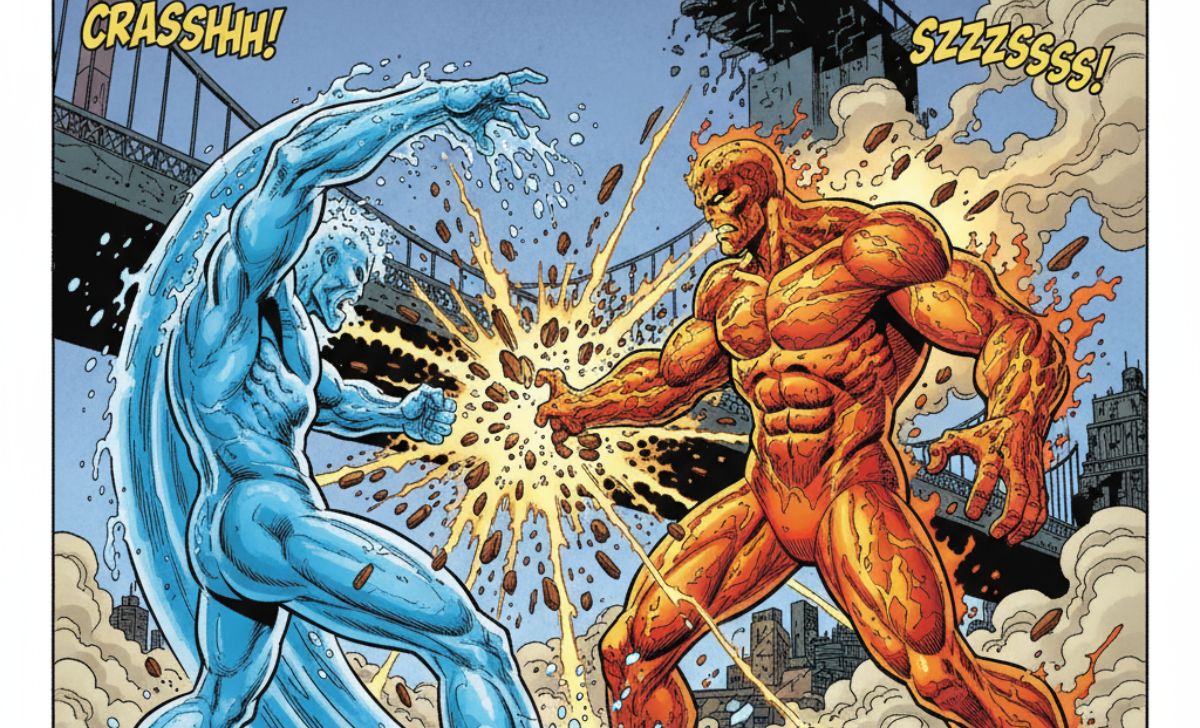
The origin stories of classic Spider-Man villains, Hydro-Man and Molten Man, highlight the unpredictable intersections of science, ambition, and accident that fuel Marvel Comics’ most memorable foes. In this detailed exploration of the “Origin of Hydro-Man and Molten Man,” we’ll break down their comic book beginnings, transformations, and comic legacy—complete with references to their appearances on screen and in modern media.
Hydro-Man: From Ordinary Crewman to Man-of-Water
Hydro-Man (Morris “Morrie” Bench) was created by Dennis O’Neil and John Romita Jr., first appearing in The Amazing Spider-Man #212 (1981). Morris Bench was an unremarkable crewman on a cargo ship when his life was irreversibly changed during the testing of an experimental underwater generator. Ordered to oversee safety by project head Mr. Whitman (with Spider-Man present), things quickly went wrong: a snapped electric cable led to chaos, and in the fray, Spider-Man accidentally knocked Bench overboard.
Falling into the ocean near the generator, Bench was exposed to a mysterious energy reaction, caused by the interaction of the device’s radiation and volcanic gases in the water. He emerged from this mix fundamentally altered—his body now capable of transforming entirely into water and controlling it at will. Initially mystified and disturbed by his powers, which included turning into a liquid and reassembling himself, Bench soon realized the destructive potential he wielded. The media soon dubbed him “Hydro-Man” after a rampage born from his new condition and thirst for revenge against Spider-Man, blaming the hero for his misfortune.
Over the years, Hydro-Man’s powers included merging with and manipulating massive quantities of water, shape-shifting his form, withstanding bullets and physical attacks, and even creating tidal waves. Though frequently portrayed as aggressive and unpredictable, Hydro-Man was at times emotionally unstable—seeking belonging or notoriety. He often allied with other supervillains, including temporary mergers with Sandman to form the composite Mud-Thing, further complicating his relationship with Spider-Man and the wider Marvel Universe.
Hydro-Man’s longevity as a Spider-Man foe is highlighted by his adaptation in various media, most notably as a basis for the Water Elemental in Spider-Man: Far from Home.

Molten Man: The Tragic Alchemy of Greed
Molten Man (Mark Raxton) made his debut much earlier, in The Amazing Spider-Man #28 (1965), created by Stan Lee and Steve Ditko. Raxton, a chemical engineer in New York City, worked as a lab assistant with Dr. Spencer Smythe (notorious among Spider-Man fans for inventing the Spider-Slayers). Ambitious and impatient for wealth, Raxton decided to steal a freshly developed experimental liquid metallic alloy, ignoring Smythe’s warnings about its instability. In the ensuing struggle, the alloy spilled and soaked Raxton’s skin, instantly turning it a metallic gold and suffusing his body with strange energy.
Though frightened and rushed to seek medical help, Raxton quickly discovered his new condition was more a boon than a curse. He was now possessed of superhuman strength, durability, and the ability to generate tremendous heat and emit dangerous radiation—eventually learning he could withstand (and project) temperatures far hotter than the human body should allow. Adopting the name “Molten Man,” Raxton embraced a life of crime empowered by his new might, only to be repeatedly thwarted by Spider-Man, their rivalry forming one of the webslinger’s earliest recurring conflicts.
Raxton’s journey in the comics is more nuanced than that of a simple villain. His story arcs involve attempts to cure his condition, strained family ties (notably with his stepsister Liz Allan), and occasional shifts from villainy to reluctant ally. Over time, he evolved into a tragic figure, sometimes assisting Spider-Man and stepping into a protective role for his sister and friends. As with Hydro-Man, the MCU’s Spider-Man: Far from Home features an illusionary creature based on Molten Man, adapting the character’s fiery essence for the big screen.

Powers, Abilities, and Legacy
Hydro-Man’s elemental mutation gave him total control over his watery form: he can shapeshift into liquid or vapor, absorb outside water to increase mass, manipulate water currents, and is largely immune to physical attacks or bullets—making him a constant threat in combat, especially near water sources. He’s even survived being vaporized, later reintegrating thanks to control over every particle of his aqueous self.
Molten Man’s transformation rendered his entire body as living, heat-generating metal alloy. This grants him tremendous strength (lifting up to 40 tons), extreme durability, and resistance to temperatures well above 500 degrees Fahrenheit. In his most radioactive states, proximity to Molten Man can be lethal. Notably, Raxton’s scientific mind has allowed him to refine and adapt his powers, though his volatility regularly puts him at odds with both heroes and other villains.
Both villains’ origins reflect a classic Marvel theme: unintended consequences of human ambition and scientific hubris. Their enduring impact is marked by continued appearances in comics, animated series, and the MCU, where reimagined versions introduce their powers to a new generation.