

The English language, spoken by over 1.5 billion people worldwide today, carries a deeply rich and fascinating history. It did not emerge overnight but developed over centuries through the convergence and transformation of many linguistic influences shaped by migrations, invasions, political shifts, cultural dominance, and global expansion. Understanding the origin of English Language takes us on a journey from ancient Germanic tribes migrating to the British Isles to the modern global lingua franca it is today.
The Roots: Germanic Tribes and Old English
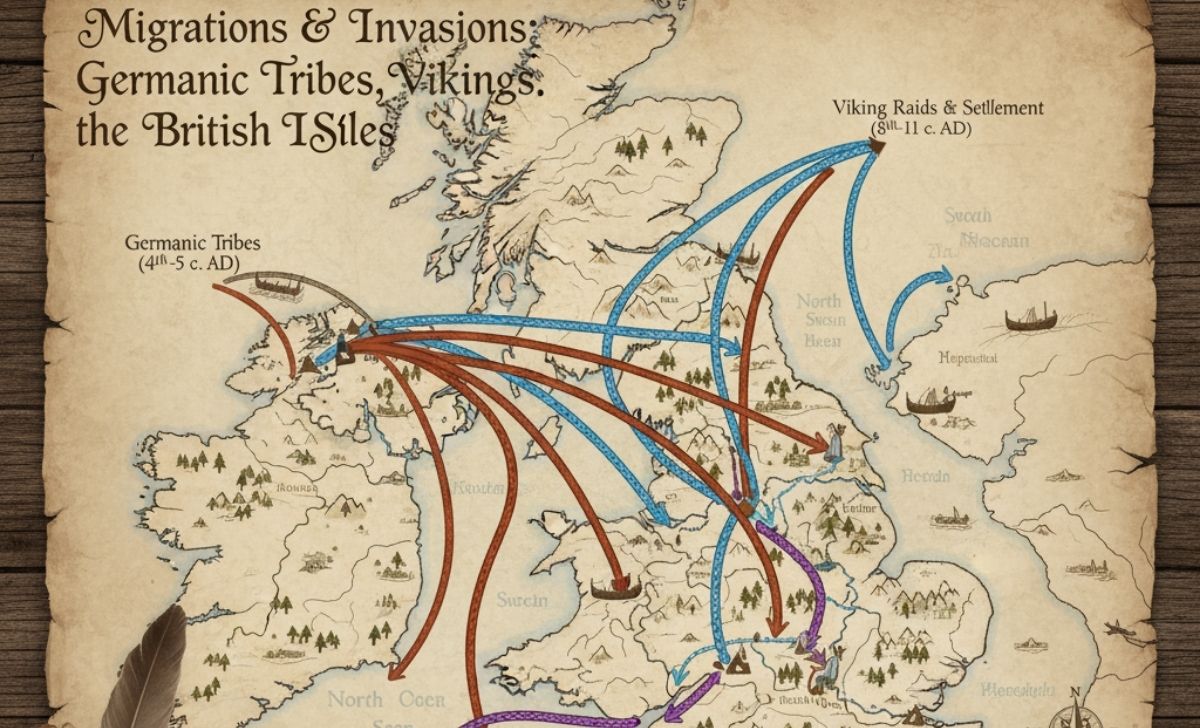
The story of the English language begins in the mid-5th century AD when several Germanic tribes migrated from continental Europe to the island of Britain. These tribes—the Angles, Saxons, and Jutes—came from regions now part of modern Germany, Denmark, and the Netherlands. Their languages belonged to the West Germanic branch of the Indo-European language family, with dialects collectively referred to as Anglo-Frisian or North Sea Germanic.
As these tribes settled in Britain after the Roman Empire withdrew, their dialects gradually became dominant. They displaced the native Celtic languages spoken by the Britons and virtually replaced Latin, which the Romans had introduced during their occupation. The term “English” itself derives from the Angles (“Ænglisc” in Old English), while “England” means “land of the Angles.”
This earliest form of English, known as Old English or Anglo-Saxon, was spoken and written approximately from 450 to 1150 AD. Old English was highly inflected, meaning it used many suffixes and prefixes to indicate grammatical relationships, and had a vocabulary very different from modern English. Famous works like “Beowulf,” the oldest surviving epic poem in English, were composed during this period in one of the main dialects called West Saxon.
The Viking Impact and Old Norse Influence
From the late 8th to the 11th centuries, Viking invasions brought another profound change to the linguistic landscape of England. The Vikings, primarily Norse-speaking peoples from Scandinavia, settled in large parts of Britain, especially northern and eastern England, known historically as the Danelaw.
The Old Norse language mingled with Old English, enriching the vocabulary and simplifying some elements of grammar. This contact introduced over 2,000 new words into English, many of which survive today, including basic terms like “give,” “take,” “knife,” “egg,” and even “viking.” This linguistic blending also contributed to the gradual loss of Old English’s complex inflectional endings, nudging the language toward a more analytic grammar typical of Modern English.
The Norman Conquest and Middle English
One of the most pivotal events in English language history was the Norman Conquest of 1066. The Normans, descendants of Vikings settled in northern France, invaded and took control of England, establishing French as the language of the ruling elite, government, and law. This ushered in the Middle English period, spanning roughly from 1100 to the late 15th century.
During this time, English was largely the language of the common people, while Norman French dominated the higher echelons of society. The influence of French profoundly shaped English vocabulary, especially in areas like law, governance, art, literature, religion, and cuisine. Thousands of French loanwords entered English, many of which remain in use today—words such as “court,” “judge,” “government,” “royal,” “beef,” and “mutton.”
Middle English saw significant changes to grammar and pronunciation. Many Old English inflections disappeared, word order became more fixed, and the Great Vowel Shift—a systematic change in vowel pronunciation—began. This made English spelling increasingly inconsistent with pronunciation, a notorious feature confusing learners even now.
Famous Middle English literature includes Geoffrey Chaucer’s “The Canterbury Tales,” which shows the blending of Anglo-Saxon roots and French vocabulary enriched by Norman influence.
Early Modern English and Global Spread
Around the late 15th century, the English language evolved into what is classified as Early Modern English, lasting until the late 17th or early 18th century. The invention of the printing press by William Caxton in 1476 played a crucial role in standardizing English spelling and grammar. The Renaissance period, with its revival of classical learning, led to the import of many Latin and Greek terms into English, especially in science, medicine, and philosophy.
This period also corresponds with the works of William Shakespeare and the King James Bible, which greatly influenced English literary style and vocabulary. English began to spread globally through exploration, colonization, and trade by the British Empire, absorbing words and influences from many languages worldwide.
Modern English and Contemporary Evolution
From the 18th century to the present, Modern English developed into the form we recognize today. The industrial revolution, scientific advancements, and American political and cultural influence further shaped vocabulary and usage. English continues to absorb words from countless languages, reflecting the multicultural nature of its speakers.
English’s role as a global lingua franca in business, science, education, and entertainment solidifies its status but also subjects it to continuous change. Technology and the internet accelerate linguistic evolution, introducing new slang, jargon, and forms of communication.
Summary
The origins of the English language illustrate a dynamic and adaptive history:
- It began with Germanic tribes bringing their dialects to Britain, forming Old English.
- The Viking invasions mixed Old Norse with Old English, adding vocabulary and simplifying grammar.
- The Norman Conquest introduced Norman French, heavily influencing vocabulary and grammar during the Middle English period.
- The Renaissance and printing press ushered in Early Modern English with standardized spelling and classical influences.
- The British Empire’s global reach and ongoing cultural shifts continually expand and change the English language.
English’s history reflects the story of the peoples and cultures that shaped it—making it a living linguistic tapestry woven from diverse threads. Understanding this rich past gives us a deeper appreciation for a language that continues to evolve and connect people around the world.