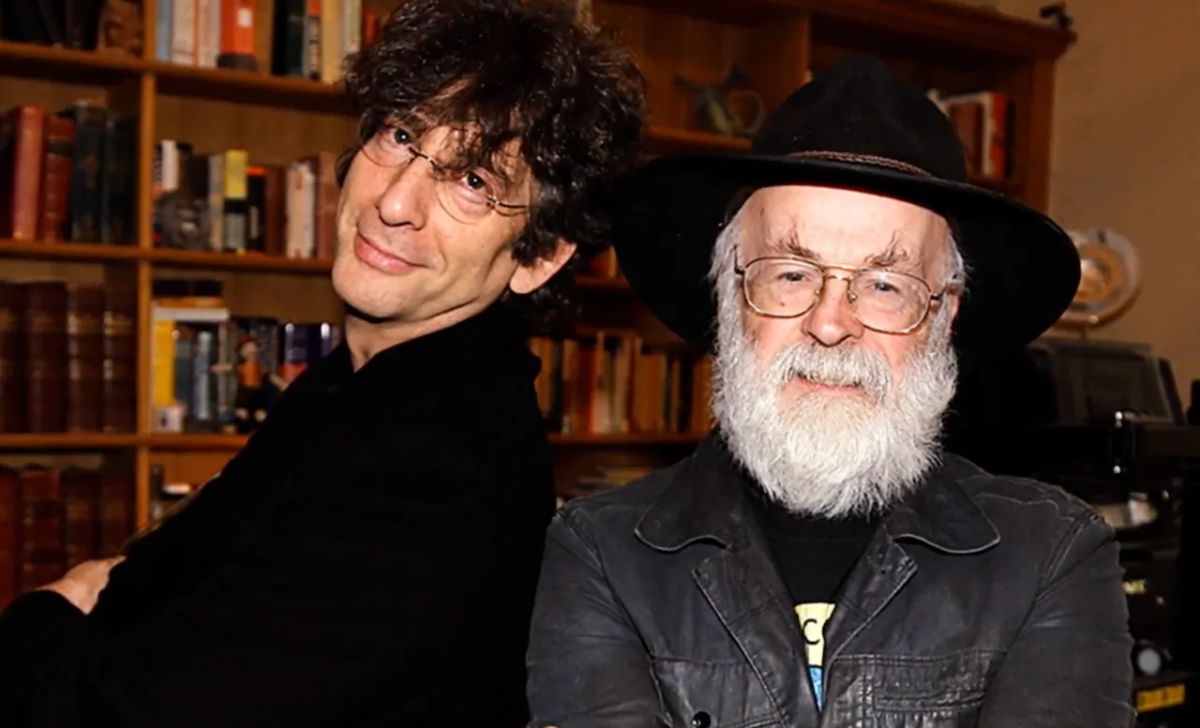
The literary world has been blessed with two modern masters of fantasy and speculative fiction: Neil Gaiman and Terry Pratchett. While both writers have carved distinct niches in contemporary literature, their collaborative novel Good Omens illuminated both their similarities and striking differences. Understanding their individual writing styles reveals not just two talented authors, but two fundamentally different approaches to storytelling, humor, and the human condition.
The Foundation of Their Craft
Neil Gaiman’s writing style emerges from a deep well of mythology and folklore. His prose carries a lyrical, almost poetic quality that hovers between dream and reality. Gaiman himself describes his work as using “memorable lies” to communicate truth, creating stories where the fantastical feels intimately relatable through careful, measured language. His sentences are deliberately crafted for clarity and resonance rather than complexity, achieving elegance through economy of language.
Terry Pratchett, conversely, built his literary empire on the foundation of satire and social commentary. His Discworld series began as straightforward parody of fantasy tropes before evolving into sophisticated satirical novels addressing politics, media, religion, and social issues. Pratchett’s style is economical, elegant, and adventurous, characterized by its accessibility across all age groups—from seven-year-olds to eighty-five-year-old academics.
Narrative Voice and Perspective
One of the most distinctive differences between these authors lies in their narrative approach. Gaiman frequently employs a classical omniscient point of view, creating what he calls a “fairy tale narrator” voice that can move fluidly through story worlds and peer into characters’ thoughts while maintaining opinions about the action. This storyteller quality makes his prose feel oral, as though someone is reading aloud and making the occasional aside. The narrative in Gaiman’s work often creates a dreamlike haze where nothing has perfectly defined edges, everything blurring and washing over the reader.
Pratchett’s narrative voice functions as a character unto itself, particularly in his earlier Discworld novels. He positions himself as a stand-up comedian who can interject into shaggy dog stories as a third-party witness, comedic commentator, or information provider. His third-person omniscient narration allows him to tell rather than show, breaking traditional writing rules with masterful confidence. This distinctive narrative presence permits Pratchett to seamlessly transition between narration and story, managing tone shifts with remarkable skill.

Humor and Wordplay
Both authors wield humor as a fundamental tool, but their comedic approaches differ significantly. Gaiman’s humor tends toward the whimsical and darkly ironic, creating balance between sincerity and levity. He finds humor in unexpected juxtapositions and the absurdity of ordinary people encountering the extraordinary. Even in his darkest works, Gaiman ensures readers laugh at least once, breathing life and flavor into his narratives through this “Touch of Gaiman™”.
Pratchett’s humor operates on multiple levels simultaneously. His work brims with wordplay, puns (which he called “punes”), and linguistic manipulation. He demonstrated genius in lowering and degrading pompous subjects, creating unexpected juxtapositions, and playing with generic and textual references. Pratchett’s signature technique involves taking fantasy clichés and using them to his advantage, examining familiar tropes through quirky lenses. His satirical humor serves not merely for laughs but as deliberate cultural, socio-historical, and political analysis.
The Footnote Phenomenon
Pratchett’s use of footnotes became one of his most recognizable stylistic signatures. These footnotes function as a back-channel for parenthetical comments, background information, or completely unconnected rabbit trails. They break the fourth wall, allowing Pratchett to inject himself into the narrative and address readers directly. The footnotes work particularly well for jokes and historically-steeped information, though he used them less frequently in more serious Discworld novels.
Gaiman rarely employs this technique, preferring to maintain narrative immersion through his lyrical prose rather than authorial asides. This represents a fundamental difference in how they perceive the author-reader relationship—Pratchett as conversational companion, Gaiman as mystical storyteller.
Character Development
Gaiman’s approach to character centers on vulnerability and authenticity. His protagonists often possess defining characteristics that make them memorable without overwhelming complexity. In American Gods, Shadow Moon exemplifies Gaiman’s character-building philosophy—a protagonist defined by his very indefinability, stoic and observant, growing through experiences rather than explicit development. Gaiman creates emotion in scenes without dictating it, giving readers reasons to care while allowing their emotions to follow naturally.
Pratchett’s character development showcases three-dimensional personalities who subvert fantasy clichés. His most celebrated characters—Sam Vimes, Granny Weatherwax, Death—embody his fierce belief in individual worth and opposition to injustice. These characters struggle internally, particularly Vimes and Weatherwax, who both fear the darkness within themselves while maintaining rigid control over it. Pratchett’s characters evolve from two-dimensional fantasy stereotypes in early books to fully realized individuals wrestling with genuine moral dilemmas.
Thematic Concerns
Gaiman’s work consistently explores the intersection of mythology and modernity, examining how ancient stories persist in contemporary contexts. His themes often involve belief systems, the power of stories themselves, and the blurred boundaries between truth and fiction. In works like Coraline and The Sandman, he fearlessly explores darker psychoemotional themes, using fantastical elements to address universal human experiences. Fear, death, and transformation recur throughout his bibliography, always wrapped in accessible yet profound narratives.
Pratchett’s thematic universe centers on humanism, morality, and social justice. His work passionately argues that compassion, mercy, and justice must come from humans because no higher power will provide them. Death appears throughout Discworld not as antagonist but as a benevolent, fascinated observer of ephemeral humanity. Pratchett’s core message emphasizes that treating people as things represents the root of evil, and that every individual possesses inherent worth regardless of social station. His later novels particularly wrestle with law, freedom, and societal responsibility while maintaining underlying humor.
World-Building and Setting
Gaiman excels at taking familiar places and subtly transforming them into something magical and unsettling. Neverwhere exemplifies this approach, turning London into a layered reality where the mundane becomes mystical. He begins by outlining major fantasy elements, then researches real-world analogues, creating worlds that feel simultaneously grounded and otherworldly. His settings blur reality and dream, inviting readers to question the boundaries between the two.
Pratchett constructed one of fantasy literature’s most extensive and cohesive worlds in Discworld—a flat disc carried by four elephants standing on a giant turtle swimming through space. What began as pure parody evolved into a fully mapped, politically complex world addressing real social issues through fantastical allegory. Pratchett’s world-building roots imagination in familiarity; Discworld’s problems mirror recognizable contemporary challenges, only the characters possess magical powers.
Literary Influences and Evolution
Gaiman’s influences span Norse mythology, British folklore, and writers like Roger Lancelyn Green. His love for myths—particularly Norse stories culminating in Ragnarök—profoundly shapes narratives like American Gods and his retelling in Norse Mythology. He adapts these ancient tales for modern audiences while maintaining reverence for their power.
Pratchett’s evolution as a writer moved from direct genre parody toward sophisticated satire while retaining humorous elements. Influenced by P.G. Wodehouse, the Flashman Papers, and Fritz Leiber’s Fafhrd and Grey Mouser stories, Pratchett developed a unique voice that could simultaneously entertain and challenge readers. His later works display less frequent but more impactful humor, making way for serious storylines and philosophical depth.

The Good Omens Synthesis
Their collaboration on Good Omens demonstrates how complementary their styles truly are. Gaiman brought mythic imagination and metaphysical depth, while Pratchett contributed satirical sharpness and structural discipline. They wrote by making each other laugh, racing to reach the next good bit first, rewriting and footnoting each other’s work. The result merges Pratchett’s grounded irreverence with Gaiman’s ethereal whimsy. As readers have noted, Gaiman seems to have grounded Pratchett while Pratchett brought out Gaiman’s goofier side.
Writing Philosophy
Gaiman advises writers to ask “What is this about?” when revising, using that question as a yardstick for what stays and what goes. He emphasizes creating mutually exclusive desires between characters, understanding that collision drives story. His philosophy centers on using fantasy—the lies we tell—to communicate emotional truth.
Pratchett championed believing in the “lies” of fiction to make bigger concepts like justice and truth real. He encouraged writers to use clichés advantageously, rooting imagination in familiarity rather than inventing entirely from scratch. His advice emphasizes hard work over innate talent, suggesting successful writing requires deep subject understanding, balanced exposition and action, and unflinching conviction in the story being told.
Conclusion
While both Neil Gaiman and Terry Pratchett revolutionized fantasy literature, their approaches remain distinct. Gaiman crafts lyrical, myth-infused narratives that blur reality and dream, inviting readers into darkly magical worlds where ancient patterns persist. Pratchett built satirical masterpieces that use fantastic settings to illuminate human folly and champion humanistic values with fierce compassion.
Their greatest similarity lies in their respect for readers’ intelligence and their commitment to stories that matter. Whether through Gaiman’s poetic mysticism or Pratchett’s satirical wit, both authors understood that fantasy serves not as escape from reality but as a lens through which we can see reality more clearly. Their legacies endure because they mastered the fundamental truth of storytelling: the best lies reveal the deepest truths about being human.