


Josh Safdie’s new film Marty Supreme unfolds with the relentless frenzy of a ping-pong ball in perpetual motion, a 149-minute cyclone of chaos powered by a single human engine: Marty Mauser. Played with volcanic energy by Timothée Chalamet, Marty is a character who demands attention from the first frame and refuses to release his grip until the final, oddly moving shot. What looks like a sports film on the surface becomes, instead, a wild odyssey of ego, delusion, showmanship and emotional self-destruction.
A Frenetic Character Study Disguised as a Sports Film
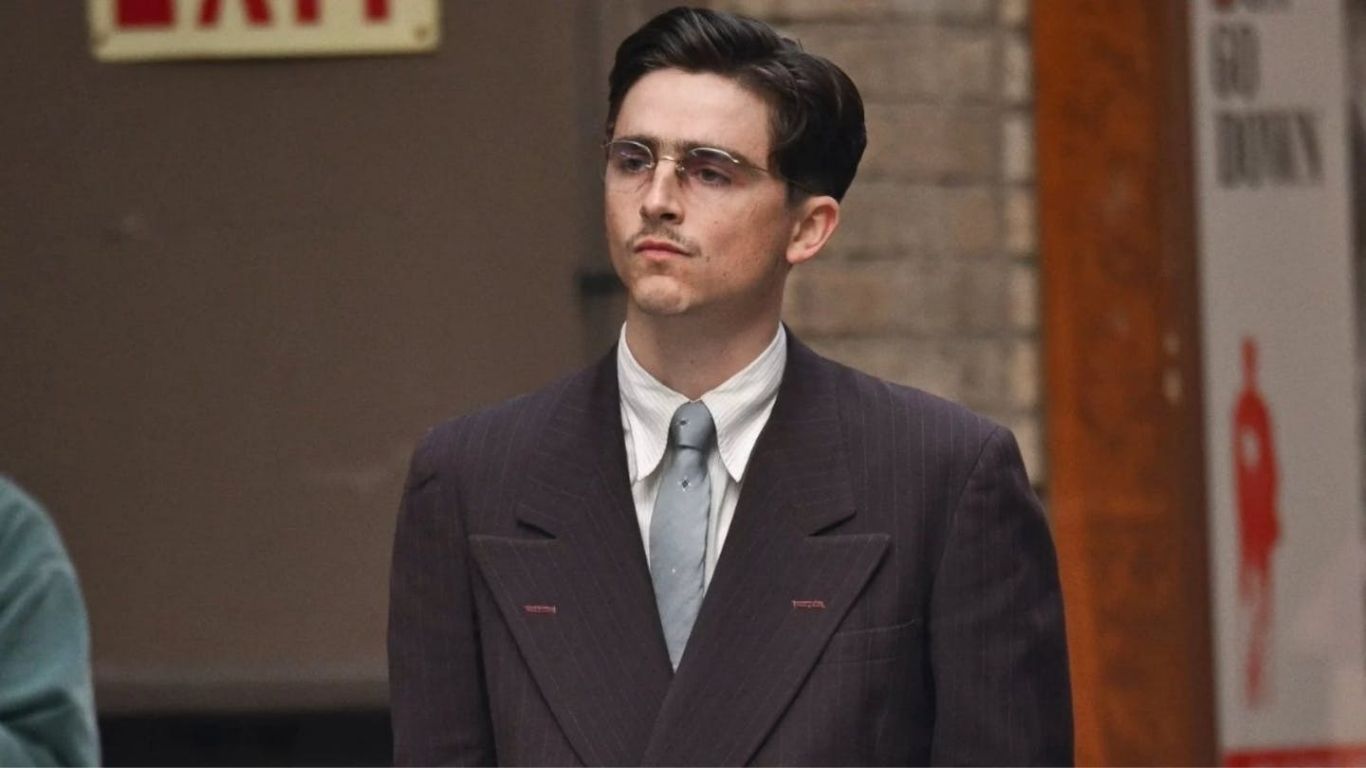
Set in 1952, the film introduces Marty Mauser as a Jewish shoe-shop employee from New York with the swagger of a movie star and the impulses of a sociopathic cartoon character. Sporting geek-chic glasses, a pencil moustache and a wiry frame, Marty barrels through life with the conviction that table tennis — a sport hardly respected by anyone at the time — is his destiny.
Loosely inspired by real-life ping-pong hustler Marty “The Needle” Reisman, Chalamet’s Marty operates at a pitch few characters ever reach. He hustles, lies, seduces, manipulates and gambles his way toward what he believes will be a legendary career, all while ricocheting between high and low moments with breathless speed.
Safdie’s film doesn’t behave like a conventional sports narrative. There are no inspirational montages, no sage mentors, no road-to-victory storyline. Instead, the film itself becomes a metaphor for table tennis — fast, erratic, clattering in rhythm, and forever on the verge of spiraling out of control.
From New York Tenements to London’s Ritz to Tokyo’s Bright Lights
The story begins in the cramped Lower East Side, where Marty works at his family’s shoe shop. Here, he hustles customers, argues with his uncle (who is also his boss), and sneaks his married girlfriend Rachel (Odessa A’zion) into the back room for risky escapades. Rachel, married to their neighbor, later becomes a key source of both chaos and support — and, in her pregnancy, a catalyst for Marty’s desperate decisions.
With no one respecting his passion, Marty resorts to extreme measures. In one shocking moment, he grabs a gun from the shoe-shop desk and demands the wages his uncle refuses to release. His goal: to travel to London for the table tennis championships at Wembley.
Once in Britain, Marty becomes a spectacle. He shocks local sports reporters with crude jokes, boasts about his talent, and insultingly references Béla, his Hungarian-Jewish friend and fellow competitor, portrayed by Géza Röhrig — a Holocaust camp survivor.
But Marty’s brashness leads him to a free stay at the Ritz, where he becomes obsessed with retired movie star Kay Stone, elegantly played by Gwyneth Paltrow. Their dynamic crackles with erotic tension, humor and manipulation. Kay sees through Marty faster than he sees himself, and her later Broadway performance becomes a highlight of Marty’s emotional unraveling.
Humiliation and Hubris: The Japanese Rivalry
Marty’s championship match against Japanese star Koto Endo (Koto Kawaguchi) ends in humiliating defeat. Where Koto is calm and disciplined, Marty is a frantic storm of bravado and panic. His ego cannot accept the loss, and he vows to secure a rematch — even if it means destroying every relationship he has in the process.
This obsession launches the film into its second half: a wild, comedic nightmare back in New York, filled with gangster schemes, chaos involving a dog in a dingy hotel bathtub, frantic money-making attempts, Abel Ferrara in a grimy cameo, and a feverish determination to reach Tokyo.
Safdie’s Signature Style Meets a New Level of Madness
Joshua Safdie, working solo for the first time in years, brings the relentless anxiety of Good Time and Uncut Gems to a grander, more theatrical canvas. His direction creates a film that is simultaneously hysterical, stressful and absurdly entertaining.
The soundtrack — packed with 1980s pop anthems like Tears for Fears’ “Change” and “Forever Young” — creates ironic contrast with the 1950s setting, amplifying Marty’s hyperactive energy. Daniel Lopatin’s jumpy, dissonant score intensifies the sense that the viewer has been dropped into a storm that never pauses to breathe.
A Supporting Cast of Outsiders
Safdie carefully surrounds Chalamet with actors whose unconventional looks and eccentricities embody the film’s chaotic spirit. Ralph Colucci’s lanky Lloyd and Luke Manley’s bumbling Dion feel ripped from underground comics. Paltrow shines as Kay Stone, a glamorous figure masking deep disappointment. Kevin O’Leary appears — perfectly cast — as a smug American businessman whose dismissiveness exposes the era’s bigotry toward Marty and Béla.
And through it all, Rachel remains Marty’s most explosive counterpart. Odessa A’zion’s performance as a brilliant, furious and cunning woman adds emotional punch — and often steals scenes from Chalamet.
The Final Spiral and Marty’s Reckoning
As Marty races toward Tokyo for his rematch with Koto Endo, the film’s energy becomes even more intense. He schemes, betrays, seduces, steals and improvises his way forward with reckless abandon. At one point, he is beaten with a wooden paddle — one of the film’s most shocking, darkly comic punishments.
Yet despite the endless disasters he triggers, Marty somehow earns a strange, bittersweet growth. He remains selfish, callow and chaotic, but the film’s final moments suggest a faint glimmer of emotional maturity — a rare quiet beat in a film defined by noise.
Conclusion: A Catastrophic Marvel Driven by Chalamet’s Best Performance
Marty Supreme is less a movie than an experience — dizzying, outrageous and oddly moving. It’s a farce, a character study, a satire of American ambition, and a portrayal of a young man whose belief in himself remains unshakeable, even when everything around him collapses.
Timothée Chalamet delivers the most unpredictable performance of his career, turning Marty into an unforgettable cinematic whirlwind: part genius, part disaster, and entirely magnetic.
Marty Supreme releases:
- 25 December in the US
- 26 December in the UK
- 22 January in Australia