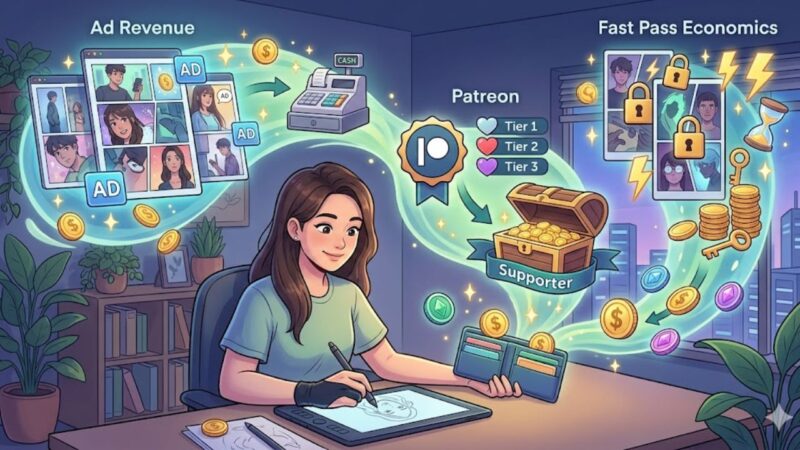

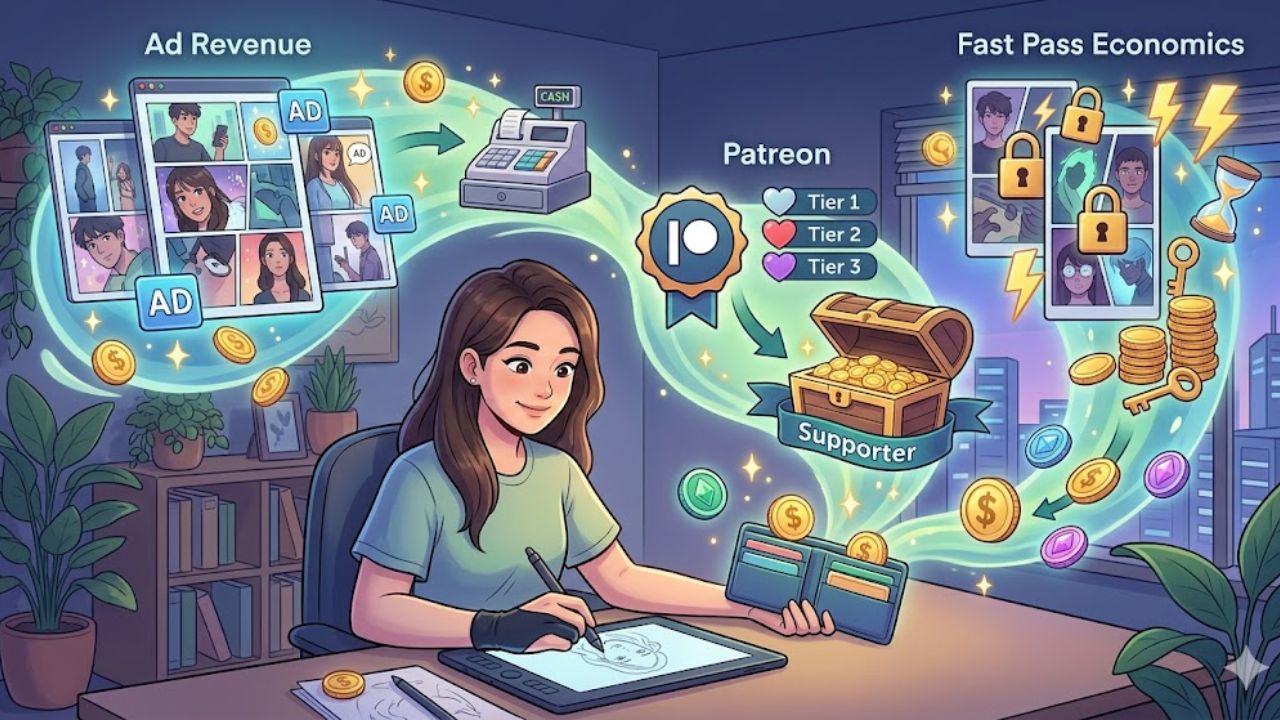
The modern webtoon economy has evolved far beyond a casual creative outlet. What was once a side-hustle space has transformed into a structured, multi-layered industry where creators can Monetize Your Webtoon through diverse and scalable income streams. Digital platforms have elevated comics into globally consumed products, connecting artists with millions of readers and opening the door to meaningful financial returns.
Yet, monetization in this landscape is anything but straightforward. It operates at the intersection of platform-driven systems like Ad Revenue, fan-powered ecosystems such as Patreon, and carefully designed payment behaviors rooted in Fast Pass economics. Each layer influences how, when, and why audiences choose to spend.
For creators stepping into this space—or looking to grow beyond inconsistent earnings—the key lies in understanding how these systems interact. Success is no longer about relying on a single source of income, but about building a strategy where multiple revenue streams reinforce each other, turning creative output into a sustainable digital business.
Understanding the Webtoon Economy
Before diving into monetization methods, it’s important to understand the underlying structure of the webtoon industry.
Unlike traditional comics, webtoons operate on a freemium model:
- Content is free to read initially
- Revenue is generated through ads, microtransactions, and fan support
- A small percentage of loyal readers generate the majority of income
This structure mirrors broader creator economy trends, where a minority of “superfans” drive earnings.
Platforms like WEBTOON have built multiple monetization layers, including:
- Ad revenue sharing
- Paid content unlock systems (Fast Pass / coins)
- Creator rewards programs
- External integrations like Patreon
Together, these systems form what is often called a stacked monetization model—you don’t rely on one stream, but several working in tandem.
1. Ad Revenue: The Foundation of Webtoon Earnings
How Ad Revenue Works
Ad revenue is typically the first income stream available to webtoon creators. Platforms display advertisements alongside episodes and share a portion of that revenue with creators.
On WEBTOON Canvas, creators can join the Ad Revenue Sharing Program once they meet eligibility requirements such as:
- Minimum subscribers
- Minimum monthly page views
Once qualified, creators earn based on:
- Ad impressions
- Reader engagement
- Geographic audience distribution
This system is essentially CPM-based (cost per thousand impressions), similar to YouTube or blogs.
What Creators Actually Earn
While ad revenue provides accessibility, it is often the least reliable income stream.
Real-world data suggests earnings can fluctuate significantly. For instance, one creator reported earning roughly $0.28–$0.50 per 1,000 views, showing how inconsistent rates can be.
That means:
- 100,000 views → ~$28–$50
- 1 million views → ~$280–$500
These numbers highlight a critical truth: ad revenue alone rarely sustains a creator unless they have massive traffic.
Why Ad Revenue Is Still Important
Despite low payouts, ad revenue plays a foundational role:
1. Passive Income Layer
Once episodes are published, they continue generating revenue over time without additional effort.
2. Audience Signal
High views unlock eligibility for other monetization programs.
3. Platform Incentives
Platforms reward consistent posting and engagement, which indirectly boosts visibility.
The 2026 Shift: Faster Payouts
WEBTOON recently reduced its payout threshold to $25, making it easier for smaller creators to access earnings earlier.
This change reflects a broader shift: platforms are trying to retain emerging creators by improving cash flow—even if total earnings remain modest.
Key Takeaway
Ad revenue is not your main income—it is your baseline layer. Think of it as the floor, not the ceiling.

2. Patreon: Turning Fans Into Monthly Income
If ad revenue is the foundation, Patreon is the engine.
Patreon allows creators to earn recurring income directly from their audience through subscriptions. Unlike ad revenue, which depends on traffic, Patreon depends on loyalty.
How Patreon Works for Webtoon Creators
Creators offer membership tiers in exchange for perks such as:
- Early access to episodes
- Behind-the-scenes content
- Exclusive side stories
- Direct interaction (Discord, comments, polls)
Patreon takes a commission of around 8–12%, plus payment processing fees.
Why Patreon Outperforms Ad Revenue
The biggest advantage of Patreon is income stability.
For example:
- A creator with modest WEBTOON views earned over $6,000/month from Patreon with ~1,300 patrons.
Compare that to ad revenue:
- Hundreds of thousands of views might only generate a few hundred dollars
This reveals a crucial insight:
Audience size matters less than audience loyalty.
The Psychology Behind Patreon
Patreon works because it taps into emotional economics:
1. Ownership Feeling
Fans feel like they are supporting the creator directly.
2. Exclusivity
Early access and bonus content create perceived value.
3. Community
Membership tiers often include access to private communities, increasing retention.
Building a High-Converting Patreon
Successful webtoon creators treat Patreon like a product, not a donation box.
Best practices include:
1. Simple Tier Structure
Start with:
- ₹100–₹300 equivalent: basic support
- ₹500–₹800: early access
- ₹1000+: premium perks
2. Content Alignment
Don’t create extra work—repurpose existing content:
- Sketches
- Draft panels
- Script notes
3. Retention Strategy
Patreon income depends on keeping subscribers, not just gaining them.
Community engagement—Discord, polls, shoutouts—reduces churn significantly.
The “Superfan Rule”
Most creators find that:
- 5–10% of their audience becomes paying supporters
This small group often generates the majority of income, making Patreon the most scalable revenue stream for independent creators.
3. Fast Pass Economics: The Premium Content Model
Fast Pass (or similar systems like Daily Pass and coins) is where webtoon monetization becomes truly strategic.
What Is Fast Pass?
Fast Pass allows readers to pay to unlock episodes early using in-app currency (coins).
On WEBTOON:
- Readers purchase coins
- Coins unlock episodes ahead of free release
- Creators receive a share of this revenue
Why Fast Pass Works
Fast Pass leverages two powerful behavioral triggers:
1. Impatience
Readers don’t want to wait weekly for updates.
2. Narrative Tension
Cliffhangers increase willingness to pay.
The Economics of Fast Pass
Unlike ads (low value per user), Fast Pass increases ARPU (Average Revenue Per User).
Example:
- Free reader → ₹0
- Ad-supported reader → very low value
- Fast Pass user → pays repeatedly for early access
This turns casual readers into micro-spenders.
The Cliffhanger Economy
Fast Pass thrives on storytelling structure.
Episodes that end with:
- Reveals
- Emotional twists
- Unresolved conflict
…drive higher conversion rates.
In other words:
Your storytelling directly impacts your revenue.
Daily Pass vs Fast Pass
WEBTOON also uses Daily Pass, where:
- Users can unlock one episode per day for free
- Or pay coins for instant access
This hybrid model:
- Keeps content accessible
- Encourages spending from impatient users
4. Comparing the Three Models
| Monetization Method | Income Type | Stability | Scalability | Effort |
|---|---|---|---|---|
| Ad Revenue | Passive | Low | High traffic needed | Low |
| Patreon | Recurring | High | Medium–High | Medium |
| Fast Pass | Transactional | Medium | High | High (story-driven) |
5. The Real Strategy: Combining All Three
The biggest mistake creators make is relying on a single income stream.
The most successful webtoon artists use a layered strategy:
Stage 1: Build Audience (Ad Revenue)
- Focus on consistency
- Grow views and subscribers
- Unlock platform monetization
Stage 2: Convert Fans (Patreon)
- Introduce early access
- Build community
- Create recurring income
Stage 3: Maximize Value (Fast Pass)
- Structure episodes for cliffhangers
- Encourage microtransactions
- Increase per-reader revenue

6. The Power Law Problem
Not all creators earn equally.
Research shows creator economies often follow a “rich-get-richer” distribution, where a small percentage earns most of the income.
This means:
- Top creators earn thousands (or more)
- Mid-tier creators struggle
- Beginners earn little
However, Patreon helps balance this by providing more stable mid-level income opportunities compared to ad-driven systems.
7. Expanding Beyond the Big Three
While this article focuses on ad revenue, Patreon, and Fast Pass, successful creators often expand into:
- Merchandise
- Licensing deals
- Print publishing
- Brand sponsorships
- Adaptations (TV, film, games)
WEBTOON itself has paid out tens of millions of dollars to creators, showing the long-term potential of the ecosystem.
8. Common Mistakes to Avoid
1. Relying Only on Ads
This leads to burnout with minimal financial return.
2. Overcomplicating Patreon
Too many tiers = confusion and churn.
3. Ignoring Story Structure
Weak endings reduce Fast Pass conversions.
4. Inconsistent Posting
All monetization systems depend on regular updates.
9. A Practical Monetization Blueprint
If you’re starting today, here’s a realistic roadmap:
Month 0–3
- Publish consistently
- Focus on quality and niche
Month 3–6
- Aim for monetization eligibility
- Start building audience loyalty
Month 6–12
- Launch Patreon
- Offer early access
Year 1+
- Optimize Fast Pass strategy
- Expand into additional revenue streams
Final Thoughts: Monetization Is a System, Not a Shortcut
The economics of webtoons are not built on viral success alone—they are built on systems.
- Ad revenue gives you reach
- Patreon gives you stability
- Fast Pass gives you scale
The creators who succeed are not necessarily the most talented—they are the ones who understand how these systems interact.
In a digital landscape where attention is currency, the real skill is not just storytelling—it’s turning that attention into sustainable income.
And in the world of webtoons, that means thinking like both an artist and an entrepreneur.