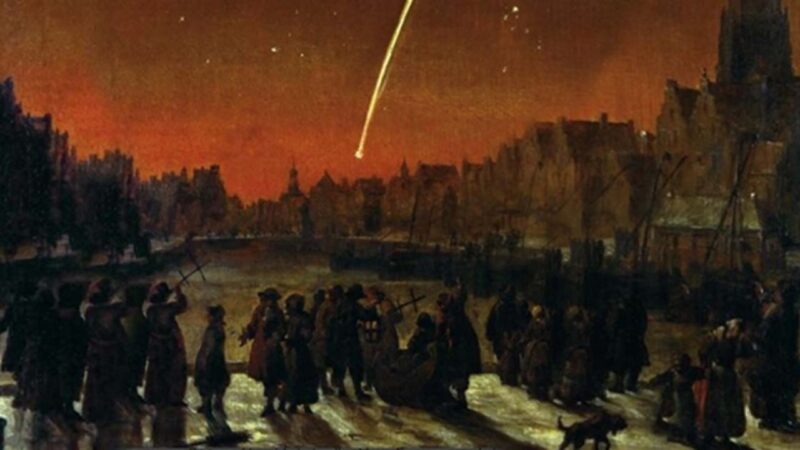

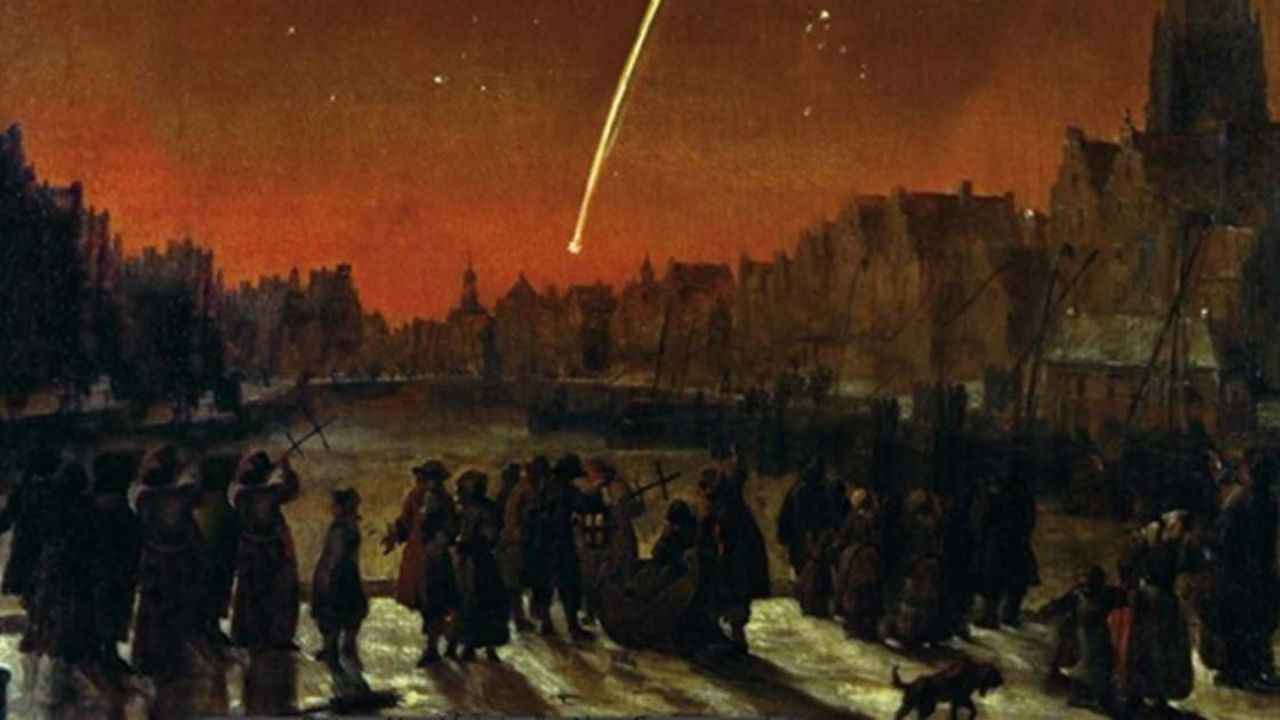
Long before telescopes and spectroscopy, a fireball in the night sky was not a chunk of rock and ice burning through the atmosphere — it was a message. A divine warning. A soul in transit. The death knell of a king. For thousands of years, civilizations across every continent looked up at the same celestial theatrics and wrote wildly different stories about what they meant.
I. The Sky as Sacred Text
When the Heavens Spoke in Fire
The ancient sky was not backdrop — it was biography. In an era before the scientific method, natural phenomena did not arrive without meaning. Thunder was the voice of gods. Eclipses were moments of cosmic crisis. And comets — those slow-moving smudges of luminous vapor dragging spectacular tails across the sky for days or even weeks — were among the most alarming spectacles a person could witness.
Unlike meteors, which vanish in a fraction of a second, comets loiter. They appear, persist, and then slowly fade, long enough to become subjects of dread, legend, and interpretation. This longevity made them uniquely potent as omens: they gave priests, astrologers, and rulers time to deliberate over what they meant — and to act on their conclusions.
To understand why so many cultures feared comets, we must first understand how pervasive the doctrine of celestial correspondence was. From Mesopotamia to Mesoamerica, the sky and the earth were understood as mirrored systems. What happened above was a precursor or reflection of what would happen below. Unusual events in the heavens — and few things were more unusual than a comet — demanded interpretation with the same urgency a modern government might respond to an intelligence report.
“The comet was not merely seen. It was read — deciphered like a letter sent in fire from the gods.”
— Paraphrase of ancient Babylonian astrological doctrine
II. Mesopotamia — The Original Omen Keepers
Celestial Diplomacy on Clay Tablets
No civilization invested more systematically in celestial interpretation than ancient Mesopotamia. The Babylonians and Assyrians maintained a staggering archive of omen literature — cuneiform tablets cataloguing the predictive significance of every astronomical event they could observe. These texts, known collectively as the Enuma Anu Enlil, contain thousands of entries pairing celestial phenomena with earthly consequences.
Comets and meteors earned special sections in this great library of the sky. The Babylonians called bright meteors kakkab šarri, “stars of the king,” and interpreted them as portents tied directly to royal fate. A comet appearing in the east was an ill omen for one country; appearing in the west, it threatened another. The direction, color, and duration all modified meaning in subtle ways that only trained ṭupšar Enuma Anu Enlil — specialist astrologers — could reliably decode.
Mesopotamia, c. 700 BCE
The Substitute King Ritual
When celestial omens (including comets) foretold doom for the king, Babylonian priests enacted a dramatic countermeasure: a substitute king was crowned, feted, and made to assume all royal duties. At the omen’s expiry, the substitute was sacrificed, believed to have “absorbed” the threatened calamity. The real king, who had been living under a false name as a commoner during this period, could then safely reclaim his throne. Royal correspondence from the Neo-Assyrian period documents this ritual having been performed multiple times.
The political stakes of astronomical interpretation were extraordinarily high. Assyrian kings like Esarhaddon and Assurbanipal received regular letters from court astrologers, many of which survive. The language in these dispatches is urgent: celestial events require immediate ritual action, political decisions are to be delayed or accelerated in accordance with what the sky prescribes. Comets did not merely inspire awe — they could pause or redirect the machinery of empire.
III. Greece & Rome — From Myth to Theory and Back Again
The Uneasy Marriage of Philosophy and Fear
The ancient Greeks present a fascinating case of a civilization simultaneously reaching toward scientific explanation while remaining viscerally bound to omen-thinking. As early as the 5th century BCE, thinkers like Anaxagoras and Democritus proposed that meteors were simply rocks falling from the sky — a startlingly modern idea. Aristotle later elaborated an elegant if wrong meteorological theory: comets were inflammable exhalations from the earth, ignited in the upper atmosphere.
And yet.
Despite these proto-scientific frameworks, Greek historians consistently report comets in the context of disasters. Comets appeared before the Peloponnesian War, before earthquakes, before famines. Whether the Greeks genuinely believed the comet caused the disaster, or whether chroniclers simply noted the conjunction because it made a rhetorically potent narrative, is difficult to say. Probably both impulses operated simultaneously — exactly as they do in humans today.
Rome, 44 BCE
Caesar’s Comet — The Sidus Iulium
Few cometary episodes in history have been more politically weaponized than the comet that appeared in July 44 BCE, three months after the assassination of Julius Caesar, during games held in his honor. Crowds flooding the Roman forum claimed they could see it with the naked eye in broad daylight. Augustus Caesar, who was consolidating power at the time, seized on the omen immediately: the comet was not a portent of doom, but Caesar’s soul ascending to join the gods, making him divus — deified. Temples were built. The comet was depicted on coins. An astronomical event became the foundation of a dynastic theology. Modern astronomers, analyzing Chinese records from the same period, have confirmed that a real comet did appear that July.
The Romans inherited Greek astronomical theory but never fully domesticated their instinctive dread of comets. When Seneca the Elder wrote about comets with relatively detached curiosity, he was something of an outlier. Roman historians — Tacitus, Suetonius, Pliny — almost universally treat comet appearances as preceding catastrophes. Nero reportedly ordered preemptive executions of nobles when a comet appeared, calculating that the omen’s “harvest” could be directed at lesser targets before fate chose them for him.
“Comets are a problem heaven sends when it wants to indicate a change of kings — or the punishment of some extraordinary crime.”
— Paraphrase from Pliny the Elder, Naturalis Historia, Book II

IV. China — The Celestial Bureaucracy
Broom Stars and the Mandate of Heaven
Chinese civilization produced perhaps the most systematically detailed astronomical records of any premodern culture. The imperial astronomical bureau, the Taishiling, maintained continuous records stretching back millennia. Comets — called huixing, “broom stars,” for their sweeping tails — were among the most carefully observed phenomena.
The Chinese conception of the sky was explicitly political. The emperor governed on earth as a reflection of the celestial order above; his moral rectitude was understood to manifest in the behavior of the heavens. A comet, then, was not simply an omen but a potential withdrawal notice — a sign that the emperor’s Tianming, the Mandate of Heaven, was in question. This made cometary interpretation an affair of the highest state urgency.
Chinese astronomical texts classified comets by tail length, orientation, color, and which celestial palace they appeared in — each sector of the sky corresponding to different aspects of imperial governance. A comet trailing through the celestial region corresponding to military affairs foretold war; one appearing in the region of the granary suggested famine. The precision of this interpretive framework is remarkable — and it served a profound social function: it gave the state a structured vocabulary for anticipating and processing catastrophe.
China, 467 BCE – 1910 CE
An Unbroken Record of “Broom Stars”
Chinese imperial records document comet sightings with extraordinary continuity, some of the oldest independently dateable comet records in the world. The Spring and Autumn Annals, attributed to Confucius himself as editor, contains what may be the world’s oldest confirmed comet record — an observation from 467 BCE. In total, Chinese records document hundreds of individual comet apparitions across more than two millennia. Modern astronomers regularly use these records to reconstruct the orbital histories of known comets, including Halley’s Comet, whose every apparition since 240 BCE is logged in Chinese sources.
V. Mesoamerica — Stars That Demanded Blood
The Aztec and Maya Cosmos of Consequence
In the cosmologies of Mesoamerica, the sky was not merely observed — it was actively managed. The survival of the world depended on human participation in the celestial cycles, expressed through ritual, sacrifice, and calendrical precision. Into this system of cosmic reciprocity, meteors and comets arrived as agents of particular menace.
The Aztecs identified shooting stars with the tzitzimimeh — skeletal stellar demons who waited at the edges of the universe, threatening to descend and devour humanity during solar eclipses and other periods of celestial instability. Meteors were sometimes understood as the tzitzimimeh in motion, scouting the earthly realm. The fear was visceral enough that it shaped ritual calendar: during the Toxiuhmolpilli, the New Fire ceremony held every 52 years at the feared juncture of two calendar cycles, all fires across the empire were extinguished and people hid indoors, fearing that if the gods chose not to renew the sun, the tzitzimimeh would descend in a blizzard of shooting stars and end the age of humanity.
The Maya, with their extraordinary calendrical precision and deep interest in Venus cycles, also tracked comets with care. Comet appearances in Maya iconography are associated with warfare, drought, and the fall of dynasties — consistent with their broader view that celestial events were encoded warnings demanding prophylactic ritual response.
Maya Lowlands, c. 900 CE
The Sky Serpent Hypothesis
Several Mayanist scholars have proposed that the serpent iconography so pervasive in Maya art — particularly the feathered serpent and the “star serpent” — may encode astronomical observation of comets. A comet with a bright coma and curved, bifurcated tail bears a striking visual resemblance to a serpent in flight. If this interpretation is correct, some of the most sacred imagery in Maya religion may have originated in the terror and awe of a spectacular comet apparition. While the hypothesis remains debated, it illustrates how deeply celestial phenomena could penetrate the symbolic vocabulary of an entire civilization.
VI. Indigenous Traditions — Wisdom Encoded in Stars
A Diversity of Meanings Across the Globe
The cultures above represent only a fraction of the human response to comets. Across the globe, indigenous traditions developed their own nuanced frameworks for celestial phenomena — frameworks that have often been dismissed as superstition but which frequently encode sophisticated observational knowledge within mythological containers.
Many Aboriginal Australian groups possess astronomical traditions of extraordinary antiquity. Some oral histories appear to encode memories of actual cosmic events thousands of years old. Bright meteors and fireballs feature in multiple Dreaming narratives as transformative, often dangerous entities — ancestral beings moving through the sky, or the spirits of the recently dead completing a final journey. The specificity of these traditions suggests generations of careful observation carefully transmitted.
In West African traditions, particularly among the Dogon people of Mali, astronomical knowledge was encoded in cosmological mythology of remarkable precision — though exactly how this knowledge was obtained and what it represents remains the subject of scholarly debate. Bright meteors in multiple African traditions are associated with ancestral communication: the dead visiting the living in a streak of fire before moving on.
Norse mythology positioned meteors as sparks from the forge of the gods, specifically from Múspellsheim, the realm of fire. Some scholars have interpreted the fiery bridge of Bifröst — the rainbow passage linking Asgard and Midgard — as partially inspired by the auroral and meteoric sky displays common at northern latitudes.
Global
The Almost Universal Soul Journey
Across wildly different cultures — ancient Egypt, Polynesia, sub-Saharan Africa, pre-Columbian North America, medieval Europe — shooting stars are associated with the transit of the human soul. Whether interpreted as the soul ascending at death, the soul being reborn, a god visiting earth, or an ancestor checking in on the living, the basic narrative structure is remarkably consistent: a bright swift light crosses the sky and someone or something passes between worlds. This cross-cultural convergence may reflect not transmitted mythology but parallel invention — the same intuitive human response to the same overwhelming visual stimulus.
VII. Medieval Europe — Comets and Christian Dread
The Bayeux Tapestry and the Terror of Halley
Medieval European Christianity had an ambivalent relationship with celestial omens. On one hand, orthodox theology was suspicious of pagan astrological practice; on the other, the tradition of celestial signs was thoroughly embedded in the Bible itself — the Star of Bethlehem being the most famous example. This created an interpretive tradition that simultaneously warned against “reading the stars” as pagans did while enthusiastically reading the stars as divine portents.
The result was that medieval chronicles are absolutely saturated with comet records presented as divine warnings. No comet made a deeper impression on medieval European consciousness than the appearance of Halley’s Comet in 1066 CE. The Bayeux Tapestry — that extraordinary embroidered chronicle of the Norman Conquest of England — depicts the comet in remarkable detail, with King Harold’s courtiers pointing upward in alarm while Harold himself looks stricken on his throne. The Latin inscription reads, essentially: “They marvel at the star.”
The comet appeared in April 1066. By October, Harold was dead at the Battle of Hastings and William the Conqueror had claimed the English throne. To medieval minds, the causal connection required no argument: the comet had announced it months in advance. The episode cemented Halley’s Comet in European cultural memory as a herald of catastrophe — an association that persisted, with remarkable tenacity, all the way to its next apparition in 1910, when newspapers reported widespread public fear that the earth would pass through the comet’s cyanogen-rich tail and suffocate.
VIII. The Psychology of the Omen
Why the Sky Has Always Spoken to Us
Surveying these traditions, a pattern emerges that is less about astronomy than about cognitive architecture. Human beings are, at the deepest level, pattern-recognition and meaning-making animals. We are constitutionally uncomfortable with randomness — especially large, alarming randomness. A fireball screaming across the sky, or a comet appearing where nothing was visible the night before, is precisely the kind of event that demands explanation.
In cultures where the sky was understood as a communication medium — and most ancient cultures held some version of this view — celestial events were naturally processed as messages. The content of those messages varied by culture, but the interpretive impulse was universal. And once interpreted, the message required response: ritual, political action, sacrifice, prayer. The omen, in this sense, was not merely a forecast. It was a prompt for collective agency.
Modern psychology has extensively documented the phenomenon known as “apophenia” — the human tendency to find patterns and meaningful connections in unrelated stimuli. Our brains evolved in environments where false positives (seeing danger that wasn’t there) were far less costly than false negatives (missing danger that was). We are, structurally, prone to finding meaning. Ancient peoples were not cognitively deficient in reading cosmic significance into comets. They were doing exactly what human brains are optimized to do — finding signal in noise, story in chaos.
“The comet didn’t change the fates of empires. But it changed how rulers thought about their fates — and that, in the end, changed everything.”
— Original synthesis

IX. The Legacy — From Omen to Observatory
How Fear Drove the Birth of Astronomy
There is a delicious irony in the history of cometary mythology: the fear that drove so many cultures to obsessively track and record celestial phenomena ultimately generated the data that would allow science to demystify those same phenomena. The Babylonian omen tablets, the Chinese imperial records, the Mayan astronomical codices — all produced primarily in service of prophetic systems — constitute the richest body of premodern astronomical data in the world.
It was partly on the basis of these historical records that Edmond Halley, in 1705, calculated that the comets of 1531, 1607, and 1682 were not three separate events but three apparitions of the same comet on a roughly 75-year orbit. He predicted it would return in 1758. It did. The “celestial messenger of doom” was revealed to be a lump of ice and rock following a predictable Newtonian ellipse. The omen became an orbit.
And yet — and this may be the deepest observation of all — knowing this has not fully extinguished the instinct. When Halley’s Comet returned in 1986, millions of people traveled to dark-sky sites to watch it. When a bright fireball blazes overhead, even the scientifically sophisticated feel a catch in the throat before the rational explanation arrives. The response is older than the reasoning. It was built by a hundred thousand years of nights spent beneath an overwhelming sky, wondering what the fire meant.
Ancient cultures were not wrong to find comets significant. They were wrong about the mechanism — but exactly right about the wonder. The universe is indeed sending us messages. We have simply learned, slowly and painfully, to read a different alphabet.