
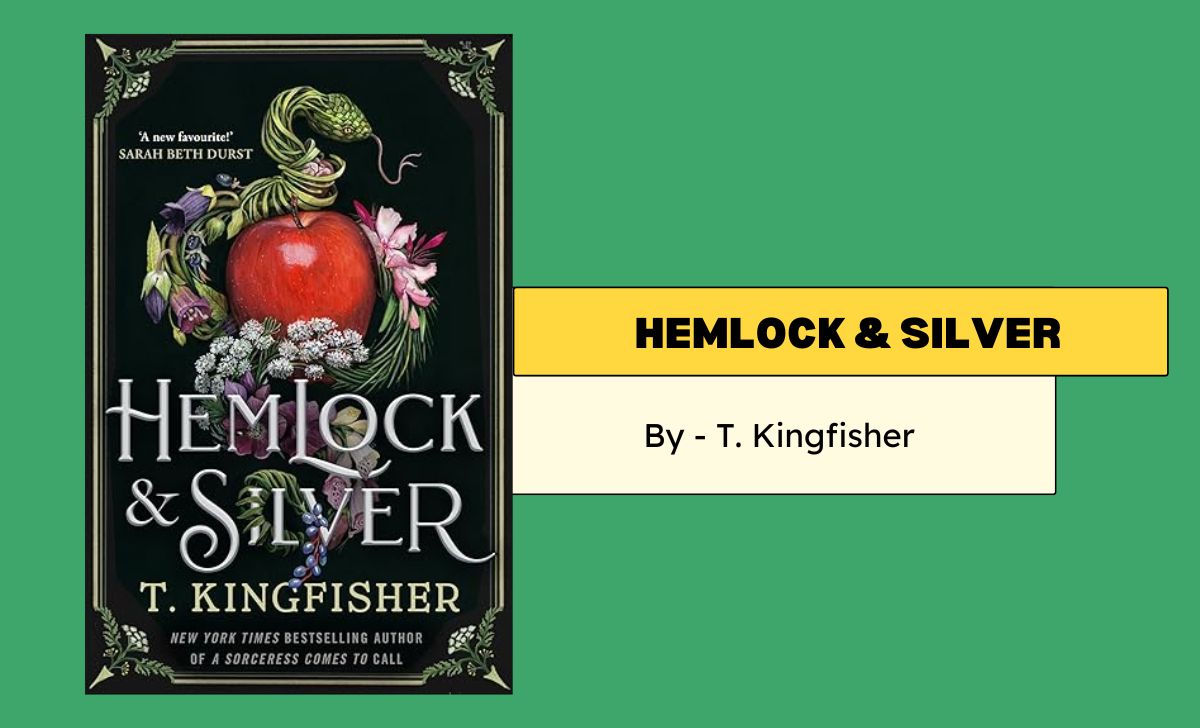
T. Kingfisher’s Hemlock & Silver arrives like a story told by someone who knows how to wink while handing you a knife: witty, unsettling, affectionate toward its genre’s bones, and frequently gleeful about twisting them. On the surface it’s a retelling of Snow White, but Kingfisher layers that familiar scaffold with body-horror notes, a medical-mystery plot, and an often-black sense of humor that keeps the pages turning. This review walks through the plot essentials, the novel’s tone and craft, what works best (and where it stumbles), and who I’d recommend this to.
Plot summary — what happens (spoiler-light)
Anja is a thirty-something, blunt, highly practical expert on poisons and antidotes; she’s not a healer who pampers fragile patients but a scientist of nasty substances who tests remedies on herself. When the king arrives at her workroom asking for help — his last surviving child is showing baffling symptoms that no physician can explain — Anja is dragged into a case that feels medical at first and gradually reveals magical and political entanglements. The central mystery (is the princess ill, bewitched, or being poisoned?) unfolds into a quest that runs through desert mesas, saints with snake heads, enchanted mirrors, and a supporting cast that includes a remarkably sarcastic cat. The book blends an investigative throughline with fairy-tale bric-a-brac until the solution demands both rational thinking and acceptance of the uncanny.
Characters and voice
Kingfisher’s narrator voice — wry, informal, and frequently amused at its own observations — is one of the novel’s strongest assets. Anja feels like an original creation: pragmatic, prickly, and morally complicated in a way that keeps her compelling throughout. Secondary characters are drawn sharply enough to be fun companions or antagonists; the king’s paranoia, the court’s politics, and Anja’s often gruff tenderness all read as distinct notes rather than one-note tropes. Readers who enjoy protagonists with an internal running commentary — sarcastic, self-aware, and occasionally tender — will find themselves at home. Several reviewers praised how Kingfisher uses humor to offset horror and unease, making the darker moments land harder because they’re surrounded by levity.
Tone, pacing, and worldbuilding
The tone shifts between cozy, horrific, and romantic without feeling dissonant; Kingfisher is adept at moving the rug out from under the reader when a scene needs to jolt. Pacing tends to favor the investigation: clues pile up, false leads appear, and the emotional stakes increase as Anja digs deeper. Worldbuilding is restrained but evocative — the setting leans toward a New-Mexico-like desert kingdom with saints and folklore that feel both invented and rooted. Several critics note that the book’s atmosphere is one of its strongest elements: a place where a domestic workspace for poisons sits comfortably next to a mirror that remembers things.
Themes and emotional core
At its heart, Hemlock & Silver explores competence and agency: Anja’s expertise is her power, and Kingfisher interrogates how knowledge — especially knowledge of harm — shapes responsibility. The book also plays with trust (who do you ask when the obvious answers are wrong?), grief and guilt (the king’s past actions hang over the court), and the odd tenderness that grows between people who save one another from small deaths every day. Humor softens but doesn’t undermine the emotional beats; when the novel leans into sorrow or body-horror, it’s earned rather than manipulative. Critics across reviews highlighted the balance between the macabre and the humane as a reason the book resonates.
Strengths — what it does well
- Original protagonist: Anja’s combination of scientific rigor and personal quirk gives the story a fresh center.
- Blended genre execution: Kingfisher’s mixing of fairy-tale retelling, medical mystery, gentle romance, and gothic horror mostly succeeds because she commits to the tonal shifts.
- Voice and humor: The narrative voice is consistently entertaining; it’s an authorial personality that delights without overshadowing the plot.
- Atmosphere and sensory details: The setting and imagery—desert mesas, saints, mirrors—linger in the mind.
Weaknesses — where it might not land for everyone
Some readers and reviewers found the slow-burn of the romance a little quick at the end — the chemistry is strong, but the book compresses certain emotional developments into a smaller number of scenes than some readers would prefer. Others might want a firmer resolution for a few of the side mysteries; Kingfisher chooses suggestiveness in a couple of places rather than tidy answers. If you favor classical fairytale fidelity (strict adherence to Snow White beats), this reworking takes liberties that could annoy purists.
Audiobook note
If you prefer audio, reviewers singled out the audiobook narration as a highlight: many felt the narrator added texture and charm, earning high marks even when readers found small issues with the pacing. If you consume a lot of audiobooks, the production may be worth the choice on its own.
Final thoughts and who should read it
Hemlock & Silver is a T. Kingfisher book through and through: a little sly, a little prickly, and ultimately generous to readers who enjoy genre tricks used for storytelling rather than for novelty alone. Pick this up if you like fairytale retellings that refuse to be tidy, protagonists who solve problems with knowledge rather than destiny, and a voice that can be funny and grim on the same page. If you want absolute closure on every subplot or a romance that simmers for hundreds of pages before boiling, temper your expectations — but even then, there’s a strong chance you’ll enjoy the ride.