


Imagine being a male firefly. You’ve found a female sending back the right light signals. Everything looks promising for romance under the night sky. But suddenly, she lunges at you—not with affection, but with deadly intent. What just happened? To understand this dangerous twist, we need to look at the mysterious and often deceptive world of fireflies.
A Glowing History
Fireflies are more than just pretty flickers in the summer night. Their ancestry stretches back over 100 million years, when the very first fireflies lit up ancient skies with a greenish glow. Today, we know of about 2,000 firefly species, spread across diverse environments—forests, marshes, grasslands, and even deserts.
One thing unites them all: their light. Fireflies create this glow using a special enzyme called luciferase and a molecule called luciferin. When these react with oxygen, they emit a cold, efficient light that wastes almost no heat. But firefly light isn’t just beautiful—it’s practical.
Why Do Fireflies Glow?
The glow isn’t only for romance. Many firefly species produce chemicals called lucibufagins, which taste awful and are toxic to predators. Their glowing bodies are like flashing warning signs: “Eat me at your own risk.”
Even firefly larvae have this glowing defense. When threatened, they light up as if to say, “Back off—I’m dangerous.” But these youngsters aren’t just playing defense. They’re active hunters, injecting venom to paralyze prey, then using their saliva to liquefy it before slurping it up. Fireflies spend most of their lives in this larval stage, saving up energy for the short but bright adult phase.
Light as a Love Language
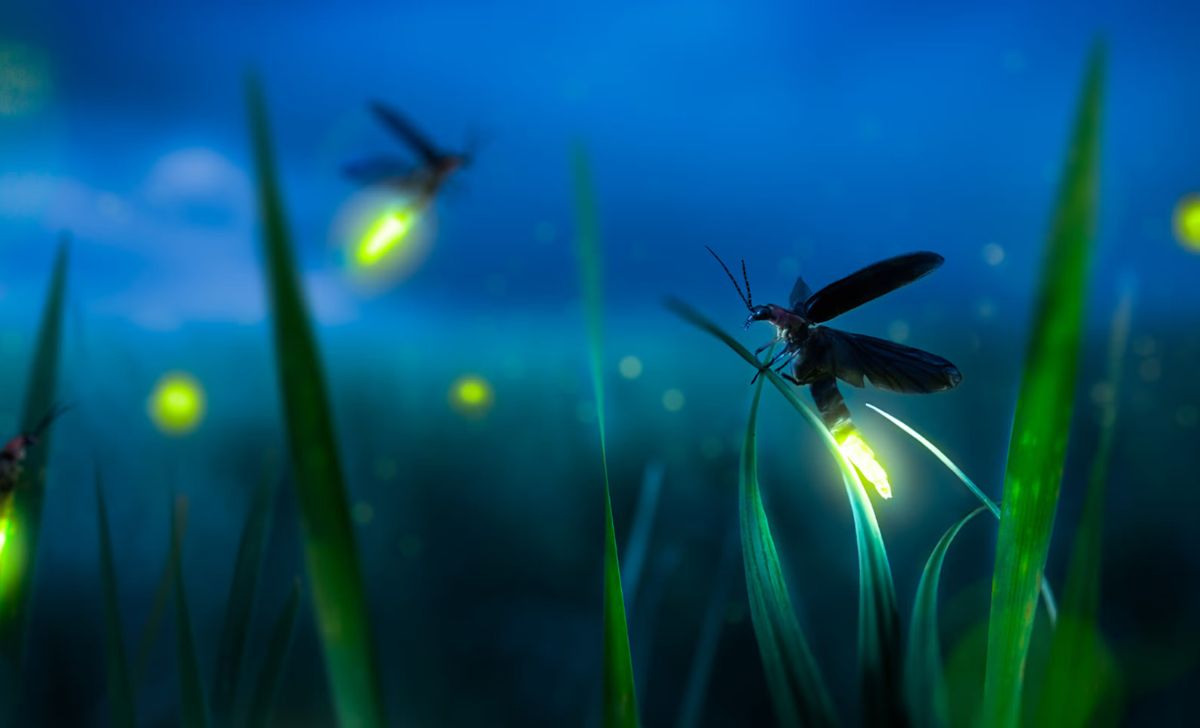
When adulthood finally arrives, fireflies have only weeks to find a mate. For most species, light is their love language. Males fly around, flashing in specific patterns and colors—green, yellow, red, even blue—while females wait and watch.
Each species has its own rhythm. Some males use rapid flickers, others long glowing pulses. In huge gatherings, males often synchronize their flashes in spectacular displays, making it easier for females to pick out individual suitors.
Females, by contrast, tend to keep things simple. When a female spots a male she likes, she signals back with her lantern, guiding him closer. If all goes well, they join at the abdomen and sometimes remain connected for hours.
But in nature, not every signal is what it seems.
The Femme Fatales of the Firefly World
Now we return to that sudden lunge. In one genus of fireflies, females take a very different approach to courtship. Known as femme fatales, these predators don’t just flirt—they hunt.
Here’s how it works: instead of producing their own mating signals, these females mimic the flashing patterns of other firefly species. When an unsuspecting male approaches, thinking he’s found love, he finds himself caught in a deadly trap. Instead of mating, the female attacks and eats him.
But food isn’t her only goal. Unlike many fireflies, femme fatales don’t naturally produce toxic chemicals. By consuming other fireflies, they steal and store their prey’s toxins, which then protect them from predators. It’s a double reward: nutrition and chemical defense.
Male Fireflies Fight Back
Of course, the males aren’t completely defenseless. Researchers have noticed that males often approach cautiously, sometimes darting away at the last moment. Some even drop several centimeters mid-flight to dodge attacks. Thanks to these evasive maneuvers, fewer than 10% of femme fatale ambushes are successful. Still, for those unlucky males, a moment of attraction can turn into their final mistake.
Deception Beyond Fireflies
The trickery doesn’t stop with fireflies themselves. In parts of China, orb-weaver spiders have been observed using fireflies as living bait. After catching a male firefly in their web, the spiders keep it alive. Somehow, they manipulate the trapped insect to flash like a female, luring more males into the sticky trap. The result? A deadly glow show orchestrated by the spider.
A Dangerous Light Show
For fireflies, light is life. It’s how they attract mates, warn predators, and sometimes, how they deceive and kill. A glowing signal might mean romance, or it could mean death. Whether it’s a femme fatale waiting to ambush, or a spider using firefly signals to bait prey, the night sky is full of dangerous illusions.
So next time you see those tiny sparks drifting across a summer evening, remember: behind their beauty lies a world of predators, prey, and perilous deception. For a male firefly, every flash carries both the promise of love and the risk of death.