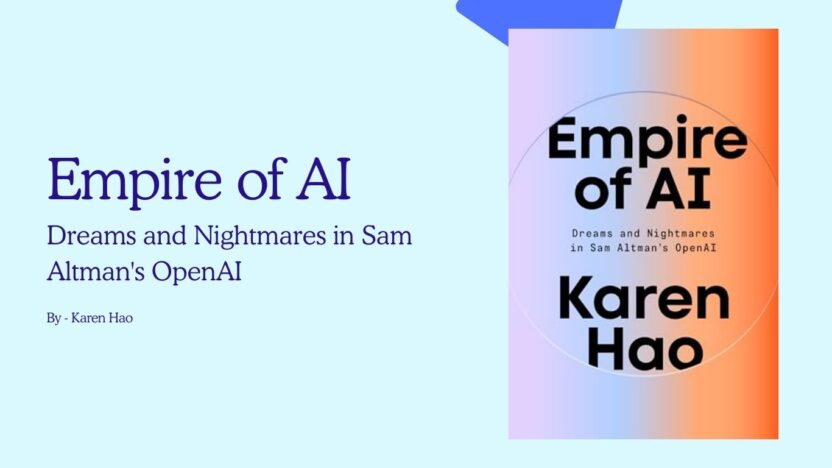
Karen Hao’s Empire of AI: Dreams and Nightmares in Sam Altman’s OpenAI reads like a suspenseful corporate chronicle. It follows the meteoric rise of OpenAI and the magnetic, controversial leadership of Sam Altman, but it does more than narrate events — it insists we look at who benefits, who pays the costs, and how power concentrates when a nascent technology becomes the center of global ambition. Hao, a seasoned technology journalist with deep access to people inside the company, stitches together boardroom maneuvers, product launches, ethical skirmishes, and the human labor that quietly undergirds today’s AI boom. The result is a readable, urgent book that raises uncomfortable questions about the business choices and social trade-offs behind the models that now shape public life.
What the book covers — a concise plot
At its core, the book follows a chronological structure. It opens with the dramatic turmoil of November 2023 — the shocking board decision that temporarily removed Sam Altman from OpenAI, followed by the intense internal backlash that led to his swift return. From there, Karen Hao traces the organization’s evolution from an idealistic nonprofit experiment into a commercially dominant force with enormous private funding and strategic alliances.
The narrative explores OpenAI’s rapid product expansion, the rise of generative language models, and the company’s deepening reliance on partnerships that altered its original mission. Hao balances these institutional developments with vivid, ground-level accounts of engineers, safety researchers, and operations staff. Particularly striking are the sections describing the often-overlooked human labor involved in training and moderating AI systems — work that is essential, exhausting, and largely invisible to end users.

Central figures and the portrayal of Sam Altman
Sam Altman emerges as the book’s most complex figure. Hao neither canonizes nor vilifies him outright. Instead, she presents Altman as a leader of remarkable vision and persuasive power, someone capable of inspiring investors and employees alike while simultaneously centralizing authority to a troubling degree.
The book depicts Altman as deeply committed to rapid progress, sometimes at the expense of transparency and caution. His ability to secure massive funding and shape public narratives gives him unusual freedom within OpenAI, and Hao carefully examines how that freedom affects decision-making. The portrait that emerges is one of a leader whose strengths — confidence, ambition, and strategic brilliance — are inseparable from the risks he introduces into the organization.
Evidence and claims: labor, environment, and governance
One of Empire of AI’s most important contributions is its insistence that artificial intelligence carries real-world costs far beyond engineering challenges. Hao devotes significant attention to the global workforce responsible for data labeling and content moderation. These workers, often located in developing countries, perform psychologically demanding tasks for low pay while remaining largely absent from public discussions about AI innovation.
The book also addresses the environmental toll of large-scale AI systems. Hao examines the resource demands of data centers, including energy consumption and water usage, and frames these impacts as policy issues rather than unavoidable side effects of progress. Equally critical is her analysis of OpenAI’s governance structure, particularly its transition from a nonprofit ideal to a hybrid entity driven by commercial imperatives. These shifts, Hao argues, fundamentally changed how decisions were made and who had influence.
Strengths: reporting, human detail, and pace
Karen Hao’s reporting is the book’s greatest strength. She brings readers into tense meetings, reconstructs internal debates, and presents firsthand accounts from people who lived through OpenAI’s most turbulent moments. Complex technical ideas are explained clearly, making the book accessible even to readers without a technical background.
The pacing is brisk and engaging, with chapters structured around pivotal events rather than abstract theory. What truly sets the book apart, however, is its focus on people rather than products. By foregrounding the experiences of workers, researchers, and dissenting voices, Hao ensures that the story of AI remains grounded in human consequences.
Weaknesses and points of controversy
The book’s critical stance is both its power and its limitation. Hao approaches OpenAI with skepticism, emphasizing failures, contradictions, and ethical compromises. Some readers may feel that alternative viewpoints — particularly arguments emphasizing AI’s societal benefits — receive less attention.
Additionally, reporting on rapidly evolving technology inevitably involves contested facts and interpretations. Certain claims discussed in the book have sparked debate, reminding readers that the story of AI is still unfolding. As such, Empire of AI works best when read as a carefully argued critique rather than a definitive final account.
Why this book matters
Empire of AI matters because it reframes artificial intelligence as a governance problem rather than a purely technical one. Hao makes clear that the future of AI will be shaped not only by algorithms but by corporate incentives, leadership structures, and regulatory choices.
By connecting internal company decisions to global consequences, the book challenges readers to consider what accountability should look like in an era when a handful of organizations wield enormous technological power. It encourages policymakers, technologists, and everyday readers to think critically about transparency, labor protections, environmental responsibility, and democratic oversight.
Final verdict
Empire of AI: Dreams and Nightmares in Sam Altman’s OpenAI is a compelling and necessary read. Karen Hao delivers a sharp, human-centered account of how ambition, innovation, and power collide inside one of the world’s most influential technology companies. While the book does not claim to provide all the answers, it succeeds in asking the right questions — and insisting that they can no longer be ignored.
For anyone seeking to understand not just how AI works, but how it is governed and who it truly serves, Empire of AI is essential reading.



perfect book to understand the meteoric rise of OpenAI and the magnetic