
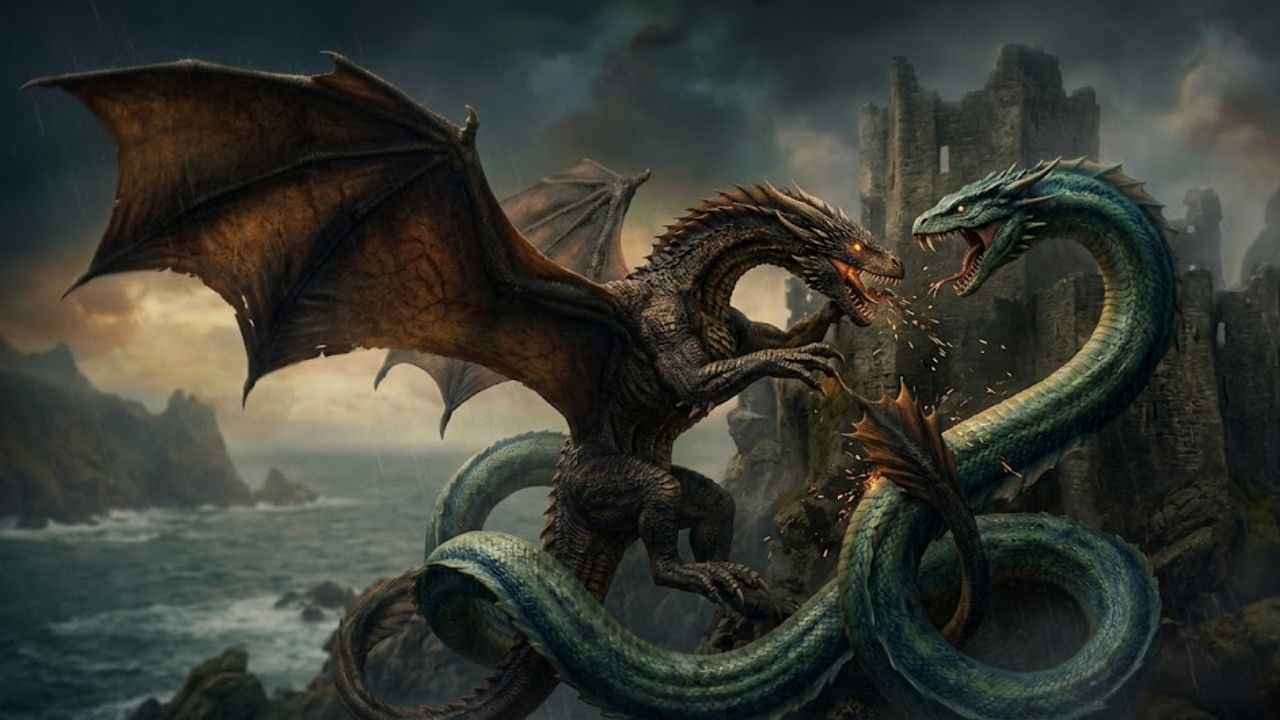
From the dawn of recorded memory, human civilization has cast its fears, faith, and fascination onto a single, recurring figure: the scaled predator. The story of Dragons and Serpents is not a scattered collection of myths, but a continuous thread woven through the spiritual and cultural fabric of the ancient world. Across the fertile floodplains of Mesopotamia, the riverine civilizations of the Nile, and the mist-veiled ridges of the Siwalik Hills, the serpentine form emerged as a potent emblem of cosmic order, existential dread, renewal, and divine authority.
The Evolution of the Scaled Beast in World Lore reveals less a tale of separate creatures and more a saga of transformation. Modern classifications may distinguish between the slithering serpent and the winged, fire-breathing dragon, but historical imagination rarely drew such rigid boundaries. Instead, the serpent stands as the primordial blueprint — the ancestral archetype from which Dragons would rise. The very language confirms this lineage. The Greek term drakōn, from which the modern word “dragon” descends, referred fundamentally to a great serpent, often imbued with supernatural sight or a lethal, unblinking gaze.
Over centuries, this scaled figure underwent a dramatic metamorphosis. In early myth, Serpents often embodied chaos, the untamed forces that threatened cosmic balance. Yet as cultures evolved, so too did their Dragons — ascending from chthonic monsters of the abyss to imperial emblems, celestial guardians, and even embodiments of wisdom and sovereignty. What began as a creature of primordial fear gradually assumed the mantle of power, majesty, and psychological depth.
Thus, the intertwined histories of Dragons and Serpents chart more than the development of mythic beasts; they illuminate humanity’s shifting relationship with nature, authority, mortality, and the unknown. The scaled form endures not merely as a relic of superstition, but as one of the most resilient archetypes in world lore — a symbol forever shedding its skin, yet never losing its ancient soul.
The Etymological Foundations of the Scaled Beast
To trace the evolution of the dragon, one must first dismantle the linguistic layers that have defined it across millennia. The term “dragon” entered the English language in the early 13th century, passing through the Old French dragon and the Latin draco before arriving at the Greek drakōn. The Greek term is derived from the Proto-Indo-European root derk-, meaning “to see,” suggesting that the earliest conceptualizations of the dragon emphasized its predatory gaze—the “all-seeing” guardian that could not be easily bypassed. This focus on vision aligns with the mythological role of many early dragons as protectors of sacred treasures, such as the golden apples in the Garden of the Hesperides, guarded by the serpent Ladon.
In the Germanic and Norse traditions, the creature was primarily identified as a wyrm or wurm. Unlike the Greek emphasis on sight, wyrm derives from the Proto-Indo-European ṷer-, meaning “to turn” or “to bend,” highlighting the physical motion of the serpent. This distinction suggests that while the Mediterranean world viewed the dragon through the lens of a supernatural sentinel, the northern European world focused on the earth-dwelling, slithering reality of the reptile. Over time, these terms began to merge, especially following the Norman Conquest of 1066, which introduced French-inflected “dragon” terminology into a landscape previously dominated by the Anglo-Saxon “wyrm”.
Comparative Etymology of Serpentine Terms
| Term | Language of Origin | Primary Meaning | Conceptual Focus |
| Drakōn | Ancient Greek | Serpent / Large sea-fish | Predatory sight / “to see clearly”. |
| Wyrm | Old English | Serpent / Dragon / Worm | Physical movement / “to turn or bend”. |
| Draco | Latin | Huge serpent / Dragon | Serpentine form; military standard. |
| Nāga | Sanskrit | Cobra / Serpent | Semi-divine spirit; water guardian. |
| Lóng | Chinese | Dragon | Onomatopoeia for thunder; rain deity. |
| Guivre | Old French | Snake / Viper | Morphological precursor to the wyvern. |
The interaction between these terms created a rich synonymy in Middle English literature. In the epic poem Beowulf, the final antagonist is described using both wyrm and draca, signaling a transitional period where the old Germanic slitherer was adopting the fire-breathing, winged characteristics of the Latinate dragon. By the time of the High Middle Ages, the word “dragon” had become the prestige term, often reserved for winged, four-legged beasts, while “worm” was relegated to an archaism or used to describe wingless, more bestial serpents.
Primordial Chaos: The Serpentine Origins of the Near East
The earliest recorded draconic figures emerged from the fertile imagination of ancient Mesopotamia and Egypt, where the struggle for survival against seasonal floods and scorching droughts was projected onto the cosmic scale. In Sumerian and Babylonian mythology, the serpent represented the untamed primordial state of the universe. The goddess Tiamat, the personification of the salt sea, is arguably the first true “dragon” in world literature. While early depictions sometimes show her in human form, her association with a brood of monstrous serpents and her eventual defeat by the god Marduk established the “Chaoskampf” motif—the struggle between the ordered sky god and the chaotic watery serpent.
Marduk’s victory over Tiamat is not merely a combat narrative; it is an act of architecture. According to the Enuma Elish, Marduk split Tiamat’s body “like a shellfish,” using one half to form the sky and the other to form the earth. This suggests that for the Babylonians, the dragon was the raw material of reality—a powerful, terrifying force that had to be dismantled and reorganized for civilization to exist. Other Mesopotamian creatures like the mušḫuššu (furious serpent) further complicated this image. Depicted on the Ishtar Gate, the mušḫuššu was a composite beast with a snake’s body, lion’s forelegs, and eagle’s talons, serving as a protective servant to the gods rather than a pure agent of chaos.
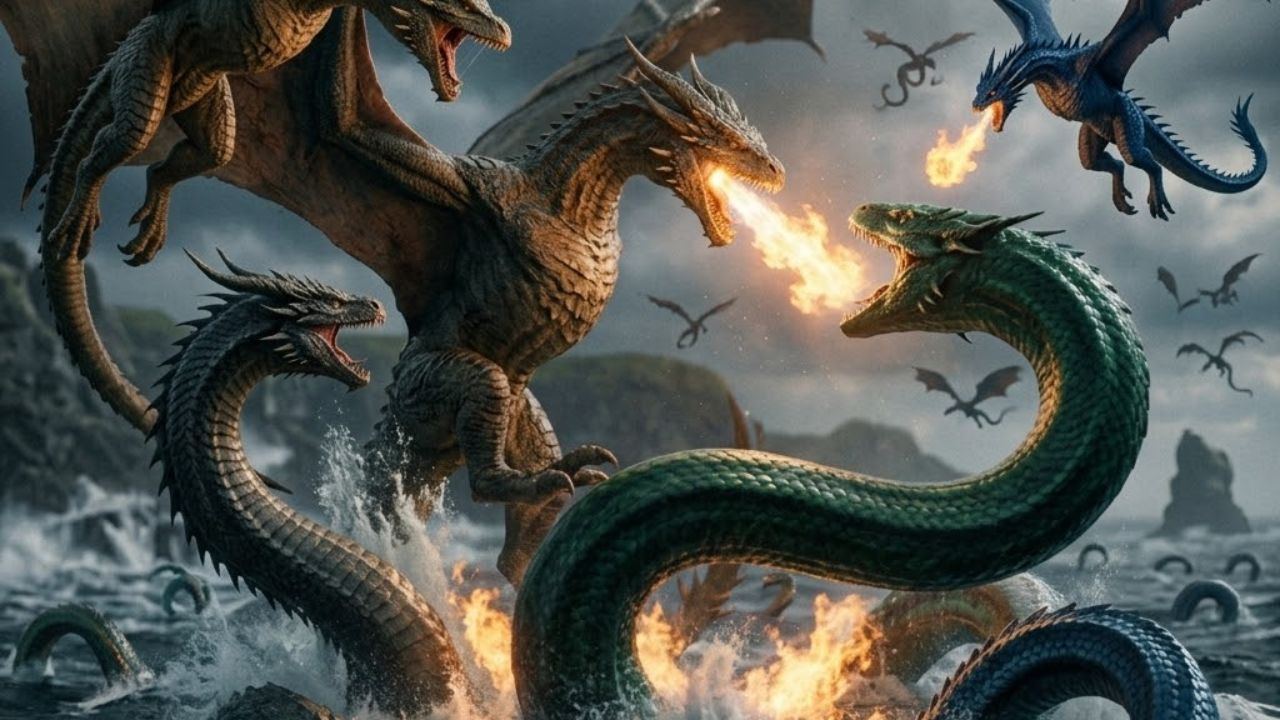
In ancient Egypt, the serpentine archetype was dominated by Apep (or Apophis), the colossal enemy of the sun god Ra. Every night, as Ra’s solar barque traveled through the underworld (the Duat), Apep would attempt to swallow the sun, bringing about a permanent eclipse and the return of the world to non-existence. This eternal struggle highlights the Egyptian view of the serpent as the personification of Isfet (chaos), which stood in direct opposition to Ma’at (order and truth). Unlike Tiamat, who was a primordial mother, Apep was a disembodied force of pure malevolence, often depicted being speared or hacked by the gods and the Pharaoh to ensure the sun would rise another day.
Major Serpentine Deities of the Ancient Near East and Egypt
| Deity | Culture | Primary Attributes | Role in Mythology |
| Tiamat | Babylonian | Primordial Sea Goddess | Mother of gods; personified salt water chaos. |
| Apep | Egyptian | Giant Serpent of Darkness | Nemesis of Ra; represents eternal disorder. |
| Nehebkau | Egyptian | Massive Earth-Serpent | Guardian of the underworld; supports the earth. |
| Mušḫuššu | Babylonian | Snake-Lion-Eagle Hybrid | Symbol of divine power and protection. |
| Kur | Sumerian | Monster of the Netherworld | Representation of all destructive forces. |
| Denwen | Egyptian | Fiery Serpent | Nearly destroyed the gods with a conflagration. |
The Egyptian tradition also introduced the Ouroboros—the serpent swallowing its own tail—which first appeared in the tomb of Tutankhamun. This image represented a more philosophical evolution of the serpent, moving away from simple chaos toward a symbol of eternal return, rebirth, and the cyclical nature of the cosmos. This duality—the serpent as both the destroyer of light (Apep) and the guardian of the sun god’s corpse (the Many-Faced)—reflects a sophisticated understanding of the necessary tension between creation and destruction.
The Classical Synthesis: Greek Drakontes and Roman Standards
The Greco-Roman world served as a bridge between the primordial serpents of the East and the heraldic dragons of medieval Europe. In Greek mythology, drakontes were primarily described as enormous snakes endowed with supernatural qualities, such as poisonous spit or a sleepless nature. These creatures were often tied to the earth (chthonic) and functioned as guardians of sacred sites or thresholds. Cadmus, the founder of Thebes, famously slew the dragon of Ares, a creature that guarded a sacred spring; by sowing the dragon’s teeth into the soil, he brought forth a crop of warriors, further emphasizing the link between the draconic and the generative power of the earth.
The Lernaean Hydra, fought by Heracles, represented a morphological shift toward the multi-headed monstrous serpent. With its ability to regenerate heads, the Hydra was an embodiment of the relentless, multi-faceted nature of hardship. Zeus’s battle with Typhon—a monstrous being with a hundred snake heads—mirrors the Near Eastern Chaoskampf, reinforcing the idea that the supreme sky god must subjugate the serpentine forces of the earth and sea to maintain celestial order.
The transition from myth to military emblem occurred during the Roman Empire. By the 2nd century AD, the Romans had adopted the draco as a military standard for their cavalry cohorts. These standards, often wind-sock-like structures that whistled as the wind passed through them, were influenced by the traditions of the Sarmatians and Dacians. This adoption marked the dragon’s evolution into a symbol of terrestrial power and military prowess, a role it would continue to play throughout the Middle Ages and into modern heraldry.
The Dragon of the East: Harmony and Imperial Majesty
While the Western tradition increasingly viewed the dragon as a beast to be vanquished, the Asian tradition—particularly in China, Japan, and Korea—developed a radically different perspective. In Chinese culture, the Lóng (dragon) evolved from a rain-bringing spirit into the ultimate symbol of imperial authority and cosmic harmony. The earliest depictions, dating back to the Xinglongwa culture (6200–5400 BC), were simple zoomorphic carvings, but by the Shang and Zhou dynasties, the dragon had become a sophisticated composite beast.
The Chinese dragon is traditionally described as a “nine-beast” chimera, representing its dominion over all segments of the natural world. This form was not random; it symbolized the dragon’s role as the master of the elements, particularly water. Unlike the fire-breathing dragons of the West, Chinese dragons were sky-dwelling masters of meteorology, believed to control rainfall, floods, and typhoons. This made them objects of veneration rather than fear, as the agricultural success of the empire depended on their benevolence.
The Morphological Composition of the Chinese Dragon (Lóng)
| Body Part | Animal Origin | Symbolic Implication |
| Horns | Deer / Stag | Longevity and regal wisdom. |
| Head | Camel / Crocodile | Power and steadfastness. |
| Eyes | Demon / Rabbit | Spiritual perception and sharp-sightedness. |
| Neck | Snake | Fluidity and grace in movement. |
| Belly | Clam / Frog | Connection to the watery depths. |
| Scales | Carp | Resilience and the ability to transform. |
| Claws | Eagle / Hawk | Mastery over the sky and predation. |
| Paws | Tiger | Terrestrial strength and courage. |
| Ears | Cow | Receptiveness to the prayers of the people. |
The dragon’s association with the Emperor began as early as the Han dynasty, with the founder Liu Bang claiming he was conceived after his mother dreamed of a dragon. This mythic propaganda established the “descendants of the dragon” narrative, where the dragon represented the celestial justice and power of the “Son of Heaven”. This connection was so strong that eventually, only the Emperor was permitted to wear robes adorned with a five-clawed dragon, while lesser officials were limited to dragons with four claws.
In Japan, the dragon (Ryū or Tatsu) shared many characteristics with its Chinese counterpart but was frequently depicted with three claws instead of five. Japanese dragons were deeply linked to the sea and were seen as powerful, untameable spirits of the ocean. The legend of Susanoo slaying the eight-headed serpent Yamata no Orochi provides a rare instance of a “dragon-slaying” hero in the Eastern tradition. However, this myth is less about the inherent evil of the dragon and more about the restoration of balance and the purification of the god Susanoo himself, who had previously been a chaotic force in the heavens.
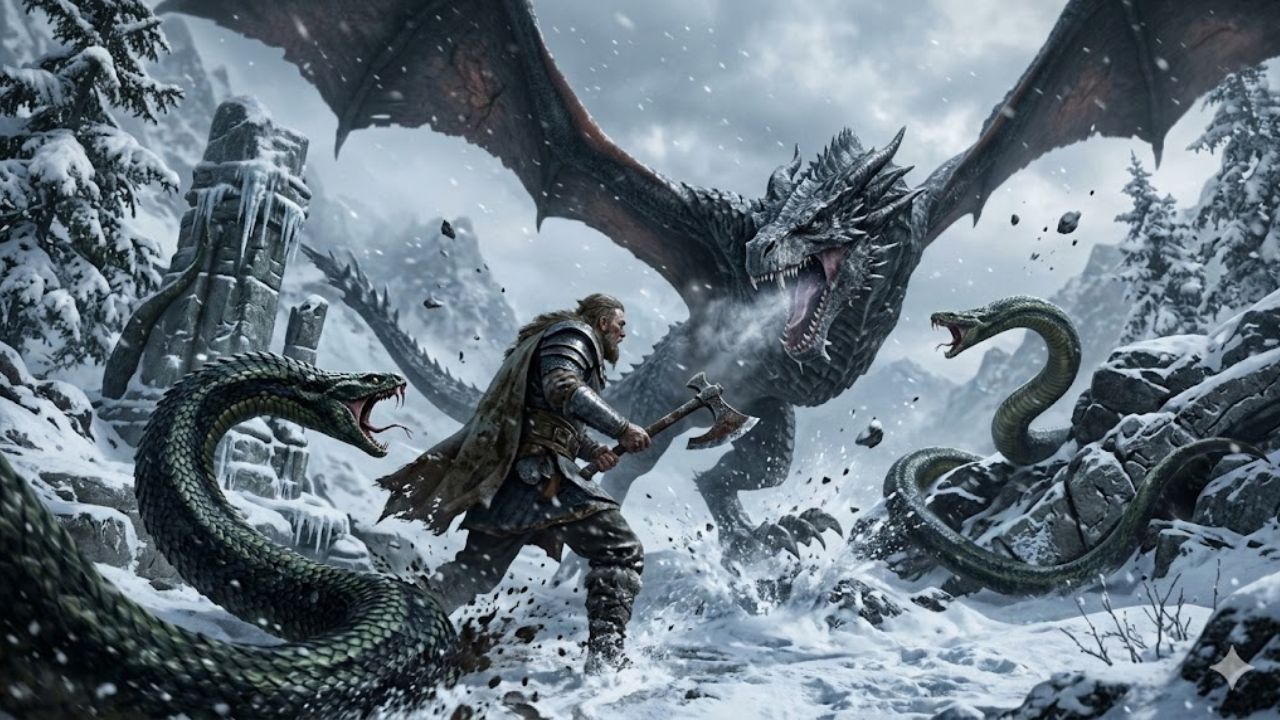
The Sacred Naga: Guardians of the Asian Netherworld
In the Indian subcontinent and Southeast Asia, the serpentine archetype took the form of the Nāga—a divine or semi-divine race of beings that were half-human and half-cobra. The Nagas are deeply interwoven with Hindu and Buddhist traditions, where they serve as guardians of water, wealth, and spiritual treasure. Unlike the Western dragon, the Naga is not fundamentally evil; it is a nature spirit that can be benevolent, neutral, or hostile depending on how it is treated.
Nagas are believed to reside in the subterranean world of Patala, a realm filled with jeweled palaces and immense riches. In Buddhist cosmology, they are assigned to the lowest tier of Mount Meru, where they protect the dharma and hidden teachings. The image of the serpent as a protector is most powerfully captured in the story of Mucalinda, the Naga king who shielded the meditating Buddha from a week-long storm by coiling his body beneath him and spreading his seven hoods overhead like an umbrella.
In Cambodia, the Naga is an ancestral figure. The founding myth of the Khmer people involves the marriage of an Indian Brahmin named Kaundinya to a Naga princess named Soma. This union legitimized the Khmer kings as descendants of both gods and serpents, grounding their royal power in the local landscape and the watery depths of the Mekong. This ancestral connection is physically manifested in the architecture of Angkor, where Naga balustrades line the bridges, serving as a symbolic link between the human world and the divine temple space.
The Five Castes of Buddhist Nagas
| Caste | Color | Direction | Symbolic Role |
| Kshatriya | White | East | Warrior caste; protectors of the crown. |
| Vaishya | Yellow | South | Merchant caste; associated with wealth. |
| Brahmin | Red | West | Priestly caste; spiritual guardians. |
| Shudra | Green | North | Laborer caste; associated with fertility. |
| Chandali | Black | Center | Outcastes; primordial energy. |
The Demonization of the Serpent: Medieval Europe and the Rise of the Villain
The Western dragon’s evolution into the ultimate symbol of evil was largely the work of early Christianity. By merging the serpentine creatures of pagan mythology with the “Serpent of Eden” and the “Great Red Dragon” of the Book of Revelation, the Church created a powerful metaphor for sin, paganism, and the devil. In this theological framework, the dragon was a creature that had to be conquered by the “soldier of Christ”.
The legend of Saint George and the Dragon became the definitive expression of this archetype. George, a Roman soldier and Christian martyr, was said to have rescued a princess from a dragon that demanded human sacrifices. Slaying the dragon was more than a heroic act; it was a conversion event, as the townspeople were said to have embraced Christianity following the beast’s defeat. This narrative aligned with the chivalric ideals of the Middle Ages, where the dragon functioned as the ultimate test of a knight’s piety and courage.
During this period, the dragon’s morphology became standardized in the Western mind: a squat, powerful reptile with bat-like wings, sharp claws, and a mouth that belched fire. The fire-breathing trait may have been inspired by biblical descriptions of the sea monster Leviathan, whose breath was said to “boil the ocean”. By the 13th century, artistic depictions of these beasts were ubiquitous in illuminated manuscripts, where they were shown being trampled under the heels of saints and martyrs, symbolizing the triumph of the divine order over bestial chaos.
The Feathered Serpent and the Americas
Independent of the Old World, the civilizations of the Americas developed their own profound serpentine deities. In Mesoamerica, the “Feathered Serpent”—known as Quetzalcoatl to the Aztecs and Kukulkan to the Maya—represented a harmonious union of heaven and earth. The name Quetzalcoatl combines the word for the resplendent feathers of the quetzal bird (representing the sky) with the word for serpent (representing the earth).
Unlike the Western dragon, Quetzalcoatl was a creator god associated with the wind, the morning star, and the breath of life. He was considered a patron of learning, the inventor of books and the calendar, and a god who opposed human sacrifice. This sophisticated conceptualization shows that the “scaled beast” could evolve into a symbol of peace and intellectual progress, far removed from the predatory monsters of European folklore.
In North America, many indigenous tribes of the Southeast Woodlands featured the “Horned Serpent” in their lore. This creature was frequently associated with water and thunder, living in rivers or lakes and possessing immense power over the elements. These traditions suggest that the association between serpents, water, and weather is a near-universal theme, arising independently across cultures that depended on the natural world’s rhythms for survival.
Scientific and Psychological Perspectives: The Biology of Myth
The universality of the dragon myth across isolated cultures has led to several intriguing scientific and psychological hypotheses. One prominent theory, proposed by historian Adrienne Mayor, suggests that dragon lore was inspired by the discovery of prehistoric fossils. Ancient people, lacking a modern understanding of paleontology, would have viewed the massive bones of dinosaurs or Pleistocene mammals as evidence of legendary beasts. In Greece, the “Monster of Troy” may have been influenced by fossils of the extinct Samotherium, while in China, dinosaur bones were traditionally referred to as “dragon bones”.
Anthropologist David E. Jones offers a more biological explanation in his “Primate Fear Hypothesis”. He argues that humans have an innate, “hardwired” fear of three primary predators that threatened our primate ancestors: big cats, birds of prey, and snakes. The dragon, Jones suggests, is a mental composite of these three threats—possessing the scales of a snake, the claws of a lion, and the wings of an eagle. This “super-predator” archetype exists because those of our ancestors who were instinctively afraid of these shapes were more likely to survive and pass on their genes.
Hypotheses for the Origin of Dragon Myths
| Hypothesis | Proponent | Primary Mechanism | Core Evidence |
| Fossil Evidence | Adrienne Mayor | Discovery of prehistoric bones | Dinosaur bones in China; Siwalik Hill fossils. |
| Primate Fear | David E. Jones | Innate fear of snakes, cats, and birds | Evolutionary “hardwiring” for predator detection. |
| Living Reptiles | Folklore | Exaggeration of monitor lizards / crocodiles | Komodo dragons; large pythons. |
| Meteorological | Comparative Myth | Personification of lightning and thunder | Association between dragons and rain in Asia. |
| Chthonic Decay | Cultural Theory | Link between snakes and rotting earth | Serpents in marshes and burial mounds. |
From a psychological perspective, Carl Jung viewed the dragon as an archetype of the “Shadow”—the darker, unconscious part of the self that must be confronted to achieve maturity. Slaying the dragon is a metaphor for “individuation,” where the hero (the Ego) conquers their inner fears and instincts to obtain the “treasure hard to attain” (self-realization). Jung noted that while Western myths focus on killing the dragon, Eastern traditions often focus on taming or integrating it, reflecting a different approach to the human psyche’s internal conflicts.
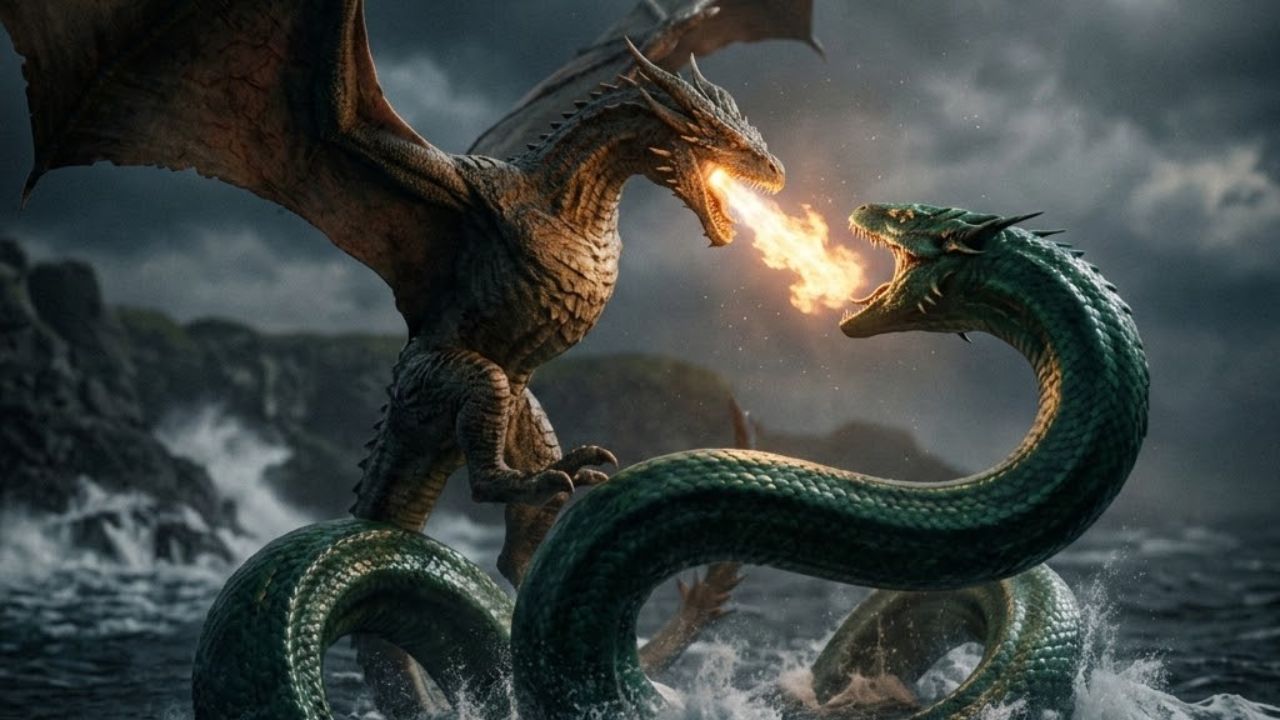
The Modern Transformation: From Beast to Icon
In the 20th and 21st centuries, the dragon has undergone its most rapid evolution. J.R.R. Tolkien’s Smaug in The Hobbit redefined the dragon for the modern age, blending the brute strength of the medieval beast with the cunning, greed, and intelligence of Norse legend. Smaug was not just a monster but a character—vain, ancient, and capable of speech—setting the template for the sophisticated dragons of contemporary fantasy.
Following Tolkien, the “humanization” of the dragon accelerated. Anne McCaffrey’s Dragonriders of Pern introduced dragons as telepathic partners, shifting the creature from an enemy to a life-long ally. Ursula K. Le Guin’s Earthsea series portrayed dragons as embodiments of ancient wisdom and the mysteries of language, moving the archetype toward a more spiritual and philosophical role.
In modern visual media, advances in CGI have allowed for more “realistic” portrayals, such as the dragons in Game of Thrones, which are treated as biological “weapons of mass destruction” that are both powerful and vulnerable. The film Reign of Fire (2002) furthered this trend by redesigning the dragon from the ground up to look like an animalistic, overpopulated plague, stripping away much of the traditional magic in favor of gritty, animalistic realism.
Milestones in Modern Dragon Fiction
| Work | Author / Director | Year | Impact on Dragon Lore |
| The Reluctant Dragon | Kenneth Grahame | 1898 | First sympathetic, poetry-loving dragon. |
| The Hobbit | J.R.R. Tolkien | 1937 | Smaug: the archetype of the cunning, intelligent hoard-guard. |
| Dragonflight | Anne McCaffrey | 1967 | Introduced the telepathic dragon-rider bond. |
| A Wizard of Earthsea | Ursula K. Le Guin | 1968 | Dragons as ancient sages and language-masters. |
| A Game of Thrones | George R.R. Martin | 1996 | Dragons as political weapons and symbols of lost power. |
| Reign of Fire | Rob Bowman | 2002 | Redesigned dragons as realistic, biological predators. |
| The Priory of the Orange Tree | Samantha Shannon | 2019 | Synthesis of Eastern and Western dragon myths. |
Conclusion: The Enduring Mirror
The evolution of the dragon from a slithering primordial serpent to a complex icon of modern fantasy reflects the shifting landscape of human consciousness. In antiquity, the scaled beast was a personification of the raw, untamed forces of nature—the flood, the darkness, and the deep ocean. In the medieval era, it became a moral mirror, representing the internal and external battles between good and evil. In the modern world, it has become a versatile symbol of power, wisdom, and the enduring connection between humanity and the wild.
Whether viewed as the chaos-serpent Apep, the benevolent imperial Lóng, or the wise sages of Earthsea, the dragon remains one of the most persistent archetypes in world lore. Its ability to adapt to the needs of every culture—to be a god in one age and a demon in the next—demonstrates its profound resonance with the human psyche. As long as humans have fears to confront and aspirations to fulfill, the image of the scaled beast will continue to haunt our stories, guarding the thresholds of our imagination.