
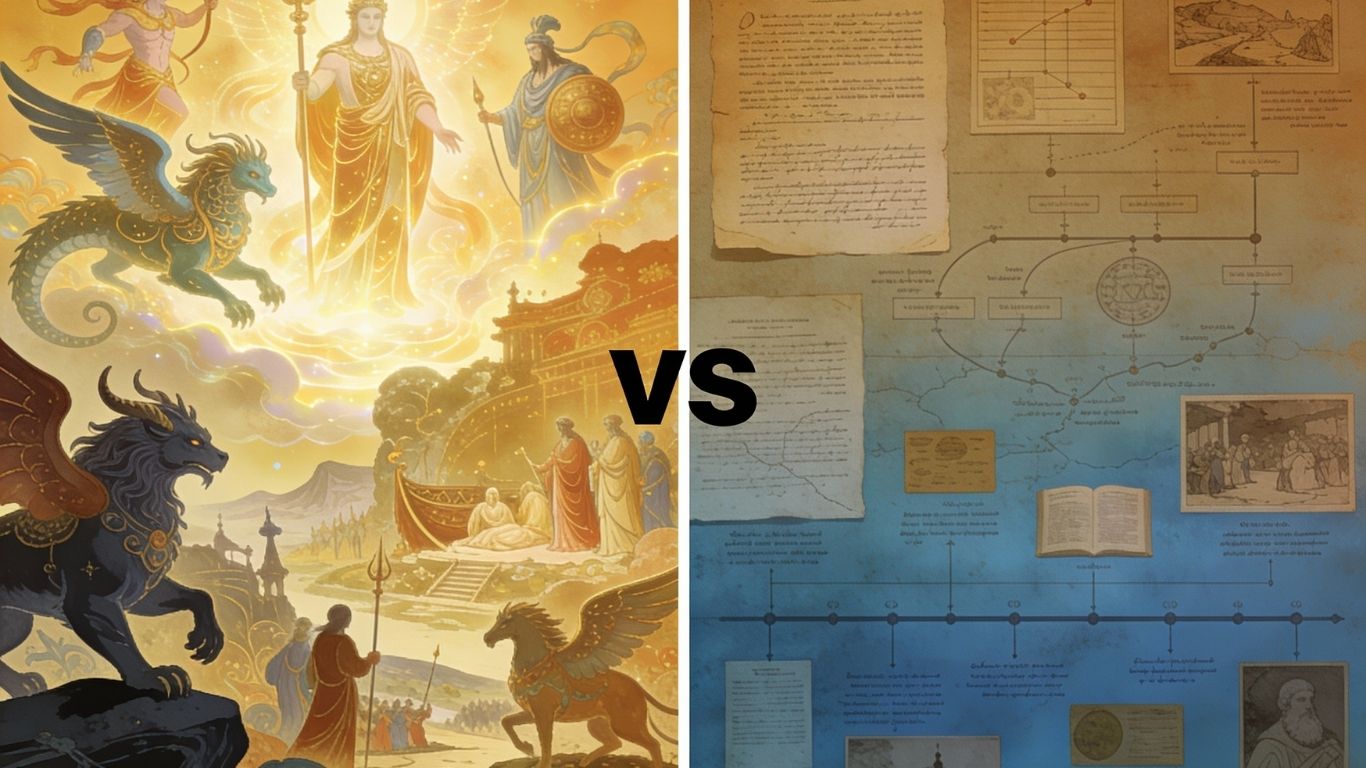
Have you ever wondered why ancient cultures obsessed over myths? Why did they spend centuries passing down stories about gods, heroes, and impossible adventures instead of documenting what actually happened? And then there’s the flip side—why do we care so much about historical accuracy today, treating it almost like a religion of facts and evidence? The truth is, mythology and history aren’t just different because one is “true” and the other is “made up.” The distinction runs deeper—it’s about why humans tell stories and what those stories are meant to do in our lives.
The Basic Difference: Proof vs. Purpose
Let’s start with the obvious distinction, because frankly, it matters.
History is grounded in evidence. When historians look at the past, they’re like detectives hunting for clues. They examine documents, scrutinize archaeological artifacts, interview eyewitnesses, cross-reference accounts from multiple sources, and then—crucially—they keep questioning everything. Did a treaty get signed? Show me the document. Was there a war? Find me the weapons, the bones, the fortifications. The siege of Troy? We can excavate it and see what layer of destruction matches the timeframe. World War II? We have photographs, video footage, survivor testimonies, and entire archives of government records.
History demands proof. It’s uncomfortable with gray areas and demands verification. Even then, historians argue endlessly about what it all means.
Mythology, on the other hand, doesn’t work that way. Myths are born from oral tradition—stories passed down through generations, told around fires and in temple courts, reshaped and reinterpreted as each culture encountered them. The Trojan War, as Homer describes it in the Iliad? No contemporary records. No eyewitness accounts from the actual time. No definitive archaeological proof. Yet for centuries, people believed it was real because the story itself was so powerful.
But here’s where it gets interesting: the lack of proof doesn’t make mythology useless. It makes it different. Because the purpose of mythology isn’t to prove something happened—it’s to explain something about the world, or about us.
Mythology’s Secret Mission: The Stories We Tell Ourselves
Think about mythology differently for a moment. The Hindu Ramayana and Mahabharata aren’t just entertainment for ancient Indians—they’re books of ethics, relationship guides, and philosophical frameworks all rolled into epic poetry. The Christian creation story in the Bible isn’t primarily meant to pass a scientific exam; it’s conveying a truth about human purpose and morality. When Indigenous cultures tell stories about volcanic eruptions disguised as battles between gods, they’re not lying—they’re capturing a genuine truth about the terror and awe of a catastrophic natural event.
Mythology serves as a mirror to society. It reflects what people fear, what they value, and how they understand the world. Greek myths about gods representing order versus chaos reflected very real concerns about maintaining stable governments. Egyptian myths about the sun god Ra’s daily journey across the sky conveyed timeless truths about cycles, death, and rebirth. Indigenous stories about ancestors and land spirits weren’t just pretty tales—they encoded centuries of knowledge about geography, seasons, and survival.
The genius of mythology is that it wraps abstract truths in narratives that stick. Metaphor and legend are far more memorable than a list of moral principles. So when societies needed to transmit values, ethics, and knowledge to the next generation, they reached for storytelling, not lecture notes.
This is why myths persist. The “hero’s journey”—leaving home, facing trials, returning transformed—appears in cultures separated by thousands of miles and centuries. From King Arthur to Harry Potter, we keep telling the same story because it resonates with something real about human experience, even if the specifics are invented.
Where They Blur: The Messy Middle Ground
Now here’s where things get genuinely weird: sometimes mythology and history overlap in ways that refuse to be neatly categorized.
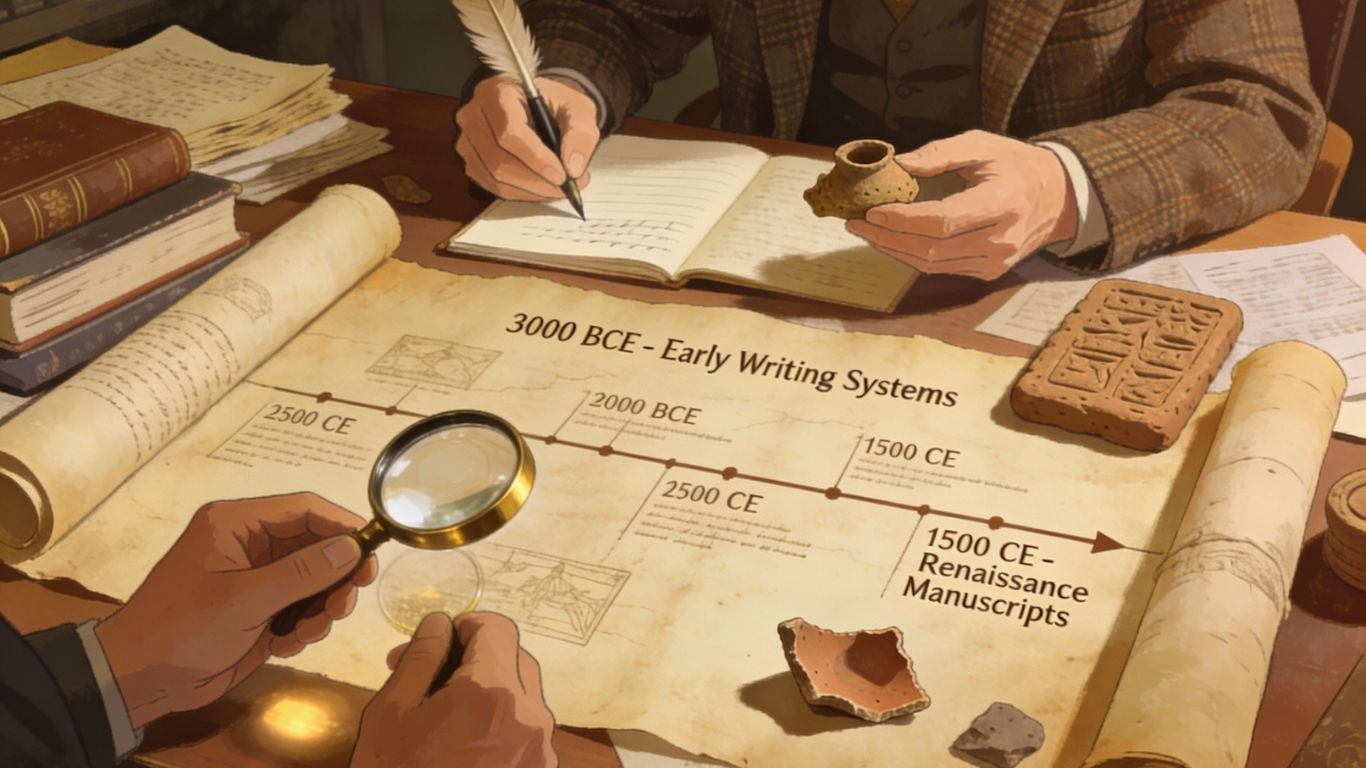
Take the city of Troy. For centuries, it was considered pure mythology—a legend that Homer invented for his epic poetry. Then, in 1870, archaeologist Heinrich Schliemann showed up with a theory: what if Troy was real? He excavated a site in modern-day Turkey and found a real city that had been destroyed multiple times by fire and warfare. Layer upon layer of ruins, weapons, and inscriptions. Suddenly, the myth had archaeological substance.
But—and this is crucial—finding Troy didn’t prove the Trojan War happened as Homer described it. The city existed, yes. But the city that matched Homer’s description likely predated the Mycenaean Greeks by a thousand years. So there was probably a Troy, and there were probably conflicts in the region, but the epic battle with Paris, Helen, Achilles, and the wooden horse? The evidence gets murky fast.
This is where mythology and history genuinely kiss and create confusion.
The Klamath people of Oregon have a myth about when two gods fought and the mountain collapsed, forming Crater Lake. Sounds purely mythological, right? Except it turns out Mount Mazama actually erupted around 7,700 years ago, and it really did collapse to form what is now Crater Lake. The Klamath story preserved a genuine geological event in mythological form—and astonishingly, their oral traditions actually contained accurate details about volcanic eruptions. The myth wasn’t just inspired by history; it was a compressed, metaphorical version of it.
Or consider the legend described in the Ramayana about an army building a floating bridge from India to Sri Lanka. The bridge in the myth is described as being built by mystical ape-men, which sounds purely fantastical. But there’s an actual geological formation called Rama’s Bridge (also known as Adam’s Bridge) in the Indian Ocean that could actually be crossed at low tide during ancient times. The myth didn’t invent the bridge—it mythologized what was real.
These aren’t exceptions. Researchers have found that Australian Aboriginal folklore contains details about sea-level rises that occurred 10,000 years ago, preserved with stunning accuracy across millennia of oral storytelling. The Yellow River in ancient China produced the worst flood in 10,000 years, and it happened at the exact date referenced in ancient Chinese mythological texts about the Xia dynasty.
The lesson here is uncomfortable: mythology and history aren’t complete opposites. They’re points on a spectrum.
Some myths have kernels of historical truth. Some historical narratives get warped and mythologized over time. The real story is usually weirder and more complex than the clean division we pretend exists.
Why Do We Keep Them Separate?
The Western obsession with dividing myth from history is actually pretty recent. In ancient times and non-Western cultures, the distinction was far blurrier. You could believe something was historically true and invest it with spiritual or metaphorical truth simultaneously. Those weren’t contradictions—they were the same story being told on different levels.
The hard division happened during the rise of rationalism in 19th-century Europe. Philosophers and scientists decided that “real” knowledge came from reason, empirical evidence, and scientific method. Everything else—mythology, folklore, religion—was relegated to the category of “not real,” almost as if storytelling and spirituality were inferior ways of knowing.
But history itself isn’t as objective as we pretend. Which events get recorded? Which ones get left in the dusty archive? Which sources do we trust, and which do we dismiss? These are deeply human decisions, shaped by who has power, what survives time, and what people cared enough to write down. An enslaved person’s perspective on history looks radically different from their slaveholder’s version. A woman’s role in history gets minimized in documents written by and for men.
Meanwhile, mythology keeps doing what it always did: preserving truths that don’t fit neatly into factual categories. Myths hold onto the cultural meaning, the philosophical lessons, the emotional weight of events.
So… Which One Gets to Be True?
This is where most people want me to give a clean answer, and I’m going to disappoint you a little.
Both do. They’re true in different ways.
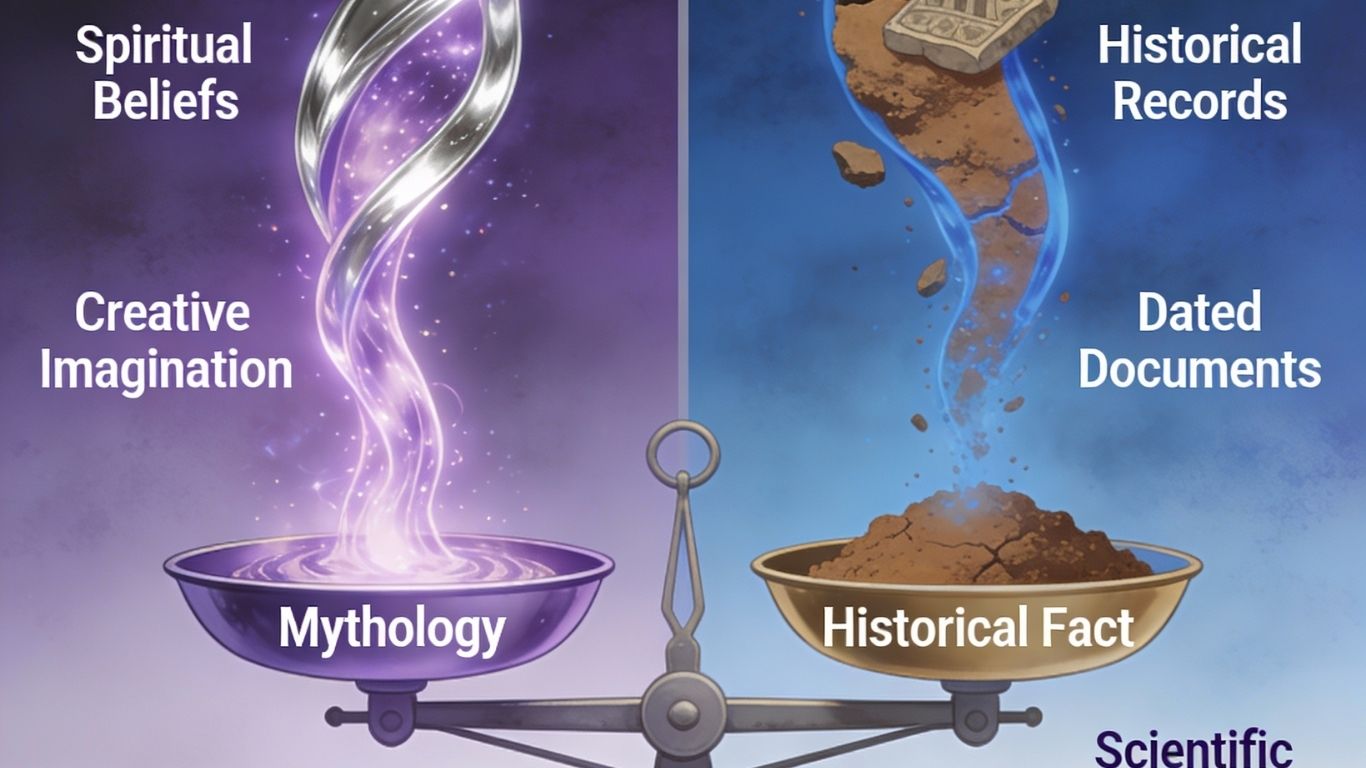
History is true in the sense that it really happened. You can verify it, debate it, prove parts of it wrong, and keep getting closer to what actually occurred. It’s a tool for understanding the causation of events and how the world developed into its current state.
Mythology is true in the sense that it captures real emotional, spiritual, and philosophical truths about human experience. When a culture tells a myth about chaos being defeated by order, they’re not making something up—they’re expressing something they deeply understand about the human condition. When Indigenous stories preserve knowledge of environmental cycles, geological events, and survival techniques, that’s a different kind of accuracy.
The irony is that we’ve been discovering more connections between mythology and history in recent decades, not fewer. As we get better tools—DNA analysis, satellite imaging, deep-sea archaeology—we keep finding that myths contained more factual grounding than we assumed. It seems like the ancients weren’t as delusional about facts as the modern, rational West believed.
Maybe they were just smarter about accepting that something could be simultaneously metaphorical and rooted in real events. That a great story could carry both the truth of what happened and the truth of what it meant.
The Real Difference
Here’s what actually separates them:
History asks: What happened, and how do we know?
Mythology asks: What does this mean, and why does it matter?
Both questions are worth asking. Both kinds of answers are worth having. We need historians to understand our past accurately, to check our assumptions, and to prevent us from deceiving ourselves about how we got here. And we need mythology to remember who we are, where our values come from, and what ideals we’re reaching toward.
The people who told myths weren’t stupid. They weren’t confused about reality. They were doing something different—using imagination and metaphor to encode and transmit the deep truths that pure facts can’t capture.
And honestly? In a world drowning in data and obsessed with metrics and verification, maybe we could use a little more mythology. Not instead of history, but alongside it. Because understanding the past requires both the facts and the meaning we make from them.
That’s not mythology speaking. That’s history finally admitting what it should have known all along: the stories we tell about what happened are just as important as what actually happened.