
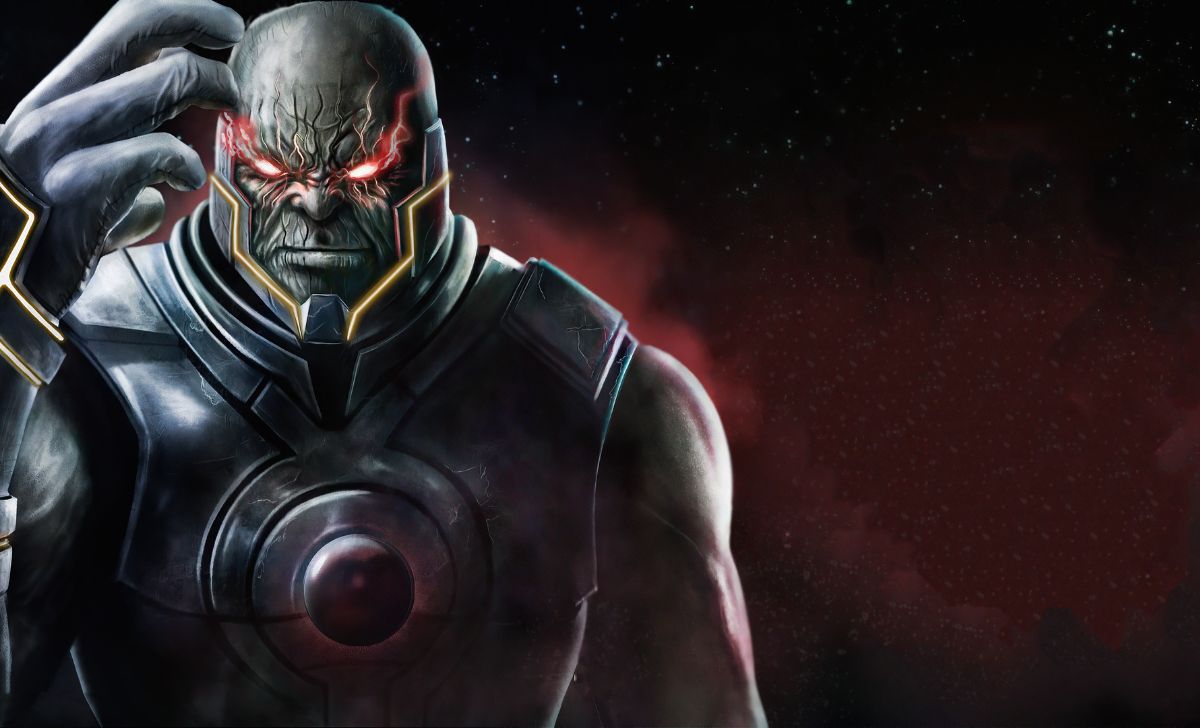
Few beings in the history of fiction embody absolute power, inevitability, and terror quite like Darkseid. As one of the greatest villains in DC Comics, Darkseid stands not merely as a conqueror but as a cosmic constant—a god whose will defines the fabric of existence itself. He is a symbol of tyranny, intellect, and willpower, always striving for the Anti-Life Equation to bring absolute order to the universe. In countless storylines across DC’s vast multiverse, this formidable New God of Apokolips has demonstrated feats of power that transcend mortal comprehension. The following exploration, “Darkseid’s Most Powerful Moments in DC Comics,” looks deeper at some of the most devastating and awe-inspiring moments in his comic book history—moments that showcase just why Darkseid remains the ultimate threat to gods and heroes alike.
The Unyielding Power in Batman/Superman #24
The dual universes of Earth-Zero and Kingdom Come collide in Batman/Superman #24, giving readers one of Darkseid’s most terrifying moments to date. Written by Mark Waid and illustrated by Dan Mora, this issue portrays the Justice Leagues from both universes uniting against a version of Darkseid radiating fury and dominance. The two Supermen, symbols of ultimate strength and hope, attack him with blinding speed and heat vision so intense it could melt even celestial metal. Yet, in classic Darkseid fashion, he stands utterly unmoved, his eyes cold and indifferent as if swatting flies with his mind. The attacks do nothing. His mere presence radiates ultimate superiority.

When Darkseid finally moves, he calmly utters the chilling words, “Two of you. Interesting,” before firing his deadly Omega Beams. In an instant, both Supermen—beacons of invulnerability—are consumed by the energy, their bodies glowing with internal pain before collapsing lifeless at his feet. Darkseid casually steps over their fallen forms, continuing forward as if the gods themselves were beneath him. The Flash, the embodiment of speed, charges at him in desperation, only to be effortlessly swatted away like a bug. Darkseid proceeds to systematically dismantle both Justice Leagues, annihilating heroes who had faced multiversal threats before but now stand powerless before pure inevitability.
Kingdom Come Wonder Woman and Green Lantern strike in tandem, their combined might sufficient to level armies. But Darkseid blocks each of their attacks barehanded, shattering their weapons like glass. “War,” he says, “is a cold game. Colder yet is the grave.” With one motion, he ends them. This moment encapsulates Darkseid’s essence: restraint paired with pure dominance. Even with his hands behind his back, he decimates the mightiest heroes of two universes. The entire encounter is not a battle—it’s a statement of cosmic superiority.
Darkseid and the Consumed Universes of Constantine #23
In Constantine #23 from DC’s New 52 continuity, Darkseid’s terrifying scale is elevated to metaphysical horror. While John Constantine wrestles with forces of magic and deception, Darkseid reveals something greater, something horrifying—he has consumed entire universes. This revelation places Darkseid in a league beyond planetary domination and into a realm of cosmic annihilation. He doesn’t simply rule worlds; he extinguishes them.

During their encounter, Darkseid towers over Constantine, the embers of destroyed realities reflected in his gaze. He declares, “This is a dead universe. One I have already consumed. There is nothing for me here.” The statement is casual, as though he’s commenting on a meal already digested. For Darkseid, the devouring of existence itself is routine. He doesn’t hunger for destruction out of need—it is the execution of his will, the extension of his being. His power transcends comprehension, reinforcing that his form in most DC stories is only an avatar of his true cosmic essence. Somewhere, beyond the multiverse, exists the true Darkseid—an omnipotent presence that reality can barely contain.
The True Power Behind the Omega Effect
Darkseid’s infamous Omega Beams are just the surface expression of an even more profound ability: the Omega Effect. Unlike most cosmic powers, the Omega Effect is not raw energy but metaphysical dominion. It grants Darkseid control over time, matter, life, and death. This control is not symbolic—it’s literal.

In Superman/Doomsday: Hunter/Prey #2, Darkseid demonstrates the malicious elegance of this ability. After absorbing great amounts of energy to restore his strength, he announces, “My powers are now at their peak. This farce must end.” With a blast of the Omega Effect, he disintegrates Cyborg Superman into nothingness. But as revealed later, Cyborg Superman is not dead—only displaced. Darkseid had extracted his life force and contained it in a small orb, to control or resurrect him later. This revelation cements Darkseid as not just a god of destruction, but a manipulator of souls. He can decide when a being lives, dies, or exists in purgatory, bending metaphysical laws as easily as physical ones. This absolute control defines the Omega Effect—it is godhood rendered into energy.
The Explosive War Against the Anti-Monitor
Few rivalries in the DC cosmos come close to matching Darkseid’s battle against the Anti-Monitor in Justice League: The Darkseid War by Geoff Johns. This wasn’t just a clash of villains; it was the violent meeting of two universal forces, each representing an aspect of totality—Darkseid as finality and will, the Anti-Monitor as entropy and destruction. Their battle shook creation itself.

As the two titans clash, Wonder Woman narrates their encounter: “This isn’t like any war we’ve ever experienced.” Darkseid commands the Black Racer, the personification of Death itself, to attack his foe. Blows ignite across dimensions as Darkseid releases Omega Beams powerful enough to fracture existence. For a fleeting moment, Darkseid gains the upper hand. But ultimate power meets its equal when the Anti-Monitor merges the Black Racer with The Flash, creating a new avatar of speed and death. The speedster, unwillingly bound, tears through Darkseid’s chest, killing even the god of tyranny. Yet, like any true constant, Darkseid’s death is never the end. Even in destruction, his influence lingers, poisoning the fabric of existence with his return already inevitable.
The Fall of the Quintessence in Infinite Frontier
In Infinite Frontier #0, Darkseid transcends all known versions of himself. He achieves unity of all his fractured forms—his multiversal echoes and shadow selves coalesce into one being: the true Darkseid. Fully realized, he stands before the Quintessence, a cosmic council of god-like overseers including Hera, the Wizard Shazam, Highfather, Phantom Stranger, and even the Spectre—the embodiment of God’s wrath.

The assembled gods face him, believing in their collective power. Darkseid simply says, “Die.” And they do. Instantly, the gods who oversee worlds and heavens fall, erased with one act of will. Standing over their corpses, he declares, “All stories lead to me. I am the last chapter.” The narration confirms that his power now exceeds what it was before the first Crisis. Holding Spectre beneath his feet, Darkseid proclaims, “The new multiverse is infinite, but I am finite. I am final. Darkseid is the end.” This statement is more than villainous posturing—it is metaphysical truth. He is no longer one god among many; he is the inevitable conclusion of creation itself.
The Ascension: King Omega Darkseid in DC KO
The current DC KO storyline takes this concept to its ultimate extreme. Darkseid has now become King Omega, a being composed of infinite divinity and manifested power. He is not simply stronger—he is existence. The text describes him as “a universe of power given form,” a line that perfectly articulates his evolution from god to totality. Each atom, molecule, and spark of energy bends to his essence. Everywhere he looks, matter and magic alike transform into himself.

Darkseid now exists simultaneously across multiple realities—seen in Themyscira, Gotham City, Oa, and the Rock of Eternity all at once. He is omnipresent, omniscient, and omnipotent. Magic, science, reality, and even the divine all emanate from his being. In alternate timelines, he destroys all creation and reconstructs it in his image, only for the heroes to rebel through rewritten histories to stop him. But the futility remains—Darkseid’s rise cannot truly be undone. King Omega Darkseid is not the god above gods—he is godhood itself, the embodiment of all beginnings and ends.
The Eternal End: Why Darkseid is the Ultimate God of the DC Universe
Darkseid’s story transcends traditional villainy. He is not a force motivated by destruction for its own sake but by the pursuit of total order, an existence where free will and chaos no longer threaten stability. His actions, horrifying as they are, stem from this singular vision of perfection through the Anti-Life Equation. He represents inevitability—the silent truth that all things, from stars to souls, must eventually obey the will that defines the end.

Even heroes know that Darkseid cannot truly die. His consciousness flows through the Multiverse, reforming endlessly because he is not bound by mortality or continuity. Every death births a rebirth. Every defeat, a darker return. In many ways, he is the metaphysical reflection of DC’s storytelling itself—an eternal constant that defines the boundaries of what it means to be heroic. For every light that rises, Darkseid casts his shadow. The very concept of hope is sharpened by his existence.
As DC KO pushes him into uncharted cosmic supremacy, one truth resonates through the Multiverse: Darkseid is not merely a villain—he is the end of all stories, the conclusion written between the stars. No matter how many crises shatter and rebuild existence, one phrase will always remain unchallenged across time, space, and soul—Darkseid is. Always.