

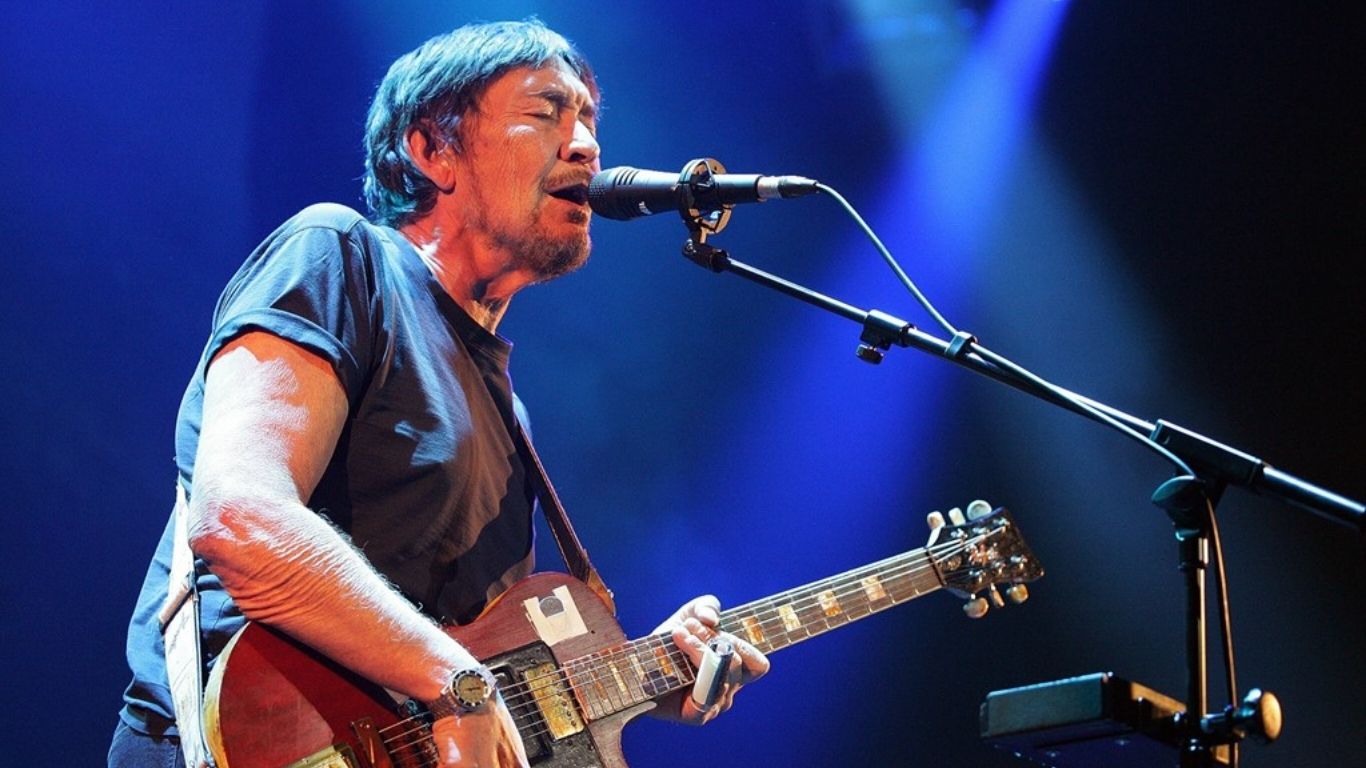
Chris Rea, the Middlesbrough-born musician who became a reluctant architect of one of Britain’s most enduring festive anthems, has passed away at the age of 74 following a short illness in hospital. His family confirmed the news today, marking the end of a remarkable career that spanned decades despite persistent health challenges.
A Reluctant Star
Rea was a contradiction—a shy artist who achieved massive success despite actively resisting the spotlight. He famously opposed his record label’s decision to release “Driving Home for Christmas,” only to grudgingly accept their judgment when the song eventually emerged in 1986. His reluctance extended further; he even resisted suggestions to adopt a more commercially appealing stage name, a decision that, ironically, did nothing to diminish his impact on popular culture.
Throughout his career, Rea recorded an impressive 25 solo albums, two of which topped the UK albums chart, establishing himself as a serious musician rather than a one-hit wonder. As a proud guitarist deeply influenced by the blues, he brought artistic depth to his work that transcended commercial calculation.
The Origin of an Icon
The genesis of “Driving Home for Christmas” embodied the creative spontaneity that defined Rea’s approach. During Christmas 1978, Rea found himself stuck in traffic on the A1 motorway while driving with his wife from Abbey Road Studios in London back to their Middlesbrough home—a grueling 220-mile journey. Unable to ignore the mundane reality unfolding around him, he scribbled down lyrics as passing headlights periodically illuminated the interior of their Mini. The raw verses captured a moment of ordinary human experience: the tedium of traffic, the simple desire to reach home, the shared experience of fellow drivers caught in the same predicament.
The completed song remained unfinished for eight years. Only later would Rea pair those original lyrics with jazzy chords he had composed separately, creating what would become his most recognizable work. Even then, his ambivalence was apparent—he initially relegated the track to a B-side, viewing Christmas songs as disposable novelties unworthy of serious attention.
The Slow Ascent to Classic Status
When Rea rerecorded “Driving Home for Christmas” for a compilation in 1988 and released it as a single, the song’s path to cultural prominence was anything but meteoric. Unlike the grandiose Christmas standards that dominated the festive charts—records built on Spectorian walls of sound, orchestral overwhelm, and emotional excess—Rea’s composition took a different approach entirely.
The song’s musical arrangement harked back to an earlier era, featuring twinkling pianos and Sinatra-era strings layered over a gentle, understated beat. This deliberately nostalgic production, ironically, provided the track with remarkable staying power. While Christmas songs typically impose themselves aggressively on listeners, forcing emotional capitulation through sonic bombast, “Driving Home for Christmas” refused such theatricality. Its restraint became its strength.
Lyrically, the song embodied quotidian reality rather than sentimentality. Rea never indulged in longing for a lover, desperate yearning for hearth and home, or frantic struggles against the clock. Instead, he simply observed: a man sitting in traffic, anticipating arrival, noticing the mirror image of his own experience reflected in the driver alongside him. “I take a look at the driver next to me, he’s just the same,” perhaps the song’s most affecting line, captured this democratized experience of shared human circumstance.
The track’s chart performance in 1988 reflected its unconventional status. While Cliff Richard’s “Mistletoe and Wine” claimed the Christmas number one spot, “Driving Home for Christmas” languished at position 53. Yet this initial commercial modesty belied the song’s true destiny. Because it refused to exhaust itself with aggressive marketing or sonic gimmickry, the song never wore out its welcome. Year after year, it returned to radio playlists and shopping center speakers, gradually embedding itself into the fabric of British Christmas tradition.

A Decade-Spanning Legacy
Nearly four decades after its 1986 initial release, “Driving Home for Christmas” demonstrated its remarkable endurance by charting at number 30 in the 2024 UK Christmas top 40—a remarkable achievement for a song treated initially as an afterthought by its own creator.
The track’s longevity stemmed from its accurate emotional calibration. Most people experience Christmas not as operatic drama but as a series of modest pleasures and quiet contentments. Few of us encounter jingling sleigh bells; fewer still wish the season could be perpetual. Yet virtually everyone has occupied a stationary vehicle on a grey winter’s day, mentally measuring the distance between their current location and their destination. Rea’s song inhabited this authentic emotional space, creating a companion for the mundane rather than a soundtrack for fantasy.
Resilience Through Adversity
Rea’s career achievements become even more remarkable when considered alongside the substantial health obstacles he navigated. At just 33 years old, he received a pancreatic cancer diagnosis—a devastating blow that could have derailed lesser artists. Beyond this initial crisis, he endured subsequent liver operations and later suffered a stroke, each incident threatening to curtail his creative output and public presence.
Yet Rea persisted, continuing to record, perform, and contribute to the cultural landscape despite these profound health challenges. His survival and continued productivity stand as testaments to resilience and artistic dedication.
The Perfect Cardigan
In his 2016 interview with The Guardian, Rea described the song as an atypical work in his broader catalogue, yet emphasized it was never intended as novelty material. Rather, he conceived of it as “a perfect cardigan”—comfortable, enduring, and appropriate to revisit season after season without the garment losing its essential character or utility.
Since his death, tributes have poured in acknowledging his broader influence and contributions to music. As his social media accounts noted, “Chris’s music has created the soundtrack to many lives, and his legacy will live on through the songs he leaves behind.” While “Driving Home for Christmas” will undoubtedly remain his most commercially recognized work, it represents only one facet of a substantive career built on musical integrity, blues-influenced guitar mastery, and an artist’s refusal to compromise his authentic vision for commercial expedience.
Chris Rea’s passing marks the end of an era, yet ensures that for generations to come, listeners will find themselves in familiar traffic on winter roads, hearing his gentle piano and understated wisdom, understanding that they’re not alone in their modest desires and human experiences.