
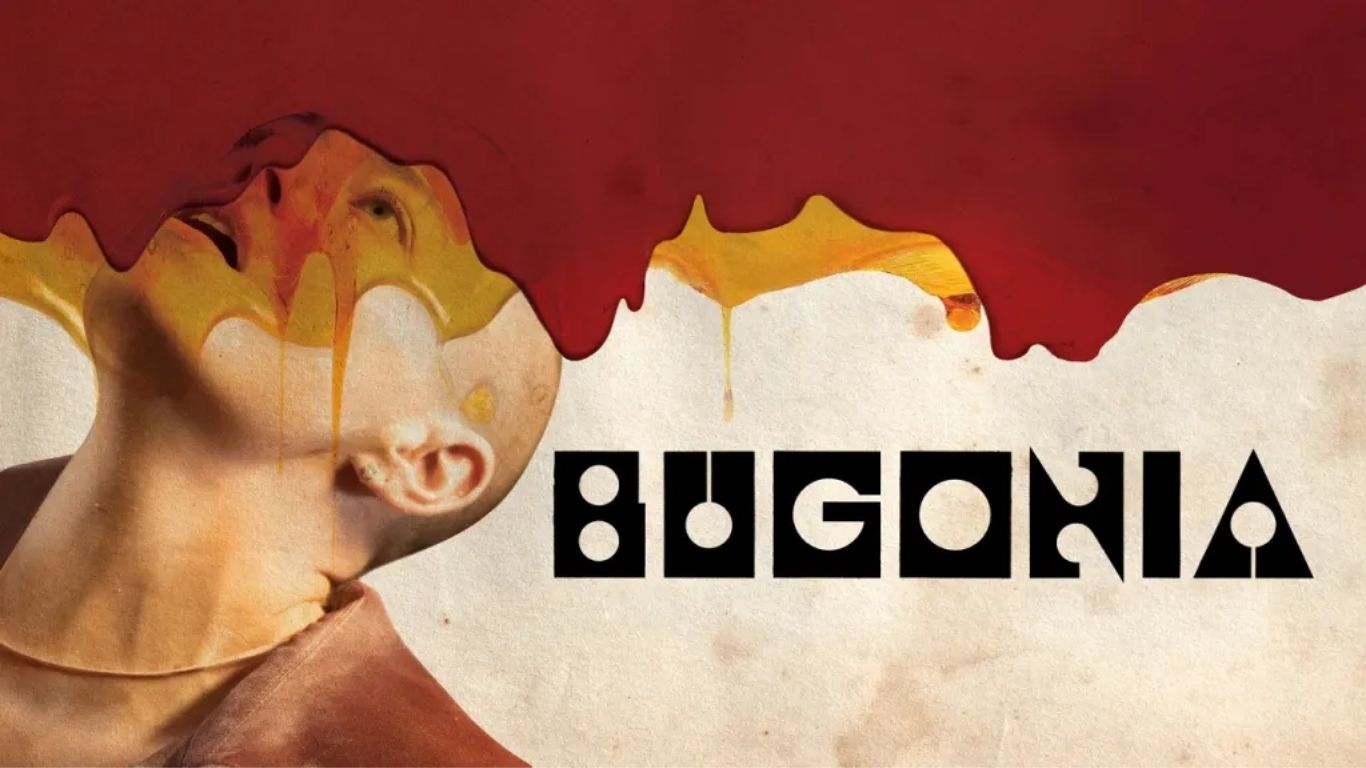
Cinema has long possessed the unsettling ability to pull audiences into the minds of people they instinctively reject. Few contemporary filmmakers exploit that power as ruthlessly as Yorgos Lanthimos. With Bugonia, he delivers a darkly playful, intellectually abrasive film that stages a brutal ideological duel between two deeply unlikable figures—and somehow makes their collision both horrifying and strangely moving. At its core, Bugonia is a confrontation between corporate authority and radical dissent, wrapped in a story that oscillates between psychological thriller, black comedy, and cosmic allegory. The film opens not with action, but with ideas: a voice explains the essential role bees play in sustaining life and warns of Colony Collapse Disorder, a phenomenon that threatens ecological balance itself. This is not background flavor—it is the moral fault line that runs through everything that follows.
The Captor: Teddy and the Politics of Obsession
Teddy lives on the outskirts of society, both geographically and psychologically. A beekeeper tending his hives with almost religious devotion, he shares a secluded farmhouse with his neurodivergent cousin Don. Together, they live modestly, scruffily, and with the intensity of people who have been shaped by neglect, trauma, and too much time absorbing unfiltered ideology from the internet.
Teddy’s rage is personal. His mother, Sandy, participated in a pharmaceutical drug trial that left her in a coma—a trial run by Auxolith Corp. The company continues to pay for her care, but to Teddy, that financial responsibility is not justice. It is hush money. His grief curdles into obsession, and obsession becomes conspiracy.
Teddy is convinced that Auxolith’s CEO, Michelle Fuller, is not merely corrupt, but alien—literally. He believes she is an emissary from Andromeda, responsible for humanity’s suffering, environmental collapse, and moral decay. His plan is audacious, disturbing, and horrifyingly sincere: kidnap Michelle, force her to contact her alien emperor, and demand restitution for the planet.
The Captive: Michelle Fuller and Corporate Performance
Michelle Fuller is introduced in absolute contrast. She begins her day with disciplined exercise, nutritional precision, and a carefully calibrated pharmaceutical routine. She sweeps into her corporate headquarters in immaculate power suits and towering Louboutins, her red soles flashing like warning signs. She is the embodiment of modern corporate performance—polished, articulate, relentlessly productive.
Michelle speaks the language of transparency while practicing obfuscation. Her HR videos celebrate diversity, flexibility, and employee choice, yet every word is carefully engineered to reinforce power structures that benefit the company above all else. The message is subtle but unmistakable: you are free to leave at 5:30, but only if you can afford the consequences.
Emma Stone plays Michelle with manic fluency, making her both repellent and fascinating. Her corporate empathy is a performance, but it is performed so well that even the audience momentarily wants to believe it. Lanthimos sets her up as someone easy to despise—and then complicates that instinct.
The Kidnapping and the Basement
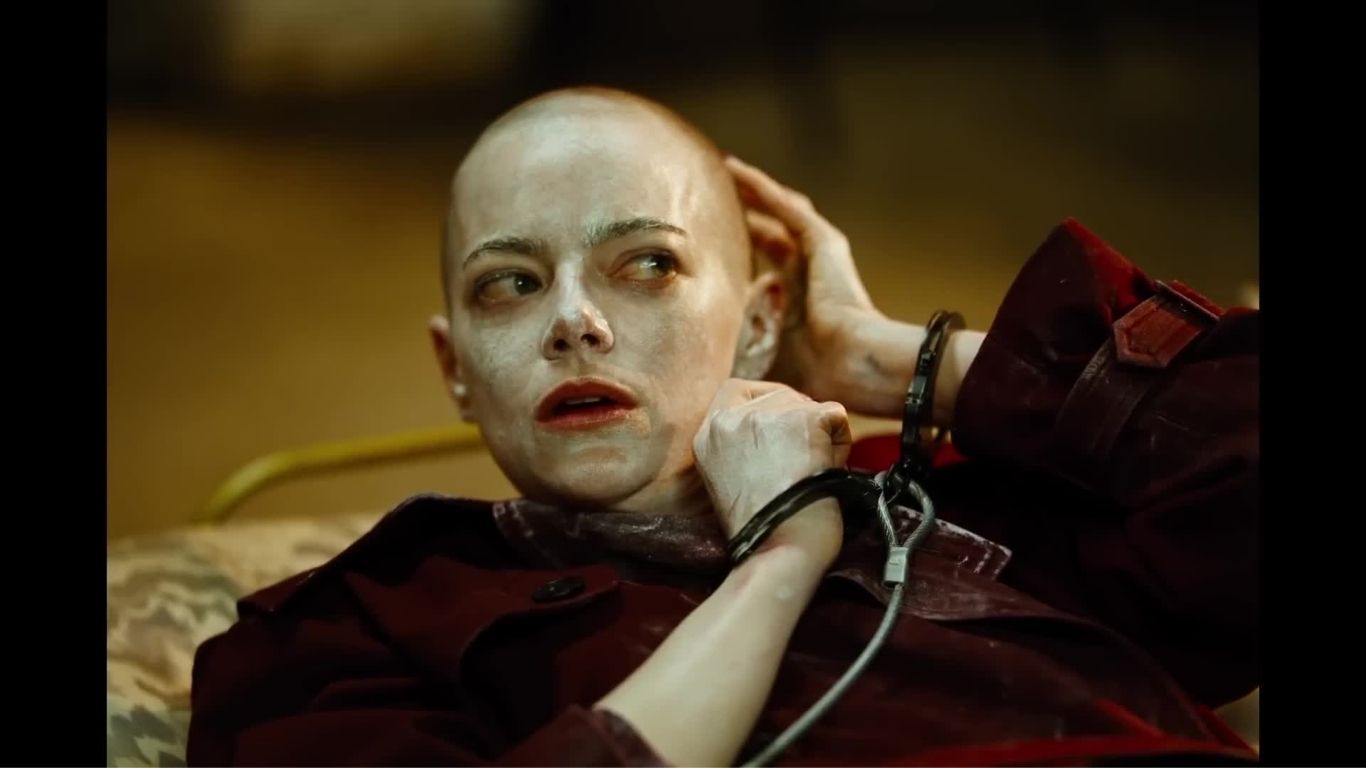
The abduction itself is chaotic rather than slick. Disguised in beekeeper suits, Teddy and Don ambush Michelle at her home. She fights back fiercely, trained and prepared, but is eventually subdued and transported to the farmhouse basement. There, her head is shaved, her body smeared with antihistamine cream meant to suppress her supposed alien powers, and she is chained like an artifact to be studied—or punished.
This scenario, familiar and deeply troubling in lesser films, unfolds differently here. Lanthimos refuses to sensationalize the setup. Instead, he turns the basement into a philosophical battleground. What emerges is not a simple captor-versus-victim dynamic, but an ideological chess match.
Michelle begins to talk. She explains, negotiates, reframes. She manipulates Teddy not just emotionally, but intellectually. Slowly, the audience begins to feel something unexpected: sympathy. Not because she is innocent—she is not—but because cruelty, even when directed at the powerful, becomes uncomfortable to witness.
A Film Without Moral Safety Nets
Bugonia refuses easy alignment. Teddy’s critiques of corporate authoritarianism and environmental destruction are often incisive, even accurate. Yet his methods are extremist, his worldview absolutist, and his certainty pathological. Michelle, meanwhile, is a master of harm dressed up as benevolence—a human face on systemic exploitation.
The film’s tension deepens when a police officer, Casey, arrives at the farmhouse seeking reconciliation. He once abused Teddy as a child while babysitting him, and his sudden attempt at redemption is both absurd and chilling. The scene oscillates between dark humor and genuine menace, further destabilizing any moral ground the audience might try to stand on.
Beauty, Horror, and the Cosmic Joke
Visually, Bugonia is stunning. Warm shadows and textured light give even its most grotesque moments a strange beauty. The film builds toward an operatic finale that is as devastating as it is darkly funny—an ending that reframes everything that came before it without offering comfort or clarity.
The title itself refers to an ancient Greek belief that bees could be born from decaying animal carcasses—a metaphor that fits perfectly. Out of rot, something essential emerges. Out of madness, a sliver of truth.
In the end, Bugonia is not about choosing sides. It is about recognizing how easily conviction becomes cruelty, how power disguises itself as care, and how a broken world can produce monsters on every level. Lanthimos does not offer solutions. He offers a mirror—distorted, unsettling, and impossible to ignore.
Bugonia is not just a thriller or a satire. It is a grimly humane film that lingers long after the screen goes dark, forcing us to sit with the uncomfortable question it never answers: what happens when everyone believes they are the hero of the story?