


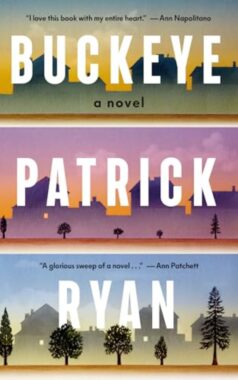
Patrick Ryan’s Buckeye is a novel that looks ordinary and, in looking, reveals how ordinary people carry the extraordinary weight of history, desire, and regret. Set in the fictional town of Bonhomie, Ohio, the book follows two intertwined married couples from the end of World War II into the late 20th century. At its heart is a single, catalytic moment—a V-E Day kiss—and the long, messy echo that moment casts over decades of family life. Ryan’s prose is quietly observant: he watches characters not for dramatic blows but for the small failures and mercies that accumulate into a life. This review walks through the plot essentials, what the book does well, where it stumbles (if at all), and why readers who like character-rich, morally curious fiction will find Buckeye rewarding.
Plot overview: what happens in Bonhomie
The novel opens in 1945 with a VE Day moment that binds two strangers together and sets into motion a chain of choices. Cal Jenkins, a good-natured man who can’t serve in WWII because of a physical disability, marries Becky Hanover, a woman who speaks with the dead (a spiritualist) and whose presence reshapes what a family can be. Across town, Margaret Salt and her enigmatic husband enter the town’s orbit, and an affair between members of the two households slowly unspools into long-term consequences: secrets get buried, loyalties shift, and children inherit mysteries they don’t understand. Ryan follows these characters through the 1950s, the turbulence of the 1960s and 70s, and beyond, tracking how war, gender expectations, and local gossip shape—and sometimes warp—human connection. The novel is panoramic but intimate, focused more on the collage of daily life than on a single climactic event.
What the book does beautifully
One of Ryan’s biggest strengths is his ear for lived detail. The novel’s small scenes—a soda fountain conversation, the hum of a hardware store, the ways a father’s temper changes a household—add up to a convincing sense of place. Ryan is especially good at rendering the ordinary as morally charged: a lie of omission, a casual cruelty, or a kindness that comes too late. Those tiny moral decisions are the engine of the book, and they give even quiet chapters a sense of consequence. Critics have praised the book for its tenderness and emotional pull; you can feel why readers call it “engrossing” and “tender,” because Ryan refuses easy judgments and lets characters remain messy and human.
Another strength is pacing. For a novel that spans decades and a great many characters, Ryan keeps momentum by focusing scenes tightly and returning often to recurring images (the buckeye tree itself is a persistent symbol of roots, shells, and the habit of returning home). The alternating focus between couples gives the novel balance: we see how similar shocks—war, desire, disappointment—play out differently depending on temperament and circumstance. Reviewers have compared Ryan’s tonal balance to a softer John Irving or to contemporary writers who favor close character work over plot fireworks.
Themes: war, marriage, and the ripple effect of choices
At its core, Buckeye is about how the big forces (wars, social change) meet the small: kitchens, funerals, backyard conversations. The book asks what families owe one another, how silence can be protective and destructive, and how forgiveness is not a single action but a slow, halting practice. Ryan doesn’t sanitize the past; he shows how marriages can be both sustaining and suffocating, how desire can betray commitments, and how communities can both comfort and constrain. The way the novel treats psychic mediumship—Becky’s role with the dead—is handled without supernatural melodrama; it becomes another way the town processes grief and longing.
Places where the novel invites disagreement
Some readers may find the book’s lack of a “slam-bang” climax frustrating. Buckeye is cumulative rather than explosive: its power comes from accrual. If you prefer plot-driven novels with tightly wound endings, this measured, observational approach might feel slow. There are also moments where the novel leans on small-town types and idiosyncrasies that flirt with caricature—an eccentric drunk father, the nosy neighbor delivering blunt aphorisms—but Ryan generally redeems that tendency by deepening those characters so they stop feeling like props and become people with private hurts. These are not fatal flaws—more like stylistic tradeoffs that reveal the author’s priorities.
Why Buckeye matters now
Beyond craft, Buckeye matters because it refuses sentimental nostalgia while still honoring ordinary human love. In an era when many novels aim to shock or to revise big histories through single extraordinary events, Ryan’s book insists that the quiet life—its betrayals, loyalties, and slow reckonings—contains enough drama to sustain a novel of impressive scope. The novel’s recent selection for popular book clubs and positive critical consensus show that readers are hungry for work that both comforts and complicates. If you value character empathy, moral nuance, and prose that listens more than it lectures, Buckeye will likely stay with you after the last page.
Final verdict
Buckeye is a spacious, compassionate novel that rewards patience. Patrick Ryan writes with clarity and warmth about people who are trying—imperfectly—to hold themselves and each other together. The book’s pleasures are not only in its moments of high drama but in the quiet, precise observations that accumulate into a life. Recommended for readers who like multilayered family sagas, midwestern settings, and fiction that trusts the moral intelligence of its audience.