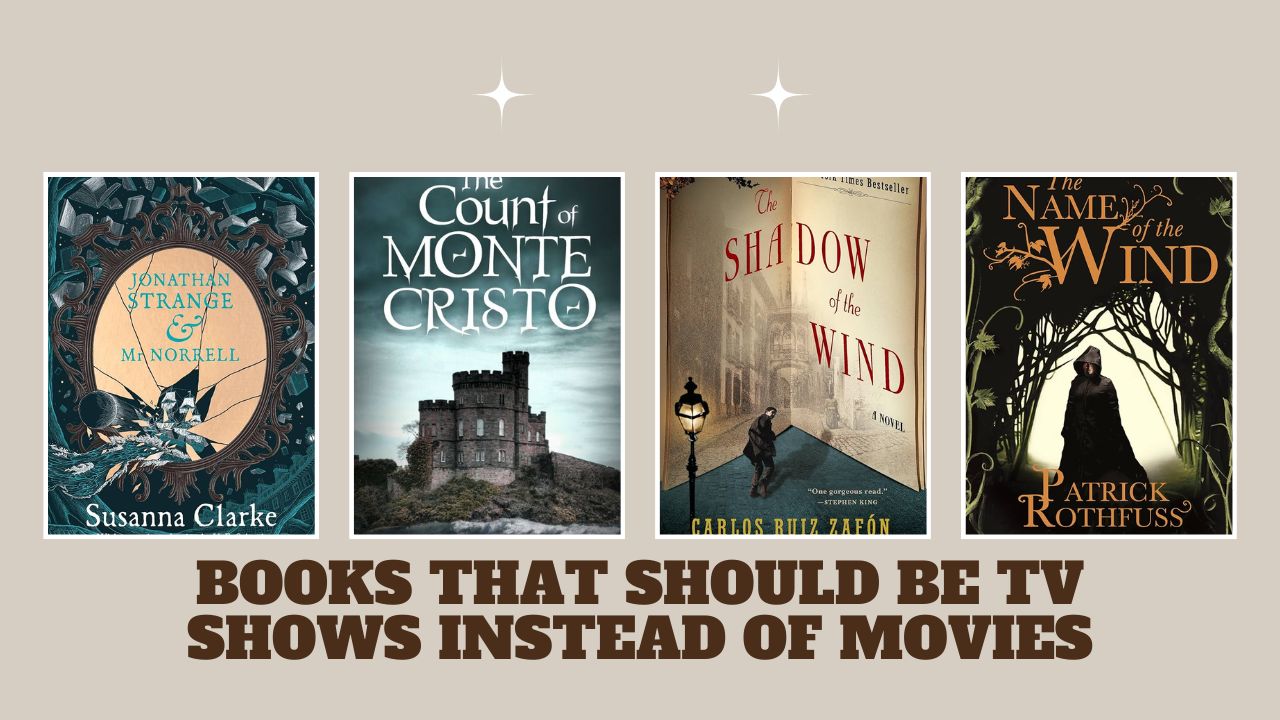
It’s not always the filmmakers’ fault. Some stories are simply too large, too layered, too in love with their own sprawl to survive the two-hour compression. And yet Hollywood keeps trying. It keeps eyeing big, ambitious novels and thinking: we can make that a movie. Sometimes it works. Most of the time, it doesn’t.
Here’s what nobody in a studio pitch meeting wants to admit: the golden age of prestige television has fundamentally changed the math. A streaming series can give a story ten hours. Twenty hours. It can let subplots breathe, let secondary characters become full human beings, let themes develop slowly the way they do in real life — and in good literature. The question we should be asking isn’t how do we adapt this book into a movie? It’s why on earth would we?
Below are books that deserve better than what a film runtime could ever give them. These are stories built for the long form — for weekly anticipation, for slow burns, for the kind of emotional investment that only television (done right) can provide.
1. Jonathan Strange & Mr Norrell by Susanna Clarke
In 2015, the BBC did something almost miraculous: they gave Susanna Clarke’s 800-page alternate history of English magic a seven-episode miniseries, and it was genuinely, quietly brilliant. The problem is almost nobody watched it.

Which is a shame, because Jonathan Strange & Mr Norrell is exactly the kind of book that exposes how inadequate a movie adaptation would be. Clarke’s novel is dense with footnotes, with digressions, with an entire imaginary scholarly tradition of English magic that runs underneath the main narrative like a second river. The story follows two magicians — the cautious, possessive Mr Norrell and the reckless, romantic Jonathan Strange — against the backdrop of the Napoleonic Wars. It takes its time. It luxuriates in atmosphere and period detail. The villain, the enigmatic Gentleman with the Thistledown Hair, does most of his damage so quietly and so slowly that you barely notice the horror accumulating until it’s unbearable.
No movie could hold this. The BBC series understood that. What it needed — what it still needs, honestly, because it deserves a wider audience — is the kind of prestige treatment that HBO or Netflix gives to its marquee properties: gorgeous production design, a full season order, and the confidence to let the story move at its own unhurried, Gothic pace.
2. The Count of Monte Cristo by Alexandre Dumas
Here’s a genuinely baffling piece of Hollywood history: The Count of Monte Cristo has been adapted into a movie more than once, and every single time, the production has had to make the same impossible choice — which seventy percent of the book do we just throw away?

Because that’s what a film adaptation requires. Dumas’s novel is enormous. It runs to over 1,200 pages in most translations. Edmond Dantès’s story — the wrongful imprisonment, the slow acquisition of wealth and knowledge, the meticulous, years-long campaign of revenge against the men who destroyed his life — is not a story that has a second act. It has about eight second acts. The revenge plots alone could sustain multiple seasons of television, each one a contained thriller with its own moral weight and dramatic irony.
What makes the book extraordinary isn’t just the plot mechanics. It’s the way Dantès’s transformation from innocent sailor to calculating aristocrat changes him in ways that are never entirely comfortable. By the time he’s engineering the downfall of his enemies, you’re not sure whether to cheer or feel uneasy. That moral complexity needs room to develop. It needs the audience to spend enough time with the man that they understand — and maybe share — both his righteousness and his ruthlessness.
A prestige drama adaptation of The Count of Monte Cristo — done the way Succession or The Crown was done, with serious money and serious writers — would be one of the greatest television events of the decade. Instead, we keep getting two-hour movies that arrive at the revenge before we’ve had time to truly feel the injustice.
3. The Shadow of the Wind by Carlos Ruiz Zafón
Zafón’s Barcelona is not just a setting. It’s a living, breathing character — a labyrinthine city of fog and rain and secrets, where books vanish and authors disappear and the past refuses to stay buried. The Shadow of the Wind follows young Daniel Sempere as he becomes obsessed with a forgotten author named Julián Carax, only to find that someone is systematically destroying every copy of Carax’s work.

On the surface, it sounds like a manageable adaptation. A mystery. A coming-of-age story. A doomed romance nested inside another doomed romance. The problem is that Zafón’s narrative structure is essentially Russian nesting dolls — stories inside stories inside stories, each one with its own emotional gravity. The novel has been called a love letter to literature itself, and that quality — that sense that books are sacred, dangerous things that change lives and carry curses — is exactly the kind of thing that gets ironed flat in a film adaptation.
A limited series, though? A moody, atmospheric, Spanish-language drama shot in Barcelona’s Gothic Quarter, with the kind of cinematography that makes you feel the city’s memory in every frame? That would be extraordinary. Zafón himself was reportedly working on a miniseries adaptation before his death in 2020. That project deserves to be completed and done with the care his work commands.
4. Lonesome Dove by Larry McMurtry
Lonesome Dove already became a miniseries — back in 1989 — and that adaptation is widely considered one of the finest things American television has ever produced. So why is it on this list?

Because the 1989 miniseries is increasingly hard to find, rarely discussed by younger audiences, and ripe for a modern reimagining that might actually reach the people who need to read this book. And also because the existence of that miniseries proves the point more emphatically than anything else: when a major movie studio tried to make Lonesome Dove into a feature film, the project collapsed. It couldn’t be done. The story of Gus McCrae and Call and their cattle drive from Texas to Montana is not a movie. It’s an epic. It’s a meditation on friendship and regret and the mythology of the West. It sprawls and wanders and takes detours that are worth more than most main plots.
The 1989 adaptation ran nearly seven hours, and it still had to cut things. Imagine what a modern prestige series — with the production values of Yellowstone or 1883, but with McMurtry’s actual text as its backbone — could do with that material.
5. The Name of the Wind by Patrick Rothfuss
Fantasy adaptations are notoriously difficult. The genre tends toward the operatic, the complex, the world-built-within-an-inch-of-its-life. Game of Thrones proved that television was the right medium for that kind of story — and then, in its final seasons, proved what happens when a show outruns its source material.

The Kingkiller Chronicle has been in various states of development limbo for years, with Rothfuss notoriously slow to finish the third book. But even setting aside the unfinished-series problem, the shape of The Name of the Wind is essentially a television show already. It’s a frame narrative: a legendary figure named Kvothe sits in a tavern and tells the story of his own life to a Chronicler over three days. Each day is a book. The story moves through distinct phases — orphaned child, street urchin, scholarship student, lover, adventurer — that map almost perfectly onto season arcs.
More importantly, Rothfuss’s magic system, his university setting, his deep mythology around a mysterious group called the Chandrian — none of it translates to two hours. The world requires investment. The kind of investment audiences are willing to make in a show they’ve followed for three seasons, not a movie they’re seeing for the first time.
A well-executed series could be the next Game of Thrones, with the significant advantage that the first two source novels are genuinely, unambiguously excellent.
6. Pachinko by Min Jin Lee
Pachinko was adapted into an Apple TV+ series in 2022, and the reception was warm — critics praised its ambition and its performances. But the show’s structure, jumping between timelines and compressing certain periods significantly, also illustrated exactly why this story needs more room than it got.

Lee’s novel follows four generations of a Korean family, beginning in early twentieth-century Korea and moving through Japan, through war, through discrimination and assimilation and the search for belonging that spans decades. The book’s power comes from accumulation — from the way each generation is shaped by what the previous one survived, from the way historical forces bend individual lives without their consent.
A prestige drama with eight to ten episodes per season, and multiple seasons to trace each generation properly, would allow the story to unfold the way Lee intended — slowly, with love, with the weight of time. The Apple TV+ series was good. What this novel deserves is something closer to Roots or The Thorn Birds in ambition: a multigenerational epic that gives each era its full emotional due.
7. A Little Life by Hanya Yanagihara
This one is, by any measure, the most challenging proposition on this list. A Little Life is not an easy book. It is, depending on who you ask, either one of the most devastating works of contemporary fiction or an exercise in sustained, almost unbearable emotional cruelty — and the correct answer is probably both.

The novel follows four men from their college years through middle age: Willem, JB, Malcolm, and Jude. At its center is Jude St. Francis, whose past trauma — revealed gradually, in pieces, with mounting dread — becomes the gravitational force around which everything else orbits. The book is nearly a thousand pages long. It takes place over decades. Its power is entirely dependent on the reader’s accumulated attachment to these characters, on the sense that you have spent years with these people and love them the way you love real people.
A film adaptation would be, not to put too fine a point on it, obscene. Not because of the book’s difficult content — though that content would require careful handling — but because the entire emotional architecture collapses without time. You cannot compress thirty years of friendship into two hours and expect the ending to mean what it means in the novel.
A limited series — something in the vein of Normal People, which understood that the intimacy of Sally Rooney’s prose required slow, attentive television — could be extraordinary. It would need the right showrunner, the right cast, and the courage to not look away from what the book doesn’t look away from. But in the right hands, it could be one of the defining dramatic events of this decade.
The Pattern Worth Noticing
Look at the books on this list long enough and a pattern emerges. They share certain qualities: they span long periods of time, or they build worlds of unusual density, or their emotional power is cumulative rather than immediate. They ask the reader to invest, to live inside the story for days or weeks, to let the characters become something closer to memory than fiction.
These are exactly the qualities that make books extraordinary and movies inadequate. And they’re exactly the qualities that television — at its best, in its current golden age — is built to honor.
The studios that keep trying to compress these stories into feature films are not wrong to see their value. They’re wrong about the format. The question was never whether Jonathan Strange or The Count of Monte Cristo or A Little Life could find an audience on screen. Of course they could. The question is whether you’re willing to give the story the space it actually needs — or whether you’re going to spend two hours trying to cram an ocean into a bottle and then wonder why it doesn’t feel like the sea.
Some books don’t want to be movies. They want to be something longer, something that lingers, something that earns its ending across hours instead of stealing it in minutes.
They want to be television. And the sooner Hollywood admits that, the better off everyone will be.