
Archimedes’ legendary “Eureka!” moment is often told as a simple bathtub story, but the real drama may lie in his audacious attempt to make a floating palace—the giant ship Syracusia—safely cross the Mediterranean. This immense engineering challenge pushed him to formalize the law of buoyancy that now bears his name, and it shows how one brilliant insight can turn an impossible royal dream into reality.
The World Of Archimedes And King Hieron
In the third murder-at-harvard-and-a-half-century-of-silence-by-becky-cooper/”>century BC, the Sicilian city of Syracuse was ruled by King Hieron, a leader with big ambitions and a taste for grand displays of power and wealth. He lived in a world where naval power meant security, trade, and prestige, and where rulers competed not just in battle, but in spectacle. The larger and more impressive your ship, the more it spoke of your strength and sophistication.
Hieron saw in Archimedes not just a clever mathematician, but a man who could turn impossible ideas into working machines. Entrusting him with an unprecedented naval project was as much a political move as it was a technical one. If the venture succeeded, Syracuse would be known across the Mediterranean for a ship like nothing the ancient world had ever seen.
A Ship The Size Of A Palace
Hieron’s dream was midnight-a-suspense-magazine-anthology-book-review/”>nothing less than a floating city. The Syracusia was planned to be about fifty times larger than a standard ancient warship, a staggering leap in scale at a time when shipbuilding usually advanced in small, cautious steps. Building such a vessel was like asking whether a mountain could sail—no one had attempted anything remotely comparable, and the risks were enormous.
To bring this to life, hundreds of workers would labor for years, drawing on resources from across the known world. Massive beams of pine and fir would arrive from the slopes of Mount Etna. Ropes would be twisted from hemp grown far away in Spain. Pitch from distant regions such as France would seal the hull. This was not just a local construction project, but a pan‑Mediterranean supply chain feeding lumber, fibers, and resins into a single colossal experiment in engineering.
Design Details: A Floating Fortress
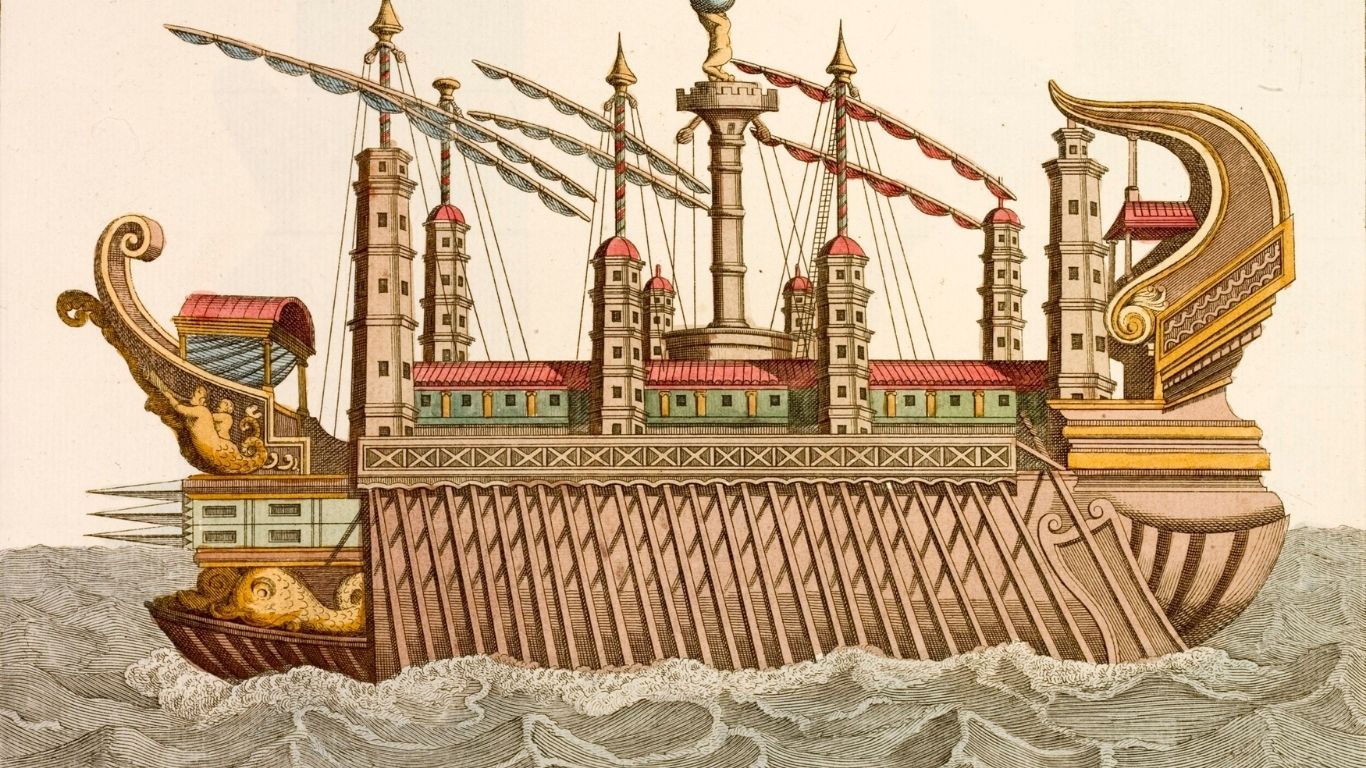
The Syracusia was not simply big; it was heavily armed, elaborately decorated, and meticulously planned as both fortress and palace. On the bow, a massive catapult was to be mounted—powerful enough to hurl stone missiles weighing around 180 pounds. This weapon turned the front of the ship into a kind of mobile artillery platform, capable of defending itself or supporting military campaigns at sea.
Above, the top deck would hold eight watchtowers, giving soldiers and lookouts commanding views in all directions. Instead of plain structural columns, this deck was to be supported by vast wooden statues of Atlas, the mythical Titan doomed to bear the heavens on his shoulders. These sculpted supports symbolically merged structural necessity with mythological grandeur, making the vessel not just a machine but a work of art and propaganda.
Luxury On The Waves
Hieron’s ambitions went beyond military might. He wanted the Syracusia to be a symbol of cultured luxury, impressive enough to dazzle even a foreign king. The vessel was to include a flower‑lined promenade on which passengers could stroll, enjoying fresh blooms and sea air at the same time. This garden‑like walkway transformed the deck from a purely functional space into a floating park.
Below and alongside it, the ship would feature a sheltered swimming pool and a bathhouse with heated water. These amenities recall the famous bath complexes of the ancient world, bringing the comforts of land‑based leisure onto the open sea. Passengers could bathe, swim, and relax as if they were in a palace, not on a wooden hull rolling over the waves.
A Ship As A Cultural Showcase
The Syracusia was also conceived as a kind of cultural embassy in wood and sailcloth. Onboard, there was to be a library filled with books and statues, a curated space for learning and art that signaled refinement and intellectual prestige. A temple dedicated to Aphrodite underscored both piety and beauty, suggesting that even at sea, the gods would be honored properly.
To complete the image of a complete civic space, the ship would house a gymnasium, echoing the training grounds and social centers of Greek cities. Here, passengers and soldiers could exercise, maintain their physical fitness, and participate in the kinds of activities associated with free citizens at home. Taken together, these features made the Syracusia feel less like a ship and more like a condensed city, complete with religion, culture, leisure, and defense.
The Immense Load: Cargo And Passengers
A vessel so large and so extravagantly furnished also needed to carry significant cargo and personnel. Hieron planned to pack the Syracusia with staggering quantities of provisions. The ship would carry around 400 tons of grain, enough to sustain large numbers of people over long voyages or serve as a significant gift of food. Ten thousand jars of pickled fish would provide preserved protein, hardy and reliable over time.
In addition, the ship would hold about 74 tons of drinking water and 600 tons of wool. The water was vital for passengers and crew, while the wool would have immense trade or gift value. Human capacity was equally impressive: the vessel was expected to carry well over a thousand people, including around 600 soldiers. To complete the picture, there was space for 20 horses in separate stalls, making the Syracusia capable of transporting cavalry as well as infantry.
The Specter Of Catastrophic Failure
All of this grandeur came with a terrifying possibility: what if the ship simply sank? Imagine years of work, enormous expense, and countless resources culminating in a single, humiliating moment when the vessel slid from the dock and vanished under the waves. Hieron’s political embarrassment would have been severe, and Archimedes’ reputation could have been permanently damaged.
Failure was not merely a technical mishap; it would have been a public spectacle of incompetence. The project had become so vast and so visible that success or failure would resonate across the Mediterranean. Under that pressure, Archimedes had to figure out, with as much certainty as possible, whether the Syracusia would float before it ever left the dock.
From Bathtub To Buoyancy Law
Some traditions imagine Archimedes pondering a simple household question: how can a heavy bathtub float? Whether that was truly the scene or not, his reflection led to a profound insight. He realized that when an object is immersed in a fluid, it experiences an upward force. That upward push is not mystical; it is equal to the weight of the fluid that the object displaces.
This became known as the law of buoyancy, or Archimedes’ Principle. Stated simply, an object partially immersed in a fluid is buoyed up by a force equal to the weight of the fluid it pushes aside. In the case of the Syracusia, this meant that if the ship weighed, say, 2,000 tons, and the volume of its submerged hull displaced exactly 2,000 tons of water, the vessel would just barely float at the surface, with its keel deep in the sea but its decks still above water.
Float, Sink, Or Ride High?
Archimedes’ reasoning allowed precise conceptual predictions about the ship’s behavior in water. There are three key possibilities, each one determined by the relationship between the ship’s weight and the weight of the displaced water.
If the Syracusia displaced less water—say, 1,000 tons—than its own weight of 2,000 tons, the upward buoyant force would be too small to balance gravity. The ship would sink lower and lower until it either displaced enough water or filled with water and went under. If it could never reach the needed volume of displacement without water pouring over the sides, the ship was doomed.
If, however, the ship’s hull displaced precisely the same weight of water as its total mass—2,000 tons of water for a 2,000‑ton ship—it would float in a delicate balance, its waterline exactly at the point where buoyant force and weight matched. Increase the cargo slightly, and it would ride lower; reduce it, and it would rise higher. This edge condition was useful for understanding safety margins.
Why Bigger Ships Can Still Float
Even more reassuring was a third scenario. If the Syracusia’s design allowed it to displace 4,000 tons of water while still keeping its decks above the sea, then loading 2,000 tons of actual mass would leave significant margin. The more water its hull could push aside before submerging dangerously deep, the more safely it could carry its lavish cargo, soldiers, and passengers.
This logic explains why a modern steel supertanker can float as easily as a light wooden rowboat. The material itself—whether dense steel or light wood—is not what guarantees flotation. What matters is the overall combination of shape, volume, and density. As long as the hull’s submerged portion displaces a volume of water whose weight matches or exceeds the total weight of the vessel, it will stay afloat above the waterline, no matter how heavy its constituent materials.
The Keystone Concept: Displaced Water
Archimedes’ key mental move was realizing that the water pushed aside by a floating or sinking object could serve as a natural measuring device. In a tub, a person sees water rise and spill over the edge when entering. On a grand scale, the sea level around a massive hull rises imperceptibly, but the principle is the same: the fluid moves out of the way to accommodate the object.
That displaced water has a definite weight, and fluids exert pressure in all directions. When an object is placed in a fluid, the pressure on the underside is greater than on the top, because the pressure in a fluid increases with depth. Summing these pressure forces produces a net upward push—the buoyant force—that is exactly as strong as the weight of the displaced fluid. With this insight, Archimedes could connect a visible phenomenon (water displacement) with a hidden force (buoyancy).
Crown Or Keel? The “Eureka” Puzzle
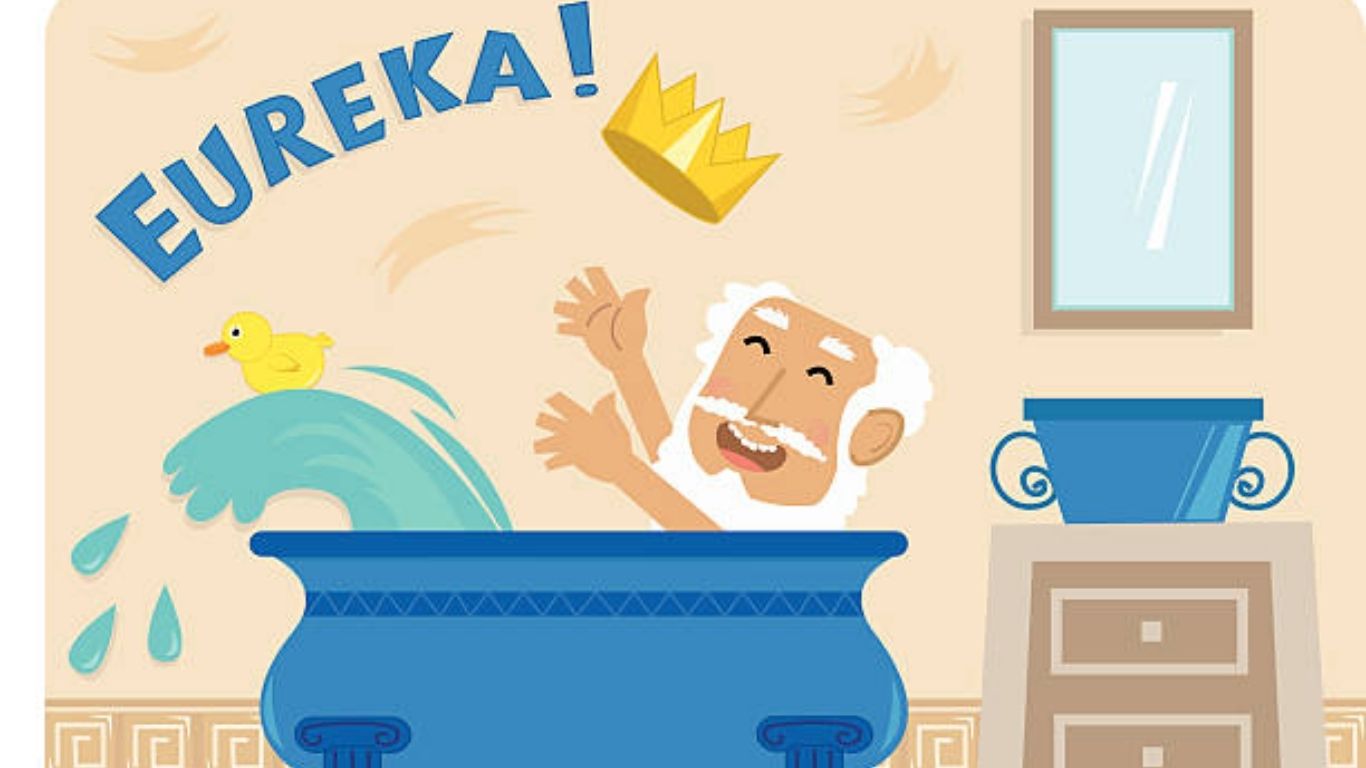
Most people know the famous story of Archimedes, a golden crown, and his naked run through the streets shouting “Eureka!” In that version, he is asked to determine whether a crown (corona in Latin) has been adulterated with cheaper metal, and the bathwater’s rise gives him the idea to compare the volume and density of the crown with pure gold. His discovery of buoyancy, in this telling, solves a problem of fraud.
However, there is another version that centers not on a crown, but on a keel. The Syracusia’s critical question—would this unprecedented hull float—may in fact be the real origin of the buoyancy breakthrough. The Greek word for keel, korone, is tantalizingly similar in sound to the Latin corona. Over centuries of retellings, it is plausible that a technical story about a ship’s keel was transformed into a more colorful legend about a royal crown.
How Stories Evolve Over Time
Ancient stories were passed down through texts, translations, and oral accounts, each layer introducing the possibility of error, embellishment, or reinterpretation. A complicated engineering narrative about calculating displacement for a giant hull might have been simplified into a vivid personal anecdote that audiences could easily remember: a bath, an overflowing tub, a shout of triumph.
Whether or not the crown story is historically accurate, both versions highlight the same central idea: water displacement can reveal hidden truths. In one case, it reveals whether metal has been swapped in a crown. In the other, it reveals whether an enormous palace‑ship will ride safely on the sea. The enduring “Eureka!” motif shows how powerfully a single conceptual leap can resonate across different domains and centuries.
The Syracusia’s Journey To Egypt
Hieron did not intend to keep this maritime marvel solely for himself. The Syracusia was meant to be presented as a gift to Ptolemy, the ruler of Egypt, cementing diplomatic ties and displaying Syracuse’s technological prowess to one of the great powers of the age. Sending such a ship was like sending a floating proclamation of wealth, ingenuity, and ambition.
When the ship finally reached Alexandria on its first and only voyage, the city’s harbor must have erupted in excitement. Residents would have flocked to the docks to glimpse this colossal silhouette approaching, its towers rising above the waves, its carved Atlases straining under the imaginary heavens, and its catapult bristling from the bow. For people used to ordinary merchant vessels and warships, it would have looked like a floating castle drifting into view.
A Titanic That Never Sank
In modern terms, the Syracusia has often been compared to the Titanic: a vast, luxurious ship that captured the public imagination. But there is a crucial difference. Where the Titanic is remembered for its tragic sinking, the Syracusia is remembered as a triumph of design and theory over risk. It completed its journey without the catastrophe that many must have secretly feared.
The ship’s successful voyage offered powerful proof that Archimedes’ principle was not just an abstract idea, but a practical rule that could guide real‑world engineering at extreme scales. By trusting that a structure of unprecedented size would float as long as it displaced enough water, Archimedes showed how mathematics and physics could tame the unknown.
Why Archimedes’ Principle Still Matters
Archimedes’ insight continues to shape the world. Every modern ship, from small fishing boats to towering cruise liners and aircraft carriers, relies on the same law of buoyancy. Naval architects calculate displacement, draft, and stability using refinements of the same principle: the upward force must balance or exceed the vessel’s weight, with safety margins to spare.
Beyond ships, the principle explains why balloons rise in air, why submarines can dive and surface by adjusting ballast, and why certain materials float while others sink. It is one of those foundational ideas that bridges everyday experience—a hand pushing down into water, a tub overflowing—with deep, quantitative understanding.
The Real Legacy Of “Eureka!”
Whether the true spark came from a golden crown or the keel of a giant ship, Archimedes’ “Eureka!” represents a moment when observation, curiosity, and reasoning converged. He saw a familiar phenomenon—water being displaced—and realized it could unlock answers to questions far larger than any bathtub. That connection allowed him to assure a king that his impossible ship could sail.
The Syracusia’s story shows that behind every awe‑inspiring feat of engineering lies a framework of ideas. Hieron’s floating palace could only exist because someone understood the quiet rules hidden in the behavior of water. Archimedes transformed those rules into a clear principle, and in doing so, turned what looked like a mad gamble into a calculated, and successful, leap across the sea.