
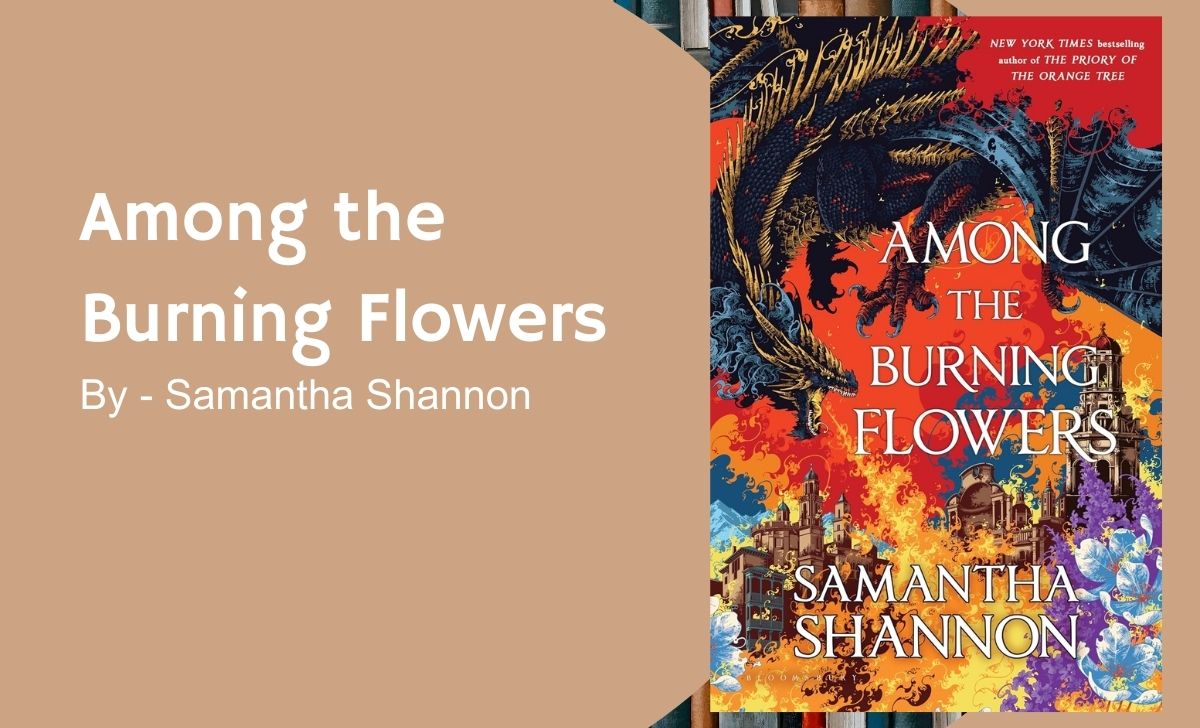
Samantha Shannon’s return to the Roots of Chaos / Priory universe is a compact, emotionally charged prequel that reframes familiar events through a narrower, intimate lens. If you loved The Priory of the Orange Tree for its sweep of kingdoms, dragons and queer-affirming romance. Among the Burning Flowers: By Samantha Shannon, gives you a focused, bruising look at the moments and choices that set that larger story in motion. It doesn’t replace the sprawling grandeur of the originals; instead, it sharpens a few blades and shows how blood, faith, and small acts of defiance ripple outward.
Plot overview
Set roughly two years before the aftermath readers already know from the Priory saga, Among the Burning Flowers centers on Yscalin’s fall and the human cost of the dragons’ reawakening. The narrative follows a handful of characters—most notably Marosa, a woman whose story becomes the emotional core of the book—alongside Aubrecht and Estina, whose loyalties, fears, and choices are rendered close-up. The novel traces the slow encroachment of draconic power, the collapse of institutions, and the personal reckonings that prepare these characters for the events in the earlier novels. The book is shorter than Shannon’s doorstop epics—about 250–300 pages in most editions—and comes illustrated with work by Rovina Cai.
Characters and emotional stakes
Shannon has always been strongest when she lets character intimacy cut through epic worldbuilding, and that skill is on full display here. Marosa is the standout: steady, fierce, and morally complicated, she’s the sort of protagonist whose resilience is earned through small, painful scenes rather than grand speeches. Aubrecht and Estina function less as set pieces and more as human counterweights—Aubrecht’s dutifulness and Estina’s haunted vigilance add necessary texture. The book’s emotional punch comes from how these individuals reckon with loss and compromised faith; Shannon lingers on grief as a social and political force, not merely a private wound. Many reviews have highlighted the novel’s emotional clarity and strong characterization.
Themes and tone
This prequel is, first and foremost, a meditation on resilience and on the ways institutions—religion, court, duty—bend and break under pressure. Shannon explores how mythology and memory are used to justify violence and how people cling to small moral centers when entire nations are reconfigured. Tonally, the book skews elegiac: there are moments of fierce action, yes, but much of the power comes from quiet scenes of endurance and moral ambiguity. Several reviewers noted that while the novella-length frame limits some of the series’ expansive plotting, it intensifies the emotional arc.
Writing, pacing, and worldbuilding
Shannon’s prose here is more economical than in some of her earlier, more luxuriant passages; that economy suits the story. The pacing is leaner—sharper cuts between scenes, less wandering exposition—so the book reads like a magnifying glass held over a single strand of a larger tapestry. Worldbuilding is still rich, but because the scope narrows, Shannon’s descriptive energy goes into the consequences of political decisions and the interiors of grief rather than mapping new geography. Illustrations by Rovina Cai punctuate the text and reinforce a mournful, almost liturgical atmosphere. Critics and early readers have said the work rewards both longtime fans and newcomers who want a shorter entry point to the series.
Strengths and limitations
Strengths: the novel channels Shannon’s talent for character empathy, gives central side-characters more agency, and distills broad series themes into concentrated, affecting scenes. The emotional through-line—how people survive and what they sacrifice to do so—is handled with care. Several trade reviews praised the book as a worthy addition to the Roots of Chaos saga while noting its tight focus.
Limitations: the brevity that gives the novel its intensity also means some political threads and secondary arcs feel truncated. Readers who expect the scale and tangled plotting of Priory may find themselves wanting more connective tissue; a few critics observed that the novella’s narrower lens sometimes leaves larger consequences implied rather than fully explored. If you come to this book hoping for an all-encompassing return to the series’ breadth, you’ll need to treat it as a complementary piece, not a replacement.
Who should read it
If you are a fan of Shannon’s world and want a tighter, character-driven supplement to The Priory of the Orange Tree, this is an ideal read. It’s also a good entry for readers who admired the original but were daunted by its length—this edition strips down the epic to a painful, human core while still preserving the world’s mythic stakes. Readers who expect complete plot closure for every political strand may come away frustrated, but those who enjoy literature that lingers on moral cost and quiet courage will find much to admire.
Final thoughts
Among the Burning Flowers is both a companion and a corrective: it reminds you why Shannon’s series mattered in the first place—because her large canvases were always completed by fierce, human centers. This prequel doesn’t attempt to replicate the scale of her doorstop novels; instead, it offers concentrated grief, hard-won hope, and clearer lines to the book’s eventual reckonings. Read it for Marosa, for the small but consequential scenes, and for the way Shannon carves out emotional truth within an already beloved fantasy architecture.