


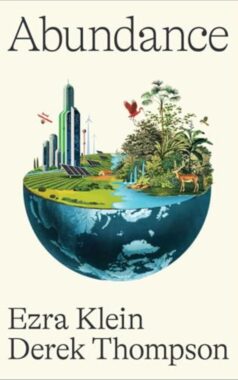
Abundance by Ezra Klein and Derek Thompson is a provocative and ambitious exploration of why the United States, despite its wealth and technological prowess, fails to build at a scale commensurate with its needs. The authors argue that well-intended regulations, bureaucratic inertia, and a progressive focus on limiting harm have created a political culture that prizes processes over outcomes. In Abundance, Klein and Thompson propose an “abundance agenda” – a path forward to reimagine liberal governance so that it can deliver the infrastructure, housing, energy, and innovation America so badly requires. This review examines the key ideas, strengths, shortcomings, and whether Abundance offers a workable blueprint or an inspiring ideal.
Plot Summary / What Abundance Argues
Although Abundance is non-fiction and policy-oriented rather than a narrative novel, it unfolds in roughly three major parts:
- Diagnosis of Scarcity
Klein and Thompson begin by documenting failures: housing crises, slow clean energy deployment, infrastructure projects that never finish or balloon in cost, and scientific breakthroughs that get stuck in funding limbo. They argue that America today has sharp problems identifying what society needs and delivering it at scale. - Origins of the Problem
The authors trace regulatory systems, zoning laws, environmental statutes, and permitting processes as mechanisms that once served public good, but have become obstacles. They point out case studies such as California’s high-speed rail, arguing that long delays and legal barriers prevent innovation and timely projects. They claim that liberals since the 1970s have often defended regulation without recognizing how its accumulation leads to stasis. - Proposed Abundance Agenda
Finally, Klein and Thompson lay out their abundance agenda. They argue for smarter regulation, not simply deregulation: to identify which rules genuinely impede progress and remove them, while strengthening areas where government can act effectively to build. They advocate for policy reforms across housing, infrastructure, green energy, transportation, and scientific research to drive growth, deliver results, and return focus to outcomes over process.
What Reviewers Say: Strengths
Clarity and Scope
Many reviewers praise Abundance for clearly articulating a complex problem. The authors weave policy, regulation, and political history into a readable narrative that connects disparate domains in a coherent framework. The Guardian calls the book “a critique … of liberalism that prioritized process over building” and commends its ambition even if it sometimes overlooks tradeoffs.
Visionary Thinking
Benjamin Wallace-Wells in The New Yorker describes Abundance as “fair-minded,” recognizing trade-offs, and urging a shift in liberal politics. Readers appreciate that Klein and Thompson aim for boldness, not incrementalism.
Policy Relevance
Many point out that Abundance matters because it addresses real policy failure: housing, infrastructure, and environmental regulation. The book connects policy theory to everyday consequences (e.g. slow permitting, zoning delays). For readers seeking a framework for thinking about how liberal government might do more, the book has been described as timely and needed.
What Critics Point Out: Weaknesses & Omissions
Vagueness & Trade-offs
A recurring criticism is that Abundance articulates what needs to be done but under-specifies how to do it. Some reviewers argue the authors gloss over tradeoffs: easing environmental rules may speed building but also harm ecosystems. Foreign Policy argues that the “utopia” of abundance is appealing but the prescriptions sometimes remain too high-level to grapple with practical trade-offs.
Lack of Engagement with Broader Ideologies
Some critics argue Abundance avoids engaging deeply with progressive critiques of deregulation or systemic inequality. For example, Jacobin notes that the policy proposals feel technocratic and insufficiently critical of structural power. The URPE review also points out that the book rarely addresses the role of elites and the systemic economic forces behind scarcity.
Overreach & Utopianism
Others suggest that Abundance sometimes presents too rosy a vision. Foreign Policy calls parts of it “utopian,” warning that aspirational imagery (like green homes and hummingbird drones) sometimes masks real problems. Some reviews argue that the authors channel a dream more than grounded realism.
My Assessment: Is Abundance Worth Reading?
Abundance is an important book in 2025. For anyone interested in progressive politics, public policy, or how government can scale to meet 21st century challenges, Klein and Thompson provide a compelling framework. Their diagnosis is strong: many of America’s greatest failures are failures of execution, not intention. They make a persuasive case that regulatory and institutional bottlenecks hinder progress and propose an agenda worth debating.
However, the book sometimes stumbles when translating big ideas into concrete plans. The optimism is inspiring, but dealing with messy trade-offs – between faster building and environmental protection, local input and centralized action – is where Abundance is weakest. It sketches a path but doesn’t always show how to navigate it.
If you read Abundance, be ready to engage critically. It’s not a perfect roadmap, but it is a call to action: to rethink how government functions, to demand more from democratic institutions, and to push for an agenda that prioritizes building as much as governing.
Conclusion
Ezra Klein and Derek Thompson’s Abundance offers a bold reinterpretation of liberal governance for our times. It challenges prevailing orthodoxies, encourages liberals to think harder about outcomes, and proposes a reorientation toward building and growth. While not all of its solutions land smoothly, the questions it raises are vital. In a moment of growing dissatisfaction with entrenched government dysfunction, Abundance is a compelling voice asking: what if we aimed higher?